


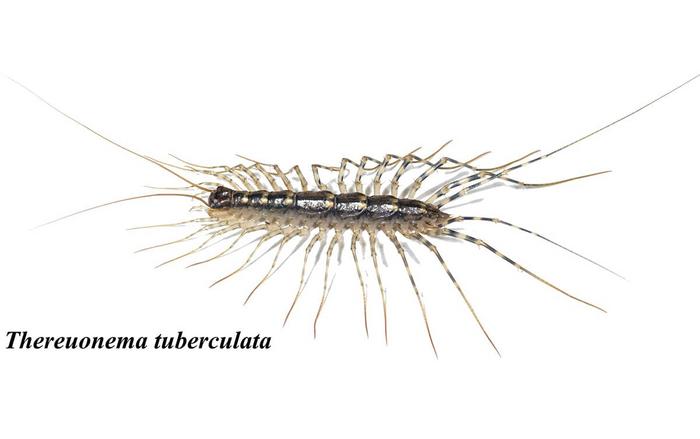
In a groundbreaking discovery that challenges long-held dogmas in cellular biology, researchers have uncovered a novel mode of interaction between somatic and germ cells in the ovaries of certain myriapod species. Traditionally, the epithelial cells surrounding animal organs are known to exhibit a strict apicobasal polarity, where their apical surfaces interact directly with neighboring cells or the external environment, and their basal surfaces remain insulated by a robust, wall-like structure called the basement membrane. This membrane, composed primarily of extracellular matrix proteins, typically acts as an impermeable barricade, preventing direct cellular contact between distinct tissue compartments. However, recent studies focusing on the myriapod species Thereuonema tuberculata and Hanseniella caldaria have upended this classical view, revealing that follicle cells in these species extend their cytoplasmic processes through the basement membrane to establish direct basal contact with oocytes.
The basement membrane has conventionally been understood as a crucial structural and biochemical barrier regulating cell polarity, tissue compartmentalization, and morphogenetic signaling pathways. In vertebrates and many invertebrates, this membrane delineates the boundary between somatic and germinal cells, ensuring the integrity of each cellular environment. The discovery that follicle cells in certain myriapods bypass this barrier introduces a previously unknown flexibility in the architecture of epithelial tissue, calling into question foundational assumptions about cell-cell communication and specialization in animal organs.
Follicle cells, which surround and support developing oocytes, have been well-documented to interface with germ cells primarily through their apical domain. This intimate apposition facilitates nutrient exchange, signaling, and mechanical support crucial for oogenesis. The observation that, in Thereuonema tuberculata and Hanseniella caldaria, follicle cells invert this arrangement by targeting the basal domain toward oocytes is an evolutionary and developmental novelty. Detailed microscopy revealed that these follicle cells send protrusions through minute, localized disruptions in the basement membrane matrix, effectively punching cellular “tunnels” that establish direct cytoplasmic contact sites with oocytes.
The timing of this interaction appears to be critical. Investigations suggest that follicle cell-oocyte contact via basal projections is initiated prior to the full formation of the basement membrane during oogenesis. This temporal aspect implies a dynamic remodeling of extracellular matrix components and prompts interesting questions about the molecular cues orchestrating basement membrane deposition and penetration. Moreover, this mechanism indicates that basement membranes may be more permeable and biologically active during specific developmental windows than previously appreciated.
This discovery carries profound implications for our understanding of epithelial polarity and cell communication. The classical model posits a fixed polarity axis mediated by the basement membrane, which influences cellular differentiation, directionality, and function. The evidence that epithelial cells can actively penetrate the basement membrane and establish contact with germ cells suggests that the polarity of cells and the structural functions of basement membranes are more plastic and adaptable. This may reflect an evolutionary adaptation peculiar to these myriapods, possibly linked to their reproductive strategies or developmental constraints.
From a mechanistic perspective, the ability of follicle cells to extend cytoplasmic processes through the basement membrane might involve specialized cytoskeletal rearrangements and molecular machinery to degrade or remodel extracellular matrix components. Proteolytic enzymes, matrix metalloproteinases, or specialized adhesion molecules could facilitate this unique cellular invasion. Determining the molecular players involved will be critical for understanding whether such interactions are confined to specific taxa or represent a more widespread but previously overlooked biological phenomenon.
This observation further compels a reevaluation of how cellular boundaries and compartmentalization are defined in complex tissues. Rather than serving solely as impermeable barriers, basement membranes might act as dynamic interfaces that permit selective cellular transit or communication under tightly regulated circumstances. Such functional plasticity could be essential during critical developmental stages, tissue regeneration, or in pathological contexts.
Additionally, this novel interaction pattern challenges existing interpretations of oogenesis and folliculogenesis in arthropods. The capacity of follicle cells to breach the basement membrane may influence nutrient delivery, signaling cascades, or morphogen gradients critical for oocyte maturation. It remains to be clarified how these basal projections affect the physiological properties and viability of both follicle and germ cells and whether similar mechanisms operate transiently or persist throughout development.
Comparative analyses with other invertebrate and vertebrate species reveal no equivalent cellular behavior, highlighting this as a unique evolutionary innovation. Understanding the selective pressures or genetic determinants that have fostered such a deviation promises to shed light on the adaptability of reproductive strategies in diverse animal lineages.
This work also opens new research avenues into how extracellular matrix dynamics and cell polarity interplay during organogenesis. It may further inform biomedical investigations into basement membrane-associated pathologies such as cancer metastasis, fibrosis, or congenital disorders, where remarkable alterations in basement membrane integrity and cell invasiveness are observed.
In sum, the revelation that ovarian follicle epithelial cells in Thereuonema tuberculata and Hanseniella caldaria can bypass the basement membrane and form direct basal contacts with oocytes presents a significant shift in our understanding of tissue organization, cell polarity, and somatic-germ cell communication. These findings underscore the complexity and plasticity of biological systems and underscore the need for broader, comparative anatomical and developmental investigations to fully appreciate the diversity of cellular strategies across species.
News Publication Date: 23-Apr-2025
Web References:
10.1098/rsbl.2025.0056
Cite Scienmag News
Drew Townsend. (May 22, 2025). Scientists Uncover New Type of Interaction Between Somatic and Germ Cells in Ovaries. Scienmag. https://scienmag.com/scientists-uncover-new-type-of-interaction-between-somatic-and-germ-cells-in-ovaries/
Drew Townsend. "Scientists Uncover New Type of Interaction Between Somatic and Germ Cells in Ovaries." Scienmag, 22 May 2025, https://scienmag.com/scientists-uncover-new-type-of-interaction-between-somatic-and-germ-cells-in-ovaries/. Accessed 4 September 2026.
Drew Townsend. "Scientists Uncover New Type of Interaction Between Somatic and Germ Cells in Ovaries." Scienmag. May 22, 2025. https://scienmag.com/scientists-uncover-new-type-of-interaction-between-somatic-and-germ-cells-in-ovaries/


