


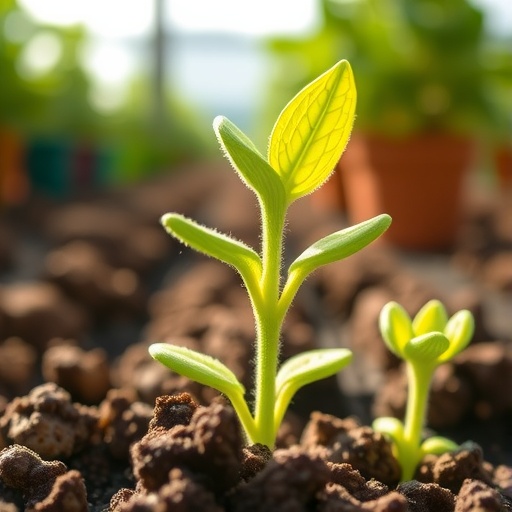
Plants possess intricate internal communication systems that enable them to finely tune their energy production in response to environmental cues. A groundbreaking study led by researchers at Penn State University has identified, for the first time, the precise molecular messengers that govern how and when plants regulate the essential processes of “breathing” and “eating.” These findings shed new light on the delicate balance plants maintain to optimize photosynthesis while minimizing water loss, with far-reaching implications for agriculture and plant biology.
Central to this research is the function of guard cells—specialized cells that flank the microscopic stomatal pores on the leaf surface. Stomata regulate the exchange of gases by opening to allow carbon dioxide (CO2) intake, vital for photosynthesis, and closing to prevent excessive water vapor loss. While it has long been recognized that light triggers stomatal opening and that a chemical signal from within the leaf must coordinate this process, the identity and nature of this internal messenger have remained elusive until now.
The study employed two model plants: Arabidopsis thaliana, commonly known as mouse-ear cress, and Vicia faba, or fava bean. By probing these species, the research team revealed that certain sugars, alongside maleic acid—a metabolite integral to energy production—serve as critical molecular messengers. These molecules convey information from the photosynthetically active mesophyll cells deep within the leaf to the guard cells, orchestrating stomatal behavior.
Researchers extracted apoplastic fluid—the intercellular liquid between plant cells—from leaves exposed to varying light conditions: red light, which intensifies photosynthesis, and darkness, which suppresses it. Through advanced metabolomic analyses, they identified 448 distinct chemical compounds within this fluid, some of which had not been previously documented in such detail. This exhaustive chemical profiling allowed the team to pinpoint specific metabolites whose concentrations shifted in correlation with photosynthetic activity.
Among these, sugars like sucrose, glucose, and fructose emerged as key players that increased in response to red light exposure, alongside maleic acid. The prevalence of these sugars suggested their role as signaling molecules, informing guard cells when to open the stomata. Such a link is instrumental in ensuring that stomatal apertures correspond accurately to the photosynthetic needs of the plant, maximizing CO2 uptake without incurring excessive dehydration risk.
To validate their hypotheses, the scientists isolated the epidermal layers of leaves and assessed stomatal responses under red light conditions, both with and without exogenously applied sugars. The experiments demonstrated a pronounced stimulatory effect from these sugars on stomatal opening. Further experimentation on intact leaves confirmed that sugar feeding enhanced CO2 uptake and influenced transpiration rates, effectively modulating the plant’s efficiency in balancing carbon assimilation and water conservation.
On a cellular level, examinations revealed that sugars activate molecular pathways within guard cells that regulate ion fluxes, crucial for stomatal movements. These pathways involve the transport of ions such as potassium and chloride, which adjust guard cell turgor pressure, driving the physical opening or closing of the stomatal pore. The identification of sugars as upstream messengers elucidates a complete feedback loop linking photosynthetic output in the mesophyll with guard cell activity.
This discovery has significant implications for understanding plant adaptation to environmental fluctuations. Plants must negotiate the tradeoff between carbon acquisition and water retention, especially under stressors like drought and heat that heighten the risk of dehydration. By decoding the molecular communication channels that allow plants to optimize this balance, scientists are better positioned to engineer crops with enhanced resilience and productivity under changing climate conditions.
The study’s comprehensive metabolomic approach also broadens the horizon for identifying novel signaling compounds that may regulate other plant physiological processes. Mapping the chemical milieu of the apoplastic space uncovers a complex network of metabolites whose roles in plant signaling remain to be explored, opening new avenues for agricultural biotechnology.
This research was a collaborative endeavor involving experts from Penn State, The Hebrew University of Jerusalem, Nagoya University in Japan, the RIKEN Center for Sustainable Resource Science, and the University of Mississippi. The multidisciplinary team combined innovative metabolomic technologies with classical plant physiology, underscoring the importance of integrated approaches in modern plant science.
The funding support from the U.S. National Science Foundation was pivotal in enabling this intricate experimental work, emphasizing the critical role of sustained federal investment in advancing fundamental biological discoveries with potential societal applications.
In a time where agricultural sustainability and food security are increasingly paramount, uncovering the molecular underpinnings of plant-environment interactions offers invaluable insights. This study represents a leap forward in plant science, charting a path for future research endeavors aimed at harnessing nature’s mechanisms for crop improvement and environmental resilience.
Cite Scienmag News
Alan Morgan. (August 25, 2025). Scientists Uncover Messenger Signals That Trigger Plants to ‘Eat’ and ‘Breathe’ for the First Time. Scienmag. https://scienmag.com/scientists-uncover-messenger-signals-that-trigger-plants-to-eat-and-breathe-for-the-first-time/
Alan Morgan. "Scientists Uncover Messenger Signals That Trigger Plants to ‘Eat’ and ‘Breathe’ for the First Time." Scienmag, 25 August 2025, https://scienmag.com/scientists-uncover-messenger-signals-that-trigger-plants-to-eat-and-breathe-for-the-first-time/. Accessed 5 September 2026.
Alan Morgan. "Scientists Uncover Messenger Signals That Trigger Plants to ‘Eat’ and ‘Breathe’ for the First Time." Scienmag. August 25, 2025. https://scienmag.com/scientists-uncover-messenger-signals-that-trigger-plants-to-eat-and-breathe-for-the-first-time/


