

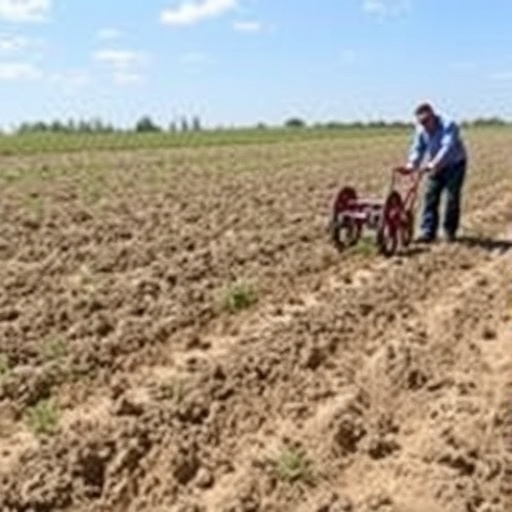
Plowing, an agricultural practice practiced for millennia, involves turning over the soil’s top layer to prepare the earth for planting. This technique aims to enhance water infiltration and nutrient circulation within the soil, supporting robust crop growth. Despite its longstanding use and effectiveness, ongoing concerns about soil degradation and long-term sustainability have spurred a shift toward regenerative agricultural methods that minimize soil disturbance. This pivot emerges from a deeper understanding of the soil’s intricate physical structure and its critical role in ecosystem functions.
In a groundbreaking experimental study led by researchers from the University of Washington, innovative seismic sensing technologies traditionally used to monitor earthquakes have been adapted to explore the soil’s response to varied tilling intensities. The research was conducted at Harper Adams University experimental farm in the United Kingdom, where plots have been consistently cultivated under controlled protocols for over two decades. These plots represent a spectrum of tillage practices, ranging from no-till to deep tillage, as well as different compaction levels induced by the modulation of tractor tire pressure.
The team utilized fiber optic cables, strategically installed alongside these representative fields, employing Distributed Acoustic Sensing (DAS) technology to record continuous ground vibrations. This technique records strain in the fiber cables generated by micro-movements within the soil substrate, capturing subtle seismic velocity changes that correlate with soil moisture dynamics. Because DAS technology is extremely sensitive, it enables unparalleled spatial and temporal resolution in measuring soil hydrodynamics compared to conventional soil moisture sensors.
This innovative application of agroseismology revealed how tilling and the mechanical compaction of soil disrupts the complex capillary networks vital for maintaining the soil’s sponge-like capacity to absorb and retain water. Counter to conventional wisdom, the researchers confirmed that tillage tends to break down these minute channels, thereby hindering water infiltration. Instead of facilitating water penetration, the degradation of soil structure due to tillage and compaction leads to surface water pooling, surface crusting, and reduced permeability. These factors incrementally exacerbate erosion risk and enhance vulnerability to flooding events over time.
Seismic velocity, the speed at which sound waves propagate through soil, serves as an effective proxy for soil moisture content. In saturated or muddy soil, sound waves travel considerably slower compared to dry soil matrices. By continuously monitoring seismic velocity fluctuations, the researchers could directly observe soil moisture variations in response to environmental dynamics such as rainfall events. The 40-hour recording period encompassed natural precipitation and mild temperature conditions, reflecting realistic field scenarios.
Analytical models developed as part of this study transformed seismic velocity data into meaningful soil moisture profiles with exceptional resolution. This approach allowed for comparative assessment across the different cultivation treatments, shedding light on how various tillage depths and compaction levels uniquely influence soil hydrodynamics. These insights provide empirical evidence that long-term no-till management preserves the soil’s microstructure and hence its water retention capabilities, whereas deeper tillage and higher compaction degrade these properties.
The implications for agricultural sustainability are profound. Understanding the soil’s physical state and moisture dynamics in real-time can inform better land management strategies, promote conservation agriculture, and ultimately foster resilient agroecosystems. Furthermore, this seismic sensing method is not only cost-effective and non-disruptive but could also serve as an early warning system for flood risks, improve water resource models by accurately quantifying soil water content, and refine seismic hazard assessments related to soil liquefaction potential.
This synergy between earth sciences and agricultural practice epitomizes the power of interdisciplinary innovation. By leveraging seismology-derived techniques in the agro-environmental context, researchers have opened a new frontier—agroseismology—that holds promise for revolutionizing how farmers monitor, manage, and protect soil health under changing global climate conditions.
This study was a collaborative effort involving Earth and space sciences experts at the University of Washington, alongside specialists at Harper Adams University and the University of Exeter. The research was supported by prestigious funding sources, including The Pan Family Fund, the Murdock Charitable Trust, the David and Lucile Packard Foundation, and the National Environmental Research Council, showcasing its scientific significance and potential impact.
Ultimately, as agriculture faces mounting pressures from climate variability, soil degradation, and food security demands, innovations like this seismic-based soil monitoring technique offer pragmatic tools. They empower stakeholders with actionable data, enable adaptive farming methods that safeguard vital soil functions, and help ensure the sustainability of ecosystems that humankind depends upon.
For further inquiries, contact Marine Denolle at the University of Washington (mdenolle@uw.edu).
Subject of Research: Impact of farming practices on soil hydrodynamics using seismic methods
Article Title: Agroseismology and the impact of farming practices on soil hydrodynamics
News Publication Date: 19-Mar-2026
Image Credits: Marine Denolle/University of Washington
Keywords: Seismology, Hydrology, Water resources, Soil science, Soil erosion, Soils, Geophysics, Earth sciences, Geological engineering, Agriculture, Farming


