


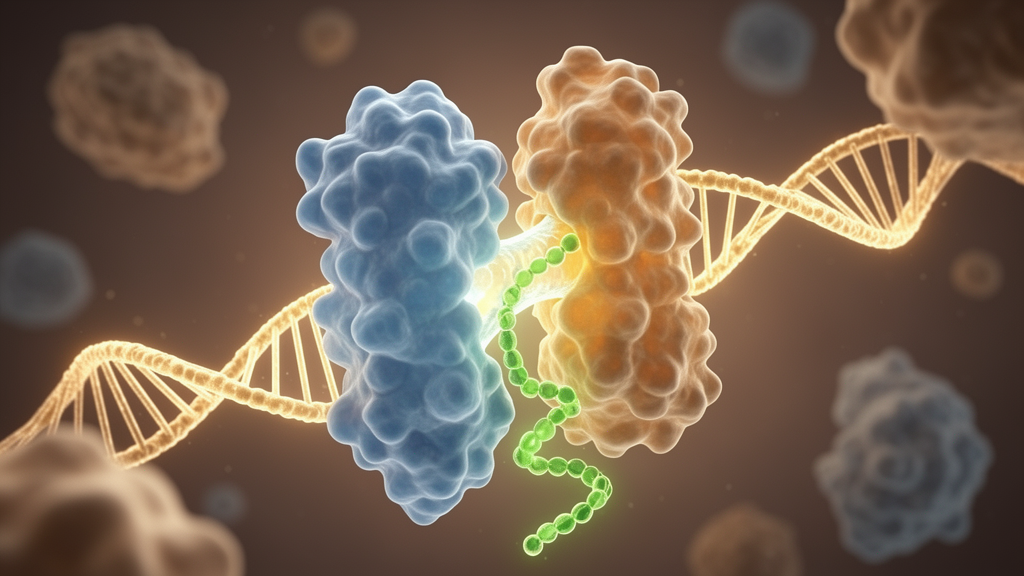
Every living cell depends on ribosomes, the molecular machines that read genetic instructions and assemble them into proteins. Because a cell needs thousands of different proteins at any given moment, natural ribosomes must be generalists, capable of translating any messenger RNA they encounter. Researchers at the University of Illinois Chicago have now engineered a fundamentally different kind of ribosome: one permanently dedicated to producing a single type of protein. The study, published in Nature, introduces a platform called Ribo-M, which physically links a ribosome to the messenger RNA encoding one specific protein, creating a self-contained unit in which the protein-making machinery and its instructions travel together.
The design addresses a limitation that becomes apparent only outside the context of natural cellular life. “Natural ribosomes need to look around the cell to find the blueprint or the recipe for any of the hundreds of proteins to synthesize,” said Kasra Alizadeh, a PhD graduate of the UIC Retzky College of Pharmacy and a postdoctoral fellow in the College of Engineering. That search strategy is highly effective for normal cellular life, but it can constrain biotechnology applications that require cells to produce unusual proteins, therapeutic molecules or other engineered products. “We decided to overcome this problem by incorporating the message into the ribosome itself,” said Alexander Mankin, distinguished professor in the Retzky College of Pharmacy and corresponding author of the study.
“Our engineered ribosomes are specialized,” Alizadeh said. “They always carry with them the recipe for one specific protein and only focus on making that protein without having to waste time looking around.” The analogy the researchers draw is with medicine: a general physician knows a little about every disease, but for brain surgery a patient seeks a specialist trained for that particular task. In the same way, a specialized ribosome could in principle be optimized for a single production job rather than juggling the cell’s entire portfolio of proteins.
Reaching a functional design required years of trial and error. The team generated tens of thousands of ribosome variants and screened thousands of bacterial colonies in search of a construct that could still translate while carrying its own message. Once they identified a working architecture, the researchers demonstrated that Ribo-M could successfully produce several different proteins, including one that creates green fluorescence, an antibiotic-resistance protein and a light-producing enzyme. According to the authors, these demonstrations establish a new framework for engineering protein production, although the platform remains at the development stage.
The longer-term ambition is to push specialized ribosomes beyond the repertoire of natural translation. One possibility is training ribosomes to incorporate nonstandard, or non-canonical, amino acids, which would allow scientists to build proteins with greater stability or entirely new capabilities. “We can teach the ribosome to incorporate non-canonical amino acids into a protein,” Mankin said. “One day, such a ribosome will be able, for example, to make therapeutic antibodies that survive longer in the body.” Because the message is physically tethered to the machine, the researchers suggest such systems could be fine-tuned by synthetic biologists as an exclusive protein synthesis platform.
For now, the current version of Ribo-M is a proof of concept, and the authors are careful about how much it should be expected to do. “This is a prototype. This is not even the Wright brothers’ airplane. This is the bicycle with wings,” Mankin said. The concept could eventually support the production of peptide-based medicines. Semaglutide, the active ingredient in drugs such as Ozempic, is currently manufactured through complex processes; in the future, specialized ribosomes could be engineered to help cells produce such molecules more efficiently, potentially creating a scalable route to designer drugs, enzymes and other proteins. “This is just the beginning of a long list of opportunities that our invention can unlock,” Alizadeh said.
Beyond practical applications, the work may also inform one of biology’s biggest unanswered questions: how the first protein-making systems emerged on Earth. Because the engineered ribosome combines protein-synthesis machinery and genetic instructions in a single unit, it offers a physical model for how primitive translation systems might have functioned before cells contained large populations of free-floating ribosomes and messenger RNAs. In that sense, Ribo-M serves simultaneously as a synthetic biology tool and as a simplified laboratory analogue of an early evolutionary state.
The study, titled “Rewiring the ribosome to translate proteins encoded in its own RNA,” was published in Nature on 2 September 2026. Dorota Klepacki and Nora Vázquez-Laslop of UIC also authored the paper alongside Alizadeh and Mankin. While the engineered ribosomes have so far been shown to produce a small set of model proteins in bacteria, the researchers describe the platform as an early-stage technology whose eventual applications, from nonstandard amino acid incorporation to peptide drug manufacturing, remain goals for future development rather than demonstrated results.
Subject of Research: Engineering ribosomes tethered to their own messenger RNA to specialize in producing a single protein
Article Title: UIC researchers rewire ribosomes to specialize in one protein
Article References: UIC researchers rewire ribosomes to specialize in one protein. Original publication (Bibliographic details unavailable.)
Image Credits: AI Generated
DOI: Not provided
Keywords: ribosomes, synthetic biology, protein synthesis, messenger RNA, Ribo-M, University of Illinois Chicago, non-canonical amino acids, peptide drugs, Nature, translation, biotechnology, origin of protein synthesis
Cite Scienmag News
Gregory Coleman. (October 25, 2026). Scientists Rewire Ribosomes to Specialize in Making a Single Protein. Scienmag. https://scienmag.com/scientists-rewire-ribosomes-to-specialize-in-making-a-single-protein/
Gregory Coleman. "Scientists Rewire Ribosomes to Specialize in Making a Single Protein." Scienmag, 25 October 2026, https://scienmag.com/scientists-rewire-ribosomes-to-specialize-in-making-a-single-protein/. Accessed 25 October 2026.
Gregory Coleman. "Scientists Rewire Ribosomes to Specialize in Making a Single Protein." Scienmag. October 25, 2026. https://scienmag.com/scientists-rewire-ribosomes-to-specialize-in-making-a-single-protein/


