


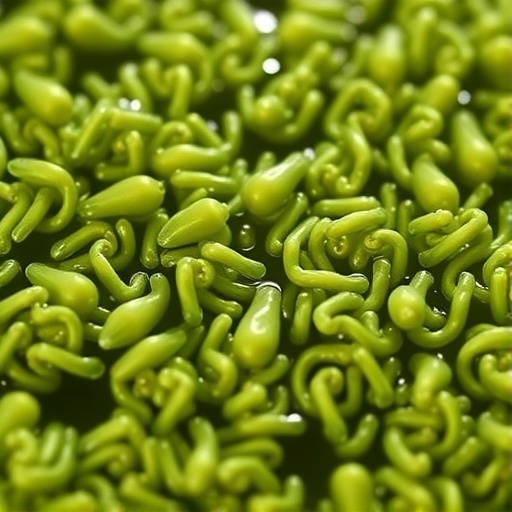
Antibiotic resistance has long been recognized as a paramount global health crisis, threatening to undermine the efficacy of modern medicine. While clinical and agricultural practices have been identified as major drivers, emerging research points to a less obvious yet profoundly influential player lurking within natural water bodies: microalgae. These minute, photosynthetic organisms, foundational to aquatic ecosystems, are now understood to play a pivotal role in the enrichment and dissemination of antibiotic resistance genes (ARGs) across watersheds, a revelation that reshapes our understanding of environmental AMR dynamics.
Microalgae inhabit a specialized microenvironment known as the phycosphere, a nutrient-dense zone immediately surrounding algal cells. This microhabitat fosters intricate interactions between microalgae and diverse bacterial populations. Organic exudates secreted by microalgae serve as substrates, attracting and sustaining bacterial colonies that often harbor ARGs. The accumulation of ARGs within this confined space facilitates an ecological hotspot where resistance gene abundance can far exceed levels detected in the ambient water column, suggesting that microalgae-associated niches significantly amplify the potential for antibiotic resistance proliferation.
At the heart of this process lies the mechanism of horizontal gene transfer (HGT), a primary vector enabling bacteria to exchange genetic material including ARGs. The phycosphere’s dense microbial consortia and extracellular polymeric substances contribute to the formation of biofilms, structured communities that enhance bacterial survival and genetic exchange efficiency. Biofilms not only protect resident microbes from environmental stressors but also serve as crucibles for heightened conjugation, transformation, and transduction events, thereby accelerating the spread of resistance determinants within and between bacterial populations inhabiting aquatic environments.
Environmental factors further exacerbate this phenomenon. Anthropogenic nutrient runoff, particularly nitrogen and phosphorus compounds, stimulates eutrophication, triggering explosive algal blooms. These blooms intensify bacterial colonization on microalgal surfaces, elevating ARG concentrations dramatically compared to non-bloom conditions. Simultaneously, sub-inhibitory concentrations of antibiotics present in water bodies—resulting from pharmaceutical discharge and agricultural application—exert selective pressure that encourages the retention and dissemination of resistance genes within microbial assemblies tethered to the phycosphere.
The complexity escalates when considering other pollution stressors such as microplastics and heavy metals. Microplastics act as novel substrates for microbial biofilm formation, creating additional niches where ARG transfer may be potentiated. Simultaneously, heavy metals like cadmium and mercury can induce biofilm formation and disrupt microbial community structures, indirectly influencing ARG proliferation by selecting for metal-resistant strains often co-resistant to antibiotics, thereby compounding the environmental reservoir of resistance genes.
Despite the mounting evidence delineating the phycosphere’s role in AMR propagation, the field is in its nascent stages. Crucial gaps remain concerning the dynamics of ARG transmission among microalgae, associated bacteria, and broader environmental compartments under natural conditions. The intricacies of microbial community interactions, gene exchange frequency, and the temporal persistence of ARGs within these micro-niches demand rigorous investigation employing advanced molecular and ecological tools.
Unraveling this cryptic ecological pathway is imperative for holistic antimicrobial resistance management. Strategies must transcend clinical and agricultural confines to integrate environmental stewardship, particularly of aquatic systems. Deploying high-resolution metagenomic sequencing, environmental DNA monitoring, and cutting-edge bioinformatics platforms will enable real-time tracking of resistance gene fluxes, elucidating the environmental fate of ARGs emanating from and amplified by microalgal communities.
Furthermore, understanding the physicochemical parameters that regulate microalgal-bacterial associations and biofilm architecture provides promising avenues for intervention. Modulating nutrient inputs to curtail harmful algal blooms, developing bioremediation approaches targeting microalgal surfaces, and engineering microbial consortia to disrupt ARG transfer mechanisms represent innovative strategies emerging from these insights.
As the global scientific community intensifies efforts to combat antimicrobial resistance, recognizing the role of environmental reservoirs such as microalgae-mediated phycospheres reframes the challenge. It underscores the interconnectedness of human, animal, and ecosystem health — a quintessential embodiment of the One Health framework. The microscopic interplay within waterborne microalgal habitats may thus hold the key to unlocking novel interventions and mitigating a burgeoning public health threat.
In summary, the burgeoning body of research highlights microalgae as critical agents in enriching and disseminating antibiotic resistance genes within natural watersheds. These findings prompt a paradigm shift toward incorporating environmental vectors in AMR surveillance and control policies. Addressing this hidden ecological dimension is vital to safeguarding antibiotic efficacy and ensuring sustainable health outcomes for future generations.
News Publication Date: 4-Feb-2026
Web References:
https://doi.org/10.48130/biocontam-0025-0028
References:
Sun S, Chen C, Wang J, Sun Y, Wang Q. 2026. Microalgae in the enrichment and spread of antibiotic resistance genes in watersheds: a review. Biocontaminant 2: e003 doi: 10.48130/biocontam-0025-0028
Cite Scienmag News
Juliet Wilcox. (February 6, 2026). Scientists Reveal Microalgae’s Unexpected Role in Spreading Antibiotic Resistance in Waterways. Scienmag. https://scienmag.com/scientists-reveal-microalgaes-unexpected-role-in-spreading-antibiotic-resistance-in-waterways/
Juliet Wilcox. "Scientists Reveal Microalgae’s Unexpected Role in Spreading Antibiotic Resistance in Waterways." Scienmag, 6 February 2026, https://scienmag.com/scientists-reveal-microalgaes-unexpected-role-in-spreading-antibiotic-resistance-in-waterways/. Accessed 3 September 2026.
Juliet Wilcox. "Scientists Reveal Microalgae’s Unexpected Role in Spreading Antibiotic Resistance in Waterways." Scienmag. February 6, 2026. https://scienmag.com/scientists-reveal-microalgaes-unexpected-role-in-spreading-antibiotic-resistance-in-waterways/


