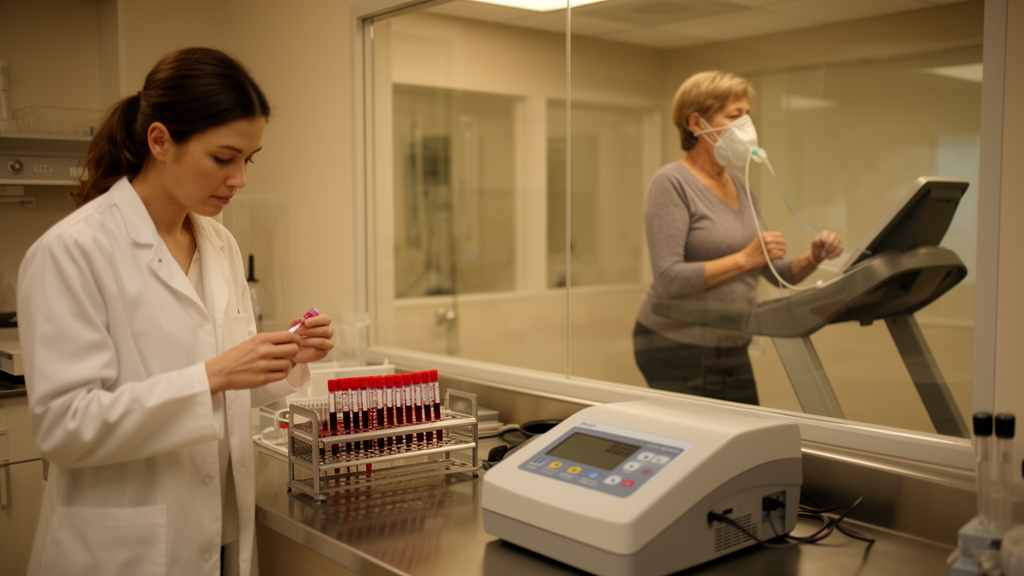
Lactate has long been misunderstood as a metabolic waste product, but decades of exercise physiology research have established it as a circulating fuel, a gluconeogenic precursor, and a carbon shuttle between tissues. Now, a new Mini Review published in Frontiers in Physiology argues that one specific question about lactate has never been answered: whether the menopausal transition changes how the body produces, transports, oxidizes, and clears lactate during exercise and recovery. The review, by Xichen Duan of Jilin Sport University and Dong Du of Guangxi Sports College, reports that a structured search of PubMed/MEDLINE and Europe PMC through 30 August 2026 identified no study that directly measured lactate flux or whole-body metabolic clearance during natural perimenopause. The authors therefore propose a hypothesis-generating framework, which they call the lactate metabolic plasticity framework, designed to test whether changing ovarian hormone status alters the coordination of systemic lactate appearance and disappearance rather than simply shifting a single blood-lactate value.
The framework is deliberately framed as a research extension of established physiology, not a replacement for it. The authors emphasize that the lactate-shuttle concept, maximal lactate steady state (MLSS), exercise-based metabolic-flexibility models, and the Lactate-Carbohydrate Model already explain that lactate is an oxidative fuel and that blood lactate concentration is a protocol-dependent marker of substrate use. For example, MLSS values measured in the same study population can vary from 5.1 to 4.3 mmol per liter depending on which of three methodological definitions is applied, so neither an exercise-induced concentration increase nor a fixed threshold directly identifies tissue hypoxia, production, or oxidation. The novelty of the proposed framework lies in its menopause-specific evidence hierarchy and study design, not in reclassifying lactate biology. The authors are explicit that the framework is not a validated biomarker, composite score, or clinical phenotype, and that no cutoff or favorable direction has been established.
Why might menopause matter for lactate at all? The review draws on direct longitudinal human evidence showing that the menopausal transition is associated with increases in abdominal and visceral fat, loss of lean or muscle mass, lower energy expenditure, and a less favorable cardiometabolic profile. In one four-year cohort, sleeping energy expenditure fell by 7.9 percent in women who became postmenopausal versus 5.3 percent in premenopausal controls. In a controlled cross-sectional exercise study of 41 women, including 19 premenopausal, 8 perimenopausal, and 14 postmenopausal participants, postmenopausal women had 33 percent lower whole-body fat oxidation, 19 percent lower energy expenditure, and 4.28 kilograms less lean body mass than premenopausal women; adjusting for lean mass reduced the fat-oxidation difference to 23 percent and eliminated the energy-expenditure difference. The authors stress that these comparisons do not establish a lactate mechanism, but they identify active muscle mass and substrate use as necessary covariates in any menopause-stage study of lactate.
Biological plausibility comes largely from indirect sources. In experimental animal and cellular models, estradiol and its receptors influence insulin signaling, substrate oxidation, mitochondrial membrane characteristics, redox balance, and mitochondrial gene expression, and in rodents ovariectomy may reduce skeletal-muscle mitochondrial respiration while estradiol replacement can recover aspects of respiratory function. The review also cites direct reproductive-stage vascular evidence: across 132 healthy women, brachial-artery flow-mediated dilation declined in a graded fashion from 9.9 percent before menopause to 4.7 percent in late postmenopause, with intermediate values in early and late perimenopause. However, that study did not measure exercising-muscle blood flow or lactate flux, so the proposed perfusion-to-lactate pathway remains untested. Similarly, no human study has shown that fluctuating estradiol regulates the PGC-1α–ERRα–LDHB axis, or that natural perimenopause changes skeletal muscle MCT1, MCT4, LDHA, LDHB, or related signaling, so these proteins remain candidate mechanisms rather than established mediators.
The authors also caution against overinterpreting a single blood-lactate number. A low peak concentration cannot be interpreted as beneficial in isolation, because it may reflect efficient oxidation, low glycolytic flux, low exercise intensity, reduced active muscle mass, or an insufficient physiological challenge. Conversely, reduced mitochondrial content or pyruvate oxidation could theoretically increase systemic lactate appearance, but an alternative pattern would be an unchanged peak followed by a slower decline, and such a concentration-recovery curve is jointly influenced by distribution, ongoing production, perfusion, oxidation, gluconeogenesis, and recovery activity. Reduced exercise capacity or active muscle mass could also lower total lactate production despite impaired cellular metabolism. The review presents these as testable hypotheses rather than observed perimenopausal patterns, and it proposes that increased variability, rather than a consistent rise or fall, may be the most plausible signature of the transition, because within-person hormone fluctuations are marked while changes in body composition, insulin sensitivity, symptoms, fitness, and vascular function are heterogeneous in timing and magnitude.
One of the framework’s most distinctive features is its insistence on separating natural perimenopause from established postmenopause and from exogenous-hormone exposure. The authors note that perimenopause should not be regarded as a uniform state of estrogen deficiency or indiscriminately grouped with established postmenopause, since estradiol can fluctuate substantially during perimenopause before becoming persistently lower after menopause, while follicle-stimulating hormone generally rises as ovarian reserve declines. For future studies, they recommend classifying reproductive stage using STRAW + 10 criteria, with repeated estradiol and FSH samples characterizing hormone variability rather than replacing menstrual-history staging. Because hormonal contraception and menopausal hormone therapy can obscure bleeding patterns and endogenous criteria, the authors propose that users of exogenous hormones be excluded from primary natural-stage comparisons or analyzed as separate strata, never assigned a stage from contemporaneous hormone values. The role of hormone therapy must be specified a priori as an exposure, confounder, mediator, or hypothesized effect modifier rather than assumed.
The proposed component measurement profile is detailed and demanding. It combines standardized absolute and relative exercise workloads, with paired fixed absolute stages and relative stages anchored to individual thresholds, alongside serial blood lactate concentrations capturing rest, each stage, immediate post-exercise values, delayed peaks, and standardized recovery, with peak, time to peak, area under the curve, and fitted recovery curves reported separately. Crucially, the framework calls for stable-isotope tracer estimates of lactate rate of appearance (Ra), rate of disappearance (Rd), oxidation, and carbon recycling, plus model-derived whole-body metabolic clearance, all reported separately, because blood concentration alone cannot identify these fluxes. The authors note that Ra and Rd are separate tracer-derived fluxes and are not interchangeable, and that a fitted concentration-decay parameter must not be interpreted as Rd or clearance without tracer data. Muscle or vascular phenotyping, including MCT content, mitochondrial respiration, fiber type, and capillary density, is proposed as exploratory.
Existing postmenopausal evidence shows what is feasible. In a study of 75 postmenopausal women, mean MLSS velocity was 7.1 kilometers per hour, and a lactate-threshold-derived predictor explained 80 percent of its variance, rising to 89.2 percent with an added constant-velocity test. The authors argue this demonstrates the feasibility and predictive performance of concentration-based exercise testing in postmenopausal women, but not a menopause effect, because the study had no premenopausal or perimenopausal comparator and did not measure lactate turnover. A 2026 single-group study in active postmenopausal women reported higher power, oxygen uptake, and blood lactate at the intensity of maximal carbohydrate oxidation after six weeks of high-intensity interval training, but without a reproductive-stage comparator or tracer measurements it provides only indirect evidence of training responsiveness. The review also notes that women were markedly underrepresented, at roughly 10 percent of human participants, in a recent systematic review of exercise-induced monocarboxylate transporter responses.
Methodological rigor receives extensive attention in the framework. The authors recommend familiarization sessions, duplicate baseline tests, and quantification of analytical and biological reliability, including analyzer coefficient of variation, within-participant coefficient of variation, intraclass correlation, typical error, and smallest detectable change, before any between-stage inference. Serial blood-lactate data should be analyzed with prespecified mixed-effects or justified nonlinear kinetic models including participant-level random effects and stage-by-intensity or stage-by-time interactions, with multiplicity control, missing-data procedures, and sensitivity analyses reported. Dietary carbohydrate and energy intake, prior exercise, muscle glycogen, fasting duration, sampling site, analyzer, temperature, and time of day should be standardized or recorded, and recovery must be prespecified as active or passive with posture, duration, and workload held constant. Covariates such as age, adiposity, active muscle mass, physical activity, fitness, insulin sensitivity, smoking, medication use, and exogenous hormone use should be selected using a prespecified causal model rather than indiscriminate adjustment.
The review acknowledges its own limitations: it is a structured narrative Mini Review rather than a registered systematic review, screening and extraction were performed by a single reviewer without duplicate assessment, and no formal risk-of-bias assessment or quantitative synthesis was produced. The claim that no direct natural-perimenopause flux study exists is bounded by the documented databases, date range, and eligibility criteria, and is not proof that such evidence cannot exist. Emerging mechanisms such as histone lactylation are kept outside the core measurement profile as exploratory, with no menopausal exercise evidence currently available. The authors conclude that available quantitative evidence supports relevant stage differences in body composition, substrate use, and endothelial function, and that concentration-based MLSS testing is feasible in postmenopausal women, but none of those observations demonstrates altered lactate turnover. Until longitudinal tracer studies are completed, the framework must not be used as a validated biomarker, composite index, clinical phenotype, or basis for selecting one exercise modality over another.
Subject of Research: A hypothesis-generating framework for testing how the menopausal transition may affect lactate metabolism during exercise
Article Title: Lactate metabolic plasticity across the menopausal transition: a hypothesis-generating framework linking ovarian hormone variability, exercise, and skeletal muscle remodeling
Article References: Duan, X., & Du, D. (2026). Lactate metabolic plasticity across the menopausal transition: a hypothesis-generating framework linking ovarian hormone variability, exercise, and skeletal muscle remodeling. Frontiers in Physiology, 17, Article 1954454. https://doi.org/10.3389/fphys.2026.1954454
Image Credits: AI Generated
DOI: 10.3389/fphys.2026.1954454
Keywords: lactate metabolism, menopause, perimenopause, exercise physiology, lactate shuttle, ovarian hormones, skeletal muscle, metabolic flexibility, stable-isotope tracers, STRAW+10 staging, estradiol, hormone therapy
Cite Scienmag News
Daisy Hatcher. (October 29, 2026). Scientists Propose a Framework to Test How Menopause Changes Lactate Metabolism During Exercise. Scienmag. https://scienmag.com/scientists-propose-a-framework-to-test-how-menopause-changes-lactate-metabolism-during-exercise/
Daisy Hatcher. "Scientists Propose a Framework to Test How Menopause Changes Lactate Metabolism During Exercise." Scienmag, 29 October 2026, https://scienmag.com/scientists-propose-a-framework-to-test-how-menopause-changes-lactate-metabolism-during-exercise/. Accessed 31 October 2026.
Daisy Hatcher. "Scientists Propose a Framework to Test How Menopause Changes Lactate Metabolism During Exercise." Scienmag. October 29, 2026. https://scienmag.com/scientists-propose-a-framework-to-test-how-menopause-changes-lactate-metabolism-during-exercise/