

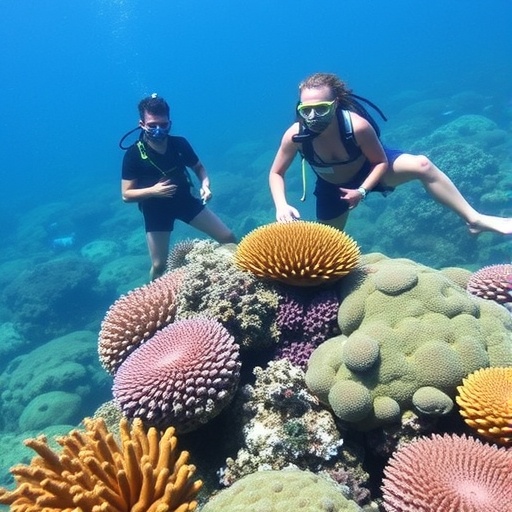
Coral reefs represent some of the most intricate and biologically productive marine ecosystems on Earth, serving as critical habitats for an impressive diversity of organisms. However, these vibrant underwater structures face unprecedented threats driven by anthropogenic pressures and accelerating climate change. Increasing ocean acidification, outbreaks of coral disease, and the overgrowth of opportunistic algae all contribute to the deterioration of reef architecture and the loss of essential habitat complexity. As such, developing robust and non-invasive techniques to assess coral reef health and productivity remains a pivotal challenge for marine science and conservation.
A fundamental indicator of reef viability is the rate of photosynthesis conducted by the reef’s primary producers. Photosynthesis—the biochemical conversion of sunlight into chemical energy—fuels the reef ecosystem by generating organic compounds that sustain diverse reef organisms. Declines in photosynthetic productivity often foreshadow broader ecosystem stresses, including coral bleaching events and susceptibility to diseases. Monitoring these photosynthetic processes over time offers critical insights into reef ecosystem status and resilience.
The photosynthetic communities within coral reefs are multifaceted, encompassing hard corals (scleractinian species) harboring endosymbiotic algae, as well as various species of benthic algae and microphytobenthos. Endosymbiotic algae, residing intracellularly within coral tissues, engage in a mutualistic relationship whereby they provide photosynthetic products to their coral hosts in exchange for nutrients and shelter. Beyond corals, photosynthetic micro-organisms embedded within reef sediments play equally crucial roles in oxygen and nutrient cycling. A promising proxy for photosynthetic activity involves quantifying oxygen bubble production, which occurs when photosynthetic oxygen supersaturation leads to bubble nucleation and detachment at the organism-water interface.
Until recently, leveraging oxygen bubble formation as a metric for photosynthesis was constrained by technical difficulties in automating bubble detection and quantification. Traditional visual observations offer limited temporal resolution and are labor-intensive, restricting scalability. Addressing these limitations, researchers from Xiamen University implemented an innovative approach utilizing passive acoustic monitoring to detect the subtle acoustic signatures generated by oxygen bubble detachment during photosynthesis within coral reef environments.
The underlying principle of this approach exploits the short, distinctive acoustic pulses that oxygen bubbles produce as they separate from photosynthetic surfaces and ascend through the water column. These acoustic emissions are temporally discrete and contain frequency characteristics that differentiate them from other ambient reef noises. The research team deployed sensitive hydrophones in the coral reefs surrounding Dongshan Island, China, to capture these spontaneous acoustic events continuously across multiple seasonal cycles.
Analyzing the acoustic data involved sophisticated signal processing techniques, including spectrogram-based time-frequency decomposition and power spectral density assessments, to isolate bubble detachment signals from background noise. Additionally, synchronous acoustic-video recordings in controlled laboratory coral conservation tanks validated the acoustic signatures and confirmed their direct linkage to bubble release events. This laboratory calibration was essential to ensure the accuracy and ecological relevance of in situ acoustic measurements.
Their findings revealed clear seasonal variations in the rate of photosynthetic bubble-generated acoustic pulses, with significantly elevated rates during the summer months and marked declines during winter. These fluctuations correspond with known patterns of reef primary productivity influenced by environmental parameters such as light availability, temperature, and nutrient dynamics. The ability to capture these temporal dynamics through passive acoustics represents a breakthrough in continuous coral reef health assessment.
By establishing a direct correlative link between acoustic pulse rates and reef metabolic activity, this research paves the way for a non-invasive, scalable monitoring tool that complements existing methodologies like advanced imaging and chemical assays. The passive acoustic technique offers several advantages: it minimizes disturbance to delicate reef communities, allows for long-term unattended deployment, and provides high temporal resolution data critical for detecting rapid ecosystem changes.
Furthermore, the integration of machine learning algorithms into the acoustic data workflow enhances the discriminatory capacity to classify bubble-related sounds amidst the complex acoustic reef soundscape. This computational advancement not only streamlines data analysis but also enhances real-time monitoring capabilities, enabling rapid detection of anomalies indicative of reef stress.
Looking forward, the research team envisions expanding this acoustic monitoring framework across diverse reef habitats and geographic regions to test the generality of photosynthetic acoustic indicators. Such global deployment could facilitate comparative assessments of reef vitality and strengthen early warning systems for ecosystem degradation caused by climate warming, pollution, and other anthropogenic stressors.
To enrich ecological interpretations, future studies aim to couple acoustic monitoring with concurrent measurements of environmental variables including irradiance, nutrient concentrations, and benthic community composition. This holistic approach would deepen understanding of the mechanistic drivers governing photosynthetic activity and refine predictive models of reef response to environmental change.
Ultimately, the goal is to develop an automated, real-time acoustic surveillance system capable of sustained operation across reef ecosystems worldwide. By continually “listening” to reefs, scientists and managers can detect early signs of metabolic shifts that precede visible degradation, enabling informed interventions to conserve these vital marine habitats.
This pioneering research led by Fei Zhang and colleagues at Xiamen University underscores the transformative potential of passive acoustic technology in marine biology. By capturing the subtle sounds of photosynthesis bubbles, the scientific community gains a powerful new lens to monitor, understand, and protect the fragile coral reef ecosystems that sustain immense biodiversity and provide critical ecosystem services to coastal human populations.
Subject of Research: Acoustic monitoring of photosynthetic activity in coral reefs
Article Title: Acoustic Characteristics and Seasonal Variations of Photosynthetic Sounds in Coral Reefs of Dongshan Island, China
News Publication Date: 27-Feb-2026
Web References: http://dx.doi.org/10.34133/olar.0137
Image Credits: Fei Zhang et al./ Ocean-Land-Atmosphere Research
Keywords: Marine biology, Oceanography, Marine photosynthesis


