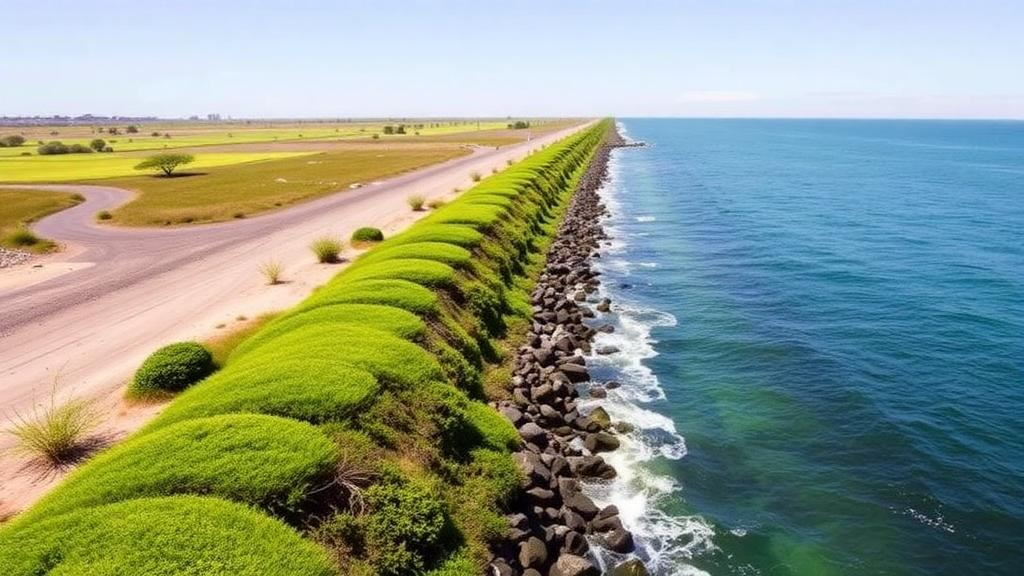
The protocol, published in the journal Environmental Evidence, describes the methods for a planned systematic review and meta-analysis rather than results, because the synthesis itself has yet to be conducted.
The motivation is urgency. Artificial structures now dominate urban coastlines worldwide, built to defend expanding coastal populations against rising seas, accelerating human population growth and the intensifying storms associated with a changing climate. The growth of the blue economy and offshore renewable energy has added a new layer of construction in open water.
Greening of grey infrastructure, abbreviated GGI, is an eco-engineering approach that applies ecological theory to conventional engineering. Rather than replacing a seawall with something else, practitioners modify it: drilling artificial rockpools into horizontal surfaces, bolting concrete habitat panels that mimic rocky shore features onto vertical walls, adding topographic complexity to otherwise featureless blocks, or building complexity in from the start — for example, complex boulders in rock armour, omitted blocks in a renovated seawall in Sydney, Australia, or manipulated mortar in a newly built seawall in Devon, UK. The aim is for structures to keep performing their primary engineered function, whether coastal protection, recreational access or energy production, while gaining a secondary environmental benefit, becoming what the authors call multifunctional ‘ecologically enhanced structures’.
Some early trials have been encouraging. Drilled pits created on breakwaters in the UK and revetments in Malaysia led to significantly higher species richness than unaltered surfaces. A global study of concrete habitat panels attached to vertical seawalls found greater taxa richness on complex tiles than on flat tiles at 10 out of 14 locations worldwide. But the authors caution that these targeted modifications show promise without yet demonstrating broader ecological effectiveness, which they argue remains uncertain without systematic and long-term evaluation.
That uncertainty is compounded by the structure of the field itself. GGI research is described as a ‘young’ science, expanding rapidly but not yet subjected to the critical evaluation needed before it can be considered a mainstream solution. Existing studies have largely been conducted at small spatial and temporal scales, often with low or no replication, even though outcomes of enhanced structures are known to vary across environmental contexts. This makes it difficult to draw generalised conclusions about which specific interventions work, where, and why. Two previous systematic reviews, by Strain and colleagues and by Evans and colleagues, covered evidence published before 2021; since then the volume and scope of research has grown substantially, and GGI has only recently begun to be applied at scale, raising the question of whether results from small experiments hold up when interventions are scaled up.
There is also a sharper concern: greenwashing. The authors note existing worries that greening measures can be used to make new coastal developments more appealing, thereby facilitating potentially damaging construction. Because GGI research is multidisciplinary, findings are dispersed across peer-reviewed journals, NGO reports, consultancy documents and government publications, constituting what the team calls a heterogeneous and fragmented evidence base. Including grey literature is therefore central to the planned review, both to minimise publication bias and to capture valuable work led by NGOs, consultants, agencies and industry groups whose reports are often excluded from conventional reviews.
The proposed review will follow the Collaboration for Environmental Evidence guidelines and ROSES reporting standards. Searches will be run in English across at least five bibliographic databases, three repositories and ten websites, using a search string combining intervention terms (such as ‘living seawalls’, ‘eco-engineering’ and ‘habitat panels’), artificial structure terms (seawalls, groynes, offshore rigs, wind farms and more), environment terms and ecological outcome terms. The string was refined against a list of 31 benchmark publications until it retrieved more than 90 percent of them, and as of July 2025 it returned 3,778 hits on Web of Science, capturing 28 of 30 benchmark papers. Snowballing of references from the two prior reviews, plus unpublished data solicited from an advisory group of 16 experts from academia, industry and government across four continents, will supplement the database searches.
The primary question the review will address is: what are the effects of GGI interventions applied to marine structures on the diversity, abundance, biomass, composition and functional diversity of species on or around these ecologically enhanced structures? Secondary questions will probe whether outcomes vary with intervention type, geography, spatial scale, retrofitting versus built-in design, and material type, and will also examine whether GGI affects the presence of non-native species and what unintended consequences have been documented. Eligible studies must concern macro marine species larger than one millimetre on or around artificial estuarine or fully marine structures serving a non-environmental primary function; structures built solely for ecological purposes, freshwater installations and nature-based solutions without hard engineering, such as saltmarsh rehabilitation, will be excluded. Only in situ experimental and observational studies qualify; laboratory studies, modelling studies and narrative reviews will be left out.
Methodologically, the team plans a two-stage screening process with three independent reviewers, consistency checked using Fleiss’s Kappa and further training triggered if agreement falls below a set threshold. Studies passing screening will undergo critical appraisal with the CEE risk-of-bias tool, and studies with unclear validity will be excluded from quantitative synthesis. Where sufficient comparable data exist, effect sizes such as log response ratios or Hedges’ g will be meta-analysed in R, with sensitivity analyses testing how findings change when low-validity studies are excluded, and funnel plots used to investigate publication bias. Narrative synthesis will describe the direction of effects at individual study level — positive, negative, mixed or no detectable effect — explicitly without vote-counting.
The authors stress that the review is intended as a decision-support tool rather than a verdict already reached. By synthesising the best available global evidence, they aim to give researchers, policy makers and practitioners a robust, up-to-date basis for deciding when, where and how to green grey infrastructure — and, crucially, when claims of ecological benefit are not yet supported by evidence. Given the pace of coastal development worldwide and the risk that unevaluated enhancements could legitimise further hardening of shorelines, that distinction may prove to be the review’s most consequential contribution.
Subject of Research: A systematic review protocol for evaluating the ecological effects of greening marine grey infrastructure worldwide
Article Title: Global evidence for the ecological effects of greening of grey infrastructure: a systematic review protocol
Article References: Allen, J. R., Firth, L. B., Bishop, M. J., Dafforn, K. A., Grasselli, F., Hanley, M. E., Knights, A. M., Mayer-Pinto, M., McQuatters-Gollop, A., O’Shaughnessy, K. A., Porri, F., Smith, R. K., Strain, E. M. A., & Lemasson, A. J. (2026). Global evidence for the ecological effects of greening of grey infrastructure: a systematic review protocol. Environmental Evidence, 15(1), Article 3. https://doi.org/10.1186/s13750-026-00382-z
Image Credits: AI Generated
DOI: 10.1186/s13750-026-00382-z
Keywords: greening of grey infrastructure, eco-engineering, marine biodiversity, seawalls, systematic review protocol, meta-analysis, coastal hardening, grey literature, evidence synthesis, offshore renewable energy, greenwashing, habitat enhancement
Cite Scienmag News
Margaret Porter. (October 29, 2026). Scientists Map Plan to Test Whether Greened Seawalls Really Help Marine Life. Scienmag. https://scienmag.com/scientists-map-plan-to-test-whether-greened-seawalls-really-help-marine-life/
Margaret Porter. "Scientists Map Plan to Test Whether Greened Seawalls Really Help Marine Life." Scienmag, 29 October 2026, https://scienmag.com/scientists-map-plan-to-test-whether-greened-seawalls-really-help-marine-life/. Accessed 4 November 2026.
Margaret Porter. "Scientists Map Plan to Test Whether Greened Seawalls Really Help Marine Life." Scienmag. October 29, 2026. https://scienmag.com/scientists-map-plan-to-test-whether-greened-seawalls-really-help-marine-life/