

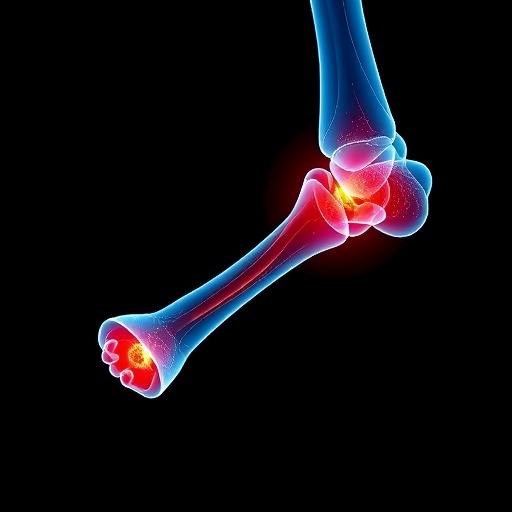
Bone possesses an extraordinary capacity for regeneration, capable of restoring its original structure and mechanical integrity without scar formation following injury. Despite this remarkable trait, a substantial subset of patients suffer from impaired fracture healing, clinically manifesting as nonunion—a condition characterized by persistent fracture gaps, chronic pain, and the necessity for repeated surgical interventions. The biological underpinnings of why certain fractures deviate from normal repair processes remain enigmatic, prompting intensive research aimed at elucidating molecular pathways critical to bone regeneration. Recent groundbreaking work has unveiled a pivotal molecular mechanism that dictates the initiation and progression of fracture healing, potentially revolutionizing therapeutic approaches for refractory bone injuries.
Fracture repair is triggered immediately after injury, in a microenvironment profoundly altered by disrupted vasculature that induces tissue hypoxia. This low-oxygen state orchestrates a complex signaling cascade, prominently featuring reactive oxygen species (ROS) as indispensable messengers. These molecules, once viewed primarily as agents of cellular damage, are now recognized as essential mediators that activate gene expression programs driving inflammation resolution, progenitor cell recruitment, and tissue remodeling. The dichotomy of ROS action is subtle: finely tuned ROS levels promote healing, while excessive oxidative stress inflicts cellular injury, thwarting regeneration. At the heart of translating these redox signals into gene regulatory events lies apurinic/apyrimidinic endonuclease 1 (Apex1), a multifunctional protein with critical roles in DNA repair and redox-sensitive transcriptional modulation.
The study, led by Dr. Emma Muiños-López at the Instituto de Investigación Sanitaria de Navarra, delves into how Apex1 integrates environmental oxidative cues to orchestrate fracture repair. Employing advanced mouse models with conditional deletion of Apex1 in mesenchymal progenitor cells—the multipotent precursors responsible for generating cartilage and bone—the team dissected Apex1’s role across the continuum of bone healing. Through sophisticated imaging, histological analyses, transcriptomics, and gene expression profiling, they demonstrated that Apex1 deficiency results in profound defects in callus formation and subsequent bone regeneration, unveiling a critical regulatory axis.
Apex1 emerges as an essential molecular switch during the inflammatory phase of fracture healing by governing the expression of bone morphogenetic protein 2 (Bmp2), a master regulator driving periosteal cell expansion and callus development. In the absence of Apex1, Bmp2 expression diminishes sharply, impairing periosteal activation and delaying early repair processes. This disruption compromises the initial scaffold formation critical for stabilizing fractures, as evidenced by markedly smaller callus size in Apex1-deficient animals. Dr. Muiños-López emphasizes that Apex1 “translates oxidative stress signals into gene expression programs necessary for initiating bone regeneration,” underscoring its irreplaceable role in the early healing milieu.
During the reparative phase, Apex1 continues to exercise control by facilitating chondrocyte maturation necessary for endochondral ossification—a process whereby cartilage is progressively replaced by bone. In Apex1-deficient models, chondrocytes stall at a pre-hypertrophic stage, failing to express pivotal markers such as type X collagen and matrix metalloproteinases vital for cartilage remodeling and vascular infiltration. This blockade hampers the transition from cartilage to bone, resulting in nonunion-like persistent fracture gaps and underscoring the intricate coordination Apex1 affords during tissue regeneration.
Remarkably, therapeutic restoration of Bmp2 signaling, either through genetic overexpression or localized recombinant protein delivery, rescues the impaired healing phenotypes observed in Apex1-deficient mice. This demonstrates that Apex1 acts upstream of Bmp2 and positions redox-sensitive transcriptional regulation as a critical control node in skeletal repair pathways. The ability to bypass Apex1 deficiency by directly stimulating Bmp2 opens enticing clinical avenues to enhance or rescue healing in patients vulnerable to nonunion, including elderly individuals, smokers, and those with metabolic comorbidities like diabetes.
Beyond fracture repair, the research provides profound insights into skeletal development. Apex1-deficient mice exhibit transient abnormalities in growth plate architecture, mirroring human metaphyseal dysplasias that spontaneously resolve, thereby highlighting Apex1’s indispensable function in chondrocyte progression during development. These findings bridge developmental biology with regenerative medicine, revealing shared molecular mechanisms governing cartilage behavior under both physiological and reparative contexts.
This study represents a paradigm shift in orthopaedic biology, resolving longstanding questions regarding the molecular barriers impeding successful skeletal regeneration. By identifying Apex1 as a master regulator that converts redox signals into precise gene expression patterns necessary for the sequential phases of bone repair, it spotlights redox biology as a fertile landscape for therapeutic innovation. Strategies aimed at modulating oxidative signaling or augmenting Apex1/Bmp2 pathways hold substantial promise for improving clinical outcomes in fracture healing, particularly for patients at elevated risk of nonunion.
The implications for personalized medicine are significant. Apex1’s central role suggests that redox-based biomarkers may stratify patient risk and guide tailored interventions. Moreover, pharmacologic agents or gene therapies targeting Apex1 or its downstream effectors like Bmp2 could be harnessed to catalyze healing in stalled fractures. This convergence of molecular genetics, redox biology, and orthopaedic pathology exemplifies the power of interdisciplinary research in addressing critical health challenges.
Dr. Emma Muiños-López and colleagues at Clínica Universidad de Navarra have charted a novel avenue in skeletal regenerative medicine by elucidating how cellular redox states dictate bone healing outcome through Apex1-mediated transcriptional control. Their findings not only clarify fundamental biological processes but also have immediate translational potential to enhance fracture repair therapeutics.
This pioneering work, published in the January 2026 issue of Bone Research, underscores the intricate interplay of hypoxia, ROS signaling, and redox-sensitive gene regulation in orchestrating the delicate balance between successful bone regeneration and healing failure. It heralds a future in which manipulating the redox environment and its transcriptional interpreters becomes a cornerstone of regenerative orthopaedics.
The identification of Apex1 as a nodal point in fracture healing marks a significant advance in our understanding of musculoskeletal biology. It exemplifies how environmental stress signals are decoded at the molecular level to orchestrate complex tissue repair programs. As the population ages and the burden of nonunion fractures grows, such insights are critical for developing next-generation therapies that restore mobility and quality of life for millions worldwide.
Subject of Research: Animals
Article Title: Apex1, a transcriptional hub for endochondral ossification and fracture repair
News Publication Date: 16-Jan-2026
Image Credits: Dr. Emma Muiños-López from Clínica Universidad de Navarra, Spain
Keywords: Bones, Bone diseases, Musculoskeletal system, Organismal biology, Anatomy, Bone formation, Clinical medicine, Diseases and disorders, Human health, Health care, Bone fractures, Muscle damage, Tissue damage


