

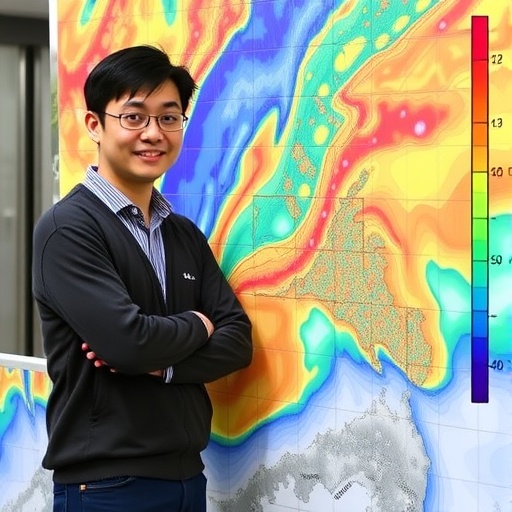
In a groundbreaking development poised to revolutionize subseasonal weather forecasting, researchers from the Institute of Industrial Science at The University of Tokyo and George Mason University’s College of Science have introduced an innovative technique that leverages prior ensemble forecast data to enhance air temperature predictions for up to five weeks in advance. This new approach, supported by the National Oceanic and Atmospheric Administration (NOAA), addresses a long-standing challenge in the meteorological community: improving forecast accuracy without incurring exorbitant computational costs.
Subseasonal-to-seasonal (S2S) forecasting occupies a critical niche between short-term weather forecasts, which typically extend up to two weeks, and long-term seasonal outlooks. However, due to the inherently chaotic nature of atmospheric dynamics, the skill of forecasts tends to deteriorate rapidly beyond the two-week mark. Traditionally, meteorologists have sought to increase the size of ensemble forecasts—running multiple simulations with slightly perturbed initial conditions—to better capture uncertainty and extend reliable prediction horizons. Yet, this strategy is severely limited by the exponential growth in computational resources required, making it impractical for operational implementation on a large scale.
Enter the Lagged Ensemble Analog Sub-selection (LEAS) methodology, a sophisticated yet computationally efficient post-processing technique designed to selectively harness the value embedded in previous forecast ensembles. Instead of indiscriminately incorporating all past simulations into the current ensemble, LEAS meticulously identifies and reuses only those ensemble members from past forecasts that demonstrated superior predictive skill at the latest initialization. This selective retention eschews the noise and error introduced by lower-quality forecasts, thereby refining the accuracy of the resulting prediction without the need for additional model runs.
Paul Dirmeyer, a distinguished professor and senior scientist affiliated with George Mason University’s Center for Ocean-Land-Atmosphere Studies, eloquently encapsulated the underlying philosophy of LEAS: “Previous forecasts are not outdated. The atmosphere and land surface provide valuable memory that can influence weather for weeks.” This insight challenges conventional wisdom, which often regards past simulation data as obsolete once a new forecast is initialized. By regrouping and weighting the most reliable historical ensemble members, the model can effectively capitalize on the latent predictability contained within the Earth system memory.
Evaluation of LEAS was rigorously conducted using hindcasts of daily maximum temperature across North America, utilizing four operational S2S models sourced from leading meteorological forecasting centers globally. The findings were compelling, demonstrating consistent improvements in forecast skill from week one through week five. Notably, the technique achieved reductions in temperature forecast errors by approximately 10% in specific geographic regions, a substantial gain considering the modest computational demands. Furthermore, LEAS enhanced the probabilistic forecasting of extreme heat events—a crucial advancement amid growing concerns over climate change-induced weather extremes.
The robustness of LEAS across multiple independent forecast systems underscores its versatility and potential for widespread adoption. Daisuke Tokuda, project lecturer at The University of Tokyo, expressed astonishment at the method’s efficacy despite its elegant simplicity. This model-agnostic feature means that LEAS can be integrated seamlessly into existing operational frameworks without requiring wholesale changes to underlying forecast architectures.
Typical ensemble forecasting strategies rely heavily on generating numerous simulations to mitigate the chaotic unpredictability of the atmosphere. While valuable, this brute-force approach is throttled by resource constraints, often necessitating trade-offs in ensemble size or model complexity. In contrast, LEAS innovatively sidesteps these limitations through intelligent data reuse. By selecting only the highest-performing prior members, it combines the benefits of increased ensemble depth with zero incremental computational cost, effectively serving as a force multiplier for forecasting systems.
Moreover, the implications of LEAS extend beyond atmospheric science. Its conceptual framework could be adapted for hydrological forecasting, climate modeling, and even machine learning-augmented prediction systems. The ability to distill predictive skill from legacy simulation data while conserving resources resonates broadly, especially as scientific domains increasingly grapple with the twin challenges of big data and limited computational bandwidth.
Reflecting on the interdisciplinary nature of this advance, Tokuda reminisced about conversations with Professor Dirmeyer concerning scientific inquiry’s philosophical underpinnings. Transitioning from an engineering mindset—characterized by seeking definitive answers—to embracing the fluidity and uncertainty inherent in atmospheric science enriched their approach to research. LEAS embodies this synergy between engineering rigor and scientific curiosity, delivering practical advancements by harnessing the complex dynamics of Earth’s atmosphere.
This work also highlights the critical role of high-performance computing support and collaborative infrastructure. The National Center for Atmospheric Research (NCAR), supported by the National Science Foundation, provided invaluable resources through the Casper supercomputer and the CMIP Analysis Platform, enabling the extensive hindcast analyses integral to validating LEAS’s performance.
Looking forward, the seamless incorporation of LEAS into operational subseasonal forecasts presents an exciting prospect for meteorological agencies worldwide. By enhancing predictability horizons and improving the skill of temperature forecasts without demanding extra computational power, this approach offers a scalable solution aligned with the growing need for accurate medium-range weather predictions amid increasing societal vulnerability to climate variability.
As climate change intensifies the frequency and severity of extreme weather events, innovations such as LEAS furnish essential tools for preparedness and resilience. Accurate temperature forecasts extending weeks into the future empower policymakers, emergency responders, and the public with critical lead time for heatwave mitigation, energy management, and health advisories.
In conclusion, the selective reuse of prior ensemble data via LEAS marks a pivotal stride toward more intelligent, resource-efficient forecasting. By blending atmospheric science with advanced data analysis, the research team has laid a foundation for improved subseasonal-to-seasonal predictions that reconcile accuracy with computational feasibility. This paradigm shift promises to reshape how meteorological centers worldwide approach ensemble forecasting, offering a glimpse into the future of predictive science where innovation and efficiency coalesce.
Subject of Research: Atmospheric science, subseasonal-to-seasonal air temperature forecasting improvements through ensemble data reuse.
Article Title: Selective reuse of prior ensemble data improves the latest air temperature forecast over North America
News Publication Date: 6-Apr-2026
Web References:
DOI: 10.1073/pnas.2524516123
Image Credits: Institute of Industrial Science, The University of Tokyo
Keywords: Atmospheric science, Meteorology, Subseasonal forecasting, Ensemble forecasting, Temperature prediction, Computational science, Extreme weather events


