


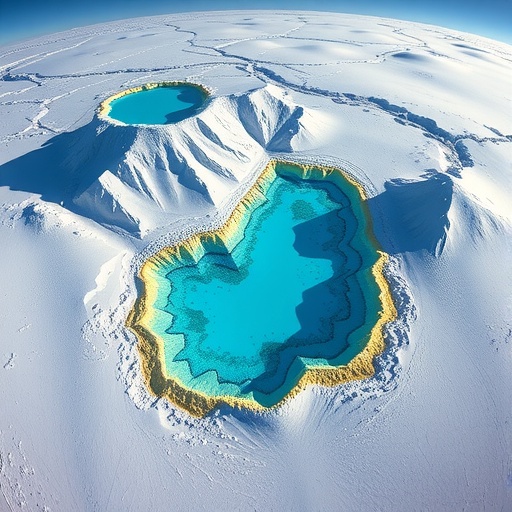
In a groundbreaking advance for cryospheric science, researchers have meticulously charted an intricate network of subglacial lakes hidden beneath the vast icy expanses of the Canadian Arctic. This pioneering study, employing over a decade’s worth of highly precise surface elevation data, reveals the presence of 33 elusive bodies of water tucked under glaciers, providing novel insights into Arctic ice dynamics and climate change processes.
By leveraging ArcticDEM, a sophisticated satellite-derived topographic dataset covering the polar regions, scientists have developed an innovative methodology to detect and monitor subtle changes in ice surface height with unprecedented accuracy. These changes correspond to the periodic drainage and refilling cycles of subglacial lakes, phenomena that were previously challenging to characterize in such remote and harsh environments due to logistical constraints and limited observational technology.
Subglacial lakes are critical components of ice-sheet hydrology and glacial mechanics—they act as reservoirs and conduits for water beneath ice masses, influencing basal sliding and ice flow velocities. The study’s revelations significantly enhance understanding of how variations in subglacial water storage can affect glacier dynamics, particularly in the context of accelerated ice mass loss observed in the rapidly warming Arctic region.
Traditionally, subglacial lakes were understood as isolated water bodies contained beneath single ice sheets or glaciers. However, this comprehensive survey extends the classification to include terminal subglacial lakes located at glacier confluences, where the merging ice flows foster unique hydrological conditions. Even more striking is the identification of partial subglacial lakes adjacent to open water bodies—a discovery reshaping conceptions of subglacial hydrology and connectivity.
The implications of these findings are profound. When present, subglacial lakes can lubricate the glacier bedrock interface, significantly modulating glacier basal sliding speeds. This lubrication effect can accelerate glacier movement, potentially exacerbating ice mass loss and contributing to sea level rise. Understanding these processes at detailed spatial and temporal scales is crucial for improving predictive models of glacier behavior and climatic feedback mechanisms.
Dr. Wesley Van Wychen of the University of Waterloo underscores the value of these new insights, highlighting that the Arctic’s dynamic subglacial water systems now serve as sensitive indicators of regional climate change impacts. The capacity to track these lakes’ drainage and replenishment cycles with such precision offers a powerful tool for monitoring how warming temperatures alter ice sheet stability and movement.
Moreover, the differentiation of lake types facilitates more nuanced predictions of glacier flow responses. For example, terminal lakes at glacier junctions may influence ice flow differently from classic subglacial lakes beneath single glaciers, meaning that hydrological complexity directly affects ice dynamics and potential destabilization pathways.
Further research efforts aimed at unraveling the stability and temporal evolution of these lakes will explore the fate of water expelled during drainage events and quantify consequential effects on ice mass balance and flow rates. These investigations will refine our comprehension of subglacial water pathways and their interactions with glacial mechanical processes, with far-reaching implications for global sea level studies.
The collaborative nature of this study, involving interdisciplinary teams from the University of Waterloo, University of Ottawa, University of Bristol, and the Remote Sensing Technology Centre of Japan, exemplifies the integration of advanced satellite remote sensing, field data, and theoretical modeling. Their collective efforts push the frontier in polar glaciology and climate science.
This research was recently published in the open-access platform EGUsphere under the title “Active subglacial lakes in the Canadian Arctic identified by multi-annual ice elevation changes.” It offers a compelling glimpse into the hidden hydrological complexities beneath Arctic glaciers and a window into how these monumental ice structures may evolve under ongoing climatic shifts.
Understanding the role that subglacial lakes play in modulating ice-sheet behavior is crucial not only for regional Arctic studies but also in the context of global climate models. These lakes modulate ice-sheet stability by controlling meltwater routing, basal lubrication, and ice flow acceleration, significantly influencing the contribution of polar ice to global sea level.
The Canadian Arctic, which hosts one of the world’s fastest-retreating glacier systems, is a strategic location for this kind of research. The integration of long-term satellite data with ground observations creates a powerful synergy for observing glaciological changes that were previously out of reach, reinforcing the urgent need for comprehensive polar monitoring infrastructures.
This landmark research opens new avenues for environmental monitoring by revealing patterns of subglacial hydrology linked directly to ice velocity changes and mass balance variations. Such capabilities are key to forecasting the Arctic ice mass response to future warming scenarios, aiding policymakers and scientists in addressing the global challenges posed by climate change.
News Publication Date: 23-Mar-2026
Web References:
https://egusphere.copernicus.org/preprints/2025/egusphere-2025-2707/
http://dx.doi.org/10.5194/tc-20-1699-2026
Cite Scienmag News
Russell Cooper. (April 2, 2026). Pioneering Survey Maps Subglacial Lakes Beneath the Canadian Arctic. Scienmag. https://scienmag.com/pioneering-survey-maps-subglacial-lakes-beneath-the-canadian-arctic/
Russell Cooper. "Pioneering Survey Maps Subglacial Lakes Beneath the Canadian Arctic." Scienmag, 2 April 2026, https://scienmag.com/pioneering-survey-maps-subglacial-lakes-beneath-the-canadian-arctic/. Accessed 4 September 2026.
Russell Cooper. "Pioneering Survey Maps Subglacial Lakes Beneath the Canadian Arctic." Scienmag. April 2, 2026. https://scienmag.com/pioneering-survey-maps-subglacial-lakes-beneath-the-canadian-arctic/


