


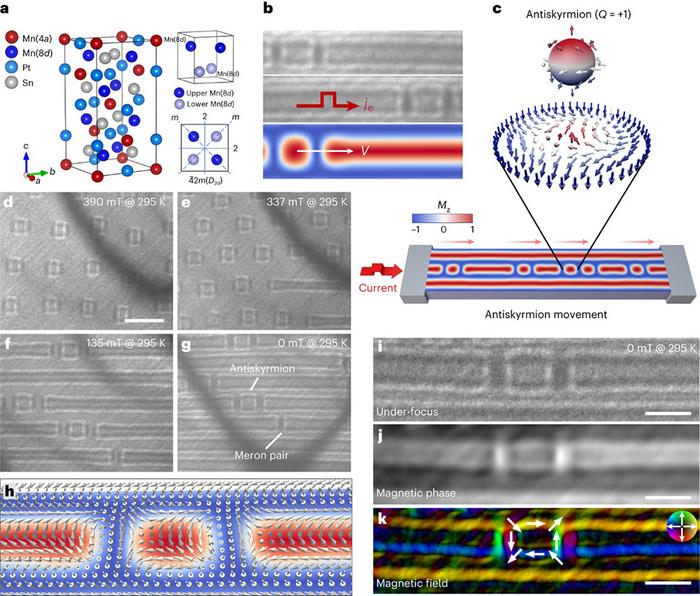
Prof. ZHANG Ying’s group from the Institute of Physics of the Chinese Academy of Sciences (CAS), in collaboration with domestic universities and the Los Alamos National Laboratory in the United States, has experimentally observed current-driven antiskyrmion sliding.

Credit: Institute of Physics
Prof. ZHANG Ying’s group from the Institute of Physics of the Chinese Academy of Sciences (CAS), in collaboration with domestic universities and the Los Alamos National Laboratory in the United States, has experimentally observed current-driven antiskyrmion sliding.
Their work was published in Nature Materials on April 11.
Magnetic (anti)skyrmions with topologically protected spin structures are promising as next-generation information units in spintronic devices. The ability to transport (anti)skyrmions using electric currents is particularly interesting for highly efficient data storage and processing. However, the major challenges are unwanted lateral deflection towards the sample edge and eventual annihilation due to the Magnus force from (anti)skyrmion Hall effects.
Under the consistent support of CAS Member SHEN Baogen, Prof. ZHANG’s research team established a dedicated magnetization characterization platform with focused ion beam microscopy, Lorentz Transmission Electron Microscopy (L-TEM), and multiple in-situ holders, etc. The platform is a powerful means of directly studying topological domains with ultra-high spatial resolution under different external fields. The researchers have used this platform to systematically study the generation and manipulation of skyrmions in many kinds of materials, thus accumulating rich experience.
In this study, the researchers successfully demonstrated the straight-sliding dynamics of electric current-driven antiskyrmions at room temperature and without the presence of an external magnetic field in a Mn1.4PtSn chiral magnet. This achievement was realized by embedding antiskyrmions in strongly correlated helical stripe domains, in contrast to the usual manipulation of topological skyrmions in the ferromagnetic background. These stripe domains naturally provide one-dimensional linear tracks, along which antiskyrmion sliding is initiated at low current densities and without transverse deflection by the antiskyrmion Hall effect.
According to the researchers, the higher mobility of the antiskyrmions in the helical stripe background can be well understood through micromagnetic simulations and collective pinning theory, allowing random pinning potentials to be easily faded out.
In addition, this method can be extended to the sliding motion of merons or skyrmions in stripe domains, further demonstrating its general applicability.
Thus, the demonstration and comprehensive understanding of antiskyrmion movement along naturally straight tracks at low current densities, while overcoming deflection under a wide temperature range and zero magnetic field, offers a new perspective for (anti)skyrmion applications in spintronics.
This study was supported by the Strategic Priority Research Program of CAS, the National Science Foundation of China, and the CAS Project for Young Scientists in Basic Research.
Journal
Nature Materials
Method of Research
Experimental study
Subject of Research
Not applicable
Article Title
Experimental observation of current-driven antiskyrmion sliding in stripe domains
Article Publication Date
11-Apr-2024
Cite Scienmag News
Reid Dalton. (April 18, 2024). Scientists experimentally observe current-driven antiskyrmion sliding. Scienmag. https://scienmag.com/scientists-experimentally-observe-current-driven-antiskyrmion-sliding/
Reid Dalton. "Scientists experimentally observe current-driven antiskyrmion sliding." Scienmag, 18 April 2024, https://scienmag.com/scientists-experimentally-observe-current-driven-antiskyrmion-sliding/. Accessed 3 September 2026.
Reid Dalton. "Scientists experimentally observe current-driven antiskyrmion sliding." Scienmag. April 18, 2024. https://scienmag.com/scientists-experimentally-observe-current-driven-antiskyrmion-sliding/

