


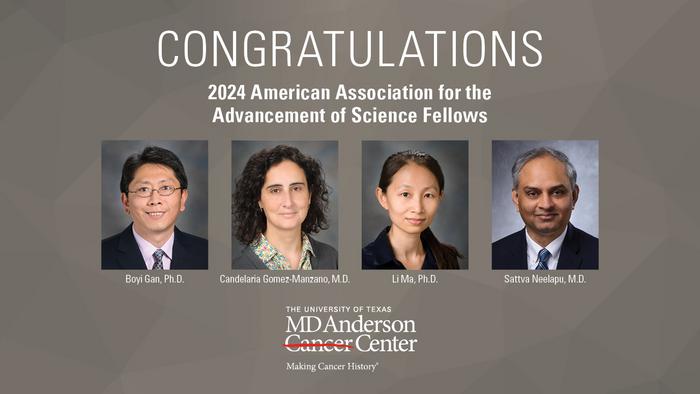
HOUSTON ― In recognition of their significant achievements in the realm of cancer care and research, four researchers at The University of Texas MD Anderson Cancer Center have been elected fellows of the American Association for the Advancement of Science (AAAS). This prestigious distinction stands as one of the highest accolades within the scientific research community.

Credit: MD Anderson Cancer Center
HOUSTON ― In recognition of their significant achievements in the realm of cancer care and research, four researchers at The University of Texas MD Anderson Cancer Center have been elected fellows of the American Association for the Advancement of Science (AAAS). This prestigious distinction stands as one of the highest accolades within the scientific research community.
Boyi Gan, Ph.D., Candelaria Gomez-Manzano, M.D., Li Ma, Ph.D., and Sattva Neelapu, M.D., now join this esteemed group of fellows elected by their peers. AAAS’s annual tradition of recognizing leading scientists as fellows dates to 1874. With these newest additions, 68 MD Anderson faculty members have been elected AAAS Fellows.
“We proudly congratulate Drs. Gan, Gomez-Manzano, Ma and Neelapu for their outstanding dedication and innovative contributions to cancer care and research,” said Peter WT Pisters, M.D., president of MD Anderson. “This group exemplifies MD Anderson’s commitment to breakthrough science, and these individuals are highly deserving of this honor from AAAS.”
MD Anderson’s research environment provides unique opportunities for seamless collaboration between clinicians and scientists, allowing new insights to flow from the lab to the clinic and back. Breakthroughs from the lab can rapidly be developed into new therapies to be evaluated in the clinic, and clinical results can guide laboratory studies in real time. This virtuous cycle of innovation, grounded in collaboration, connectivity and data-based science, accelerates discoveries in ways not possible at other institutions.
Gan, professor of Experimental Radiation Oncology, was elected for his contributions to understanding and targeting ferroptosis in cancer and to discovering disulfidptosis as a new form of regulated cell death. He is recognized worldwide as a leader for these achievements and for the development of novel cancer therapies targeting these pathways. Gan currently serves as director of the Radiation and Cancer Metabolism Research Program in Division of Radiation Oncology and leads Acquired Resistance to Therapy and Iron (ARTI) Center at MD Anderson.
Gomez-Manzano, professor of Neuro-Oncology, was elected for her contributions to generating engineered oncolytic adenoviruses, which target and destroy cancer cells while minimizing the negative impact on normal cells, to treat adult and pediatric tumors. She is also recognized for her work in propelling cancer viro-immunotherapy. Gomez-Manzano serves as co-lead of MD Anderson’s Glioblastoma Moon Shot® and co-lead of the Neuro-Neoplasm Initiative within MD Anderson’s Cancer Neuroscience Program.
Ma, professor of Experimental Radiation Oncology, was elected for her fundamental discoveries of cancer spread and resistance to treatment that have transformed the field, including pioneering work on the role of long non-coding RNAs in metastasis. As a prominent scientist in the field, she has reached numerous significant research milestones and has authored more than 65 papers in leading peer-reviewed journals.
Neelapu, professor of Lymphoma and Myeloma, was selected for his clinical and translational research, focusing on developing novel immunotherapeutic strategies for patients with lymphoma. Through his contributions, expertise and leadership, Neelapu has earned recognition nationally and internationally in the field of chimeric antigen receptor (CAR) T cell therapy. As a physician-scientist, his contributions to clinical and translational research have resulted in at least two Food and Drug Administration approvals and multiple patent filings of novel immune and cell therapy approaches that soon will be evaluated in clinic.
“The AAAS Fellows are composed of exceptional scientists whose outstanding research achievements showcase the transformative influence of science on our world,” said Giulio Draetta, M.D., Ph.D., chief scientific officer at MD Anderson. “We celebrate these distinguished MD Anderson scientists, who epitomize our continual dedication to progress in cancer care, research and prevention.”
Cite Scienmag News
Nathaniel Bowman. (April 18, 2024). Four MD Anderson researchers elected AAAS Fellows. Scienmag. https://scienmag.com/four-md-anderson-researchers-elected-aaas-fellows/
Nathaniel Bowman. "Four MD Anderson researchers elected AAAS Fellows." Scienmag, 18 April 2024, https://scienmag.com/four-md-anderson-researchers-elected-aaas-fellows/. Accessed 5 September 2026.
Nathaniel Bowman. "Four MD Anderson researchers elected AAAS Fellows." Scienmag. April 18, 2024. https://scienmag.com/four-md-anderson-researchers-elected-aaas-fellows/

