


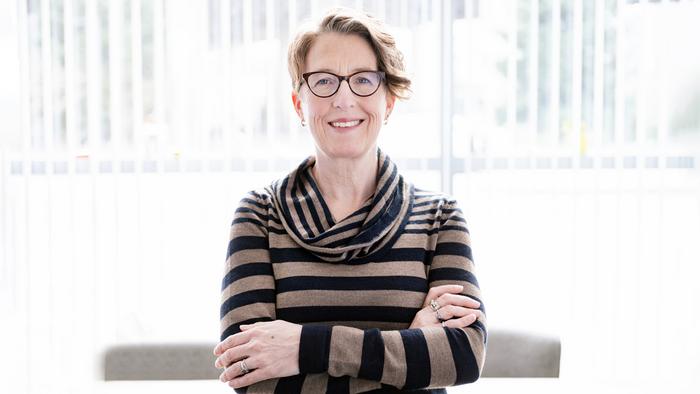
SAN FRANCISCO—April 18, 2024—The American Association for the Advancement of Science (AAAS), one of the world’s largest general scientific societies, has elected Gladstone Senior Investigator Katie Pollard, PhD, into its new class of AAAS Fellows, a lifetime honor within the scientific community.

Credit: Gladstone Institutes
SAN FRANCISCO—April 18, 2024—The American Association for the Advancement of Science (AAAS), one of the world’s largest general scientific societies, has elected Gladstone Senior Investigator Katie Pollard, PhD, into its new class of AAAS Fellows, a lifetime honor within the scientific community.
AAAS recognized Pollard for her “distinguished contributions to the field of computational biology and bioinformatics, particularly her discovery of Human Accelerated Regions, and development of open-source software for gene expression, comparative genomics, and microbiomes.”
“This year’s class embodies scientific excellence, fosters trust in science throughout the communities they serve, and leads the next generation of scientists while advancing scientific achievements,” says Sudip S. Parikh, PhD, AAAS chief executive officer and executive publisher of the Science family of journals.
Pollard—who also serves as director of the Gladstone Institute of Data Science and Biotechnology, a professor in the Department of Epidemiology and Biostatistics at UC San Francisco, and a Chan Zuckerberg Biohub investigator—leads teams of scientists who develop statistical and computational methods to decode how genomes work, evolve, and break in disease. By analyzing massive sets of genomic and epigenomic data, Pollard and her teams have gained a greater understanding of human genetic variation, what makes humans unique compared to other species, and genomic diversity of the human microbiome.
“I’m honored to be named an AAAS Fellow, joining the ranks of some of the most noted scientists in history,” Pollard says. “I’m very much aligned with the AAAS mission to advance science and serve society, which is what we’re doing every day in the lab and as we collaborate with our peers.”
Pollard also is an elected member of the National Academy of Medicine and a fellow of the California Academy of Sciences, among many other honors and awards.
In a landmark study published last year in Science, Pollard and her team analyzed how stretches of DNA called human accelerated regions (HARs) vary between humans and chimpanzees. HARs are nearly identical among all humans, but are different in all other mammals and therefore thought to confer human-specific traits. Through machine learning and lab experiments, they found that these human-specific structural changes in the genome may have created the right environment for HARs to evolve quickly in the human ancestor, after remaining almost the same over millions of years of mammal evolution.
Most recently, a team led by Pollard received a major grant from the Biswas Family Foundation to create the Biswas Center for Transformative Computational Cancer Biology, where scientists will fuse powerful machine learning with cutting-edge experimental technologies to help identify and prioritize new research avenues for cancer diagnosis and treatment. As with most of Pollard’s work, findings will be freely shared with the scientific community to accelerate global research.
“Gladstone congratulates Katie on this major and well-deserved career achievement,” says Gladstone President and Senior Investigator Deepak Srivastava, MD. “Katie’s groundbreaking work in computational biology, artificial intelligence, and genomics has moved us closer to understanding the root causes of disease and how to address them. We’re excited for all the discoveries yet to come.”
With the addition of Pollard, Gladstone now has seven AAAS Fellows; the others are Sanders “Sandy” Williams (1992), Robert Mahley (1998), Warner Greene (2004), Jennifer Doudna (2008), Srivastava (2011), and Katerina Akassoglou (2021).
The latest class of AAAS fellows is comprised of 502 scientists, engineers, and innovators across 24 AAAS scientific disciplines, from biological sciences and chemistry to neuroscience and physics. Fellows will receive a certificate and a gold and blue rosette pin (representing science and engineering, respectively) to commemorate their election and will be celebrated in Washington, D.C., on September 21.
A tradition dating back to 1874, the AAAS Fellows program has recognized over the years notable scientists such as W.E.B DuBois, Maria Mitchell, Steven Chu, Ellen Ochoa, Irwin M. Jacobs, Alan Alda, Mae Jemison, and Ayanna Howard.
About Gladstone Institutes
Gladstone Institutes is an independent, nonprofit life science research organization that uses visionary science and technology to overcome disease. Established in 1979, it is located in the epicenter of biomedical and technological innovation, in the Mission Bay neighborhood of San Francisco. Gladstone has created a research model that disrupts how science is done, funds big ideas, and attracts the brightest minds.
Cite Scienmag News
Denise Maddox. (April 18, 2024). Computational biology pioneer Katie Pollard elected as AAAS fellow. Scienmag. https://scienmag.com/computational-biology-pioneer-katie-pollard-elected-as-aaas-fellow/
Denise Maddox. "Computational biology pioneer Katie Pollard elected as AAAS fellow." Scienmag, 18 April 2024, https://scienmag.com/computational-biology-pioneer-katie-pollard-elected-as-aaas-fellow/. Accessed 5 September 2026.
Denise Maddox. "Computational biology pioneer Katie Pollard elected as AAAS fellow." Scienmag. April 18, 2024. https://scienmag.com/computational-biology-pioneer-katie-pollard-elected-as-aaas-fellow/

