


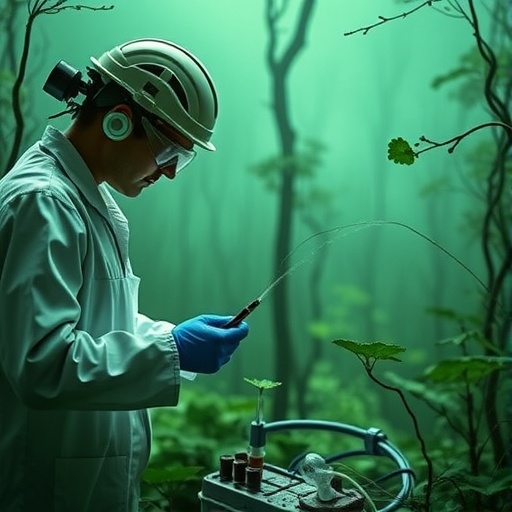
Methane, a greenhouse gas with a warming potential far exceeding that of carbon dioxide, constitutes a significant challenge in climate science due to uncertainties surrounding its sources and fluxes. Approximately two-thirds of atmospheric methane emissions originate from microbes thriving in oxygen-deprived environments such as wetlands, rice paddies, landfills, and the digestive systems of ruminant animals. Despite this knowledge, pinpointing and quantifying these methane origins remains elusive, owing largely to the intricate metabolic pathways involved and the complexities of natural isotope variations.
Tracing methane’s provenance often involves analyzing the isotopic composition of its constituent carbon and hydrogen atoms. These isotopes serve as molecular fingerprints, enabling scientists to differentiate methane derived from biological activities, fossil fuel extraction, or other biogeochemical processes. However, the nuances of how microbial enzymatic activity influences these isotopic ratios have not been fully elucidated—until now.
In a groundbreaking study led by researchers at the University of California, Berkeley, a team has demonstrated for the first time how variations in the expression of a crucial microbial enzyme—methyl-coenzyme M reductase (MCR)—significantly influence the isotope signature of the methane produced by methanogenic archaea. This research bridges molecular biology with isotope geochemistry, offering novel insights that could radically enhance our ability to map methane flows and thus target reduction efforts with greater precision.
Jonathan Gropp, a UC Berkeley postdoctoral fellow and first author on the study, notes that while global carbon dioxide budgets have become increasingly refined through well-established traceability methods, methane remains fraught with uncertainty. “When we integrate all carbon dioxide sources and sinks, the overall budget aligns closely with atmospheric measurements. But methane fluxes exhibit broad margins of error, sometimes off by tens of percent, which hampers our understanding of their changing contributions and dynamics over time,” Gropp explained.
Central to the new research is the enzymatic process mediated by MCR, a protein complex that directly catalyzes the final step in microbial methane production. The team employed CRISPR gene-editing techniques to modulate MCR activity within Methanosarcina acetivorans, a representative methanogen capable of utilizing a variety of substrates—including acetate and methanol—to produce methane. This methodological innovation allowed the scientists to experimentally mimic environmental conditions where substrate scarcity limits enzymatic activity, thus providing unprecedented insight into how microbes respond at a molecular level.
Dipti Nayak, assistant professor of molecular and cell biology at UC Berkeley and co-author of the study, emphasized the novelty of integrating molecular manipulation with isotopic measurements. “This work is the first to marry molecular biology tools like CRISPR with isotope biogeochemistry to decode how methanogen biology shapes methane’s isotopic fingerprint,” she said. The findings challenge prevailing assumptions that the isotope signature of methane is dictated solely by the organism’s carbon source.
Isotopes—variants of elements differing in neutron number—play a crucial role in tracing environmental processes. For instance, the relative abundances of carbon-12 and carbon-13, along with hydrogen isotopes hydrogen-1 and deuterium (hydrogen-2), in methane molecules can vary depending on biological pathways and environmental contexts. Traditionally, scientists have interpreted these isotopic patterns as static markers tied to the substrate. However, this new work reveals a dynamic interplay involving cellular enzyme activity directly influencing isotopic ratios.
Geochemist Daniel Stolper, co-author and associate professor of earth and planetary science at UC Berkeley, elucidated the experimental observations. The decreased expression of MCR induced a cascade where other enzymes inside the methanogen’s metabolic network began operating concurrently in forward and reverse directions. This cycling facilitates isotopic exchanges, notably the incorporation of hydrogen atoms derived from intracellular water into the methane molecule, thereby altering the isotope signature away from the expected substrate-derived fingerprint.
Such enzyme-mediated isotope exchange affirms that in natural settings, where methanogens face variable nutrient limitation and environmental stresses, isotopic fingerprints become more complex than laboratory-derived standards have accounted for. “This variability implies that the contribution of methane from acetate-utilizing microbes may have been underappreciated in global methane budgets,” Gropp suggested. Recognizing these microbial physiological responses may refine models that apportion methane sources and improve climate mitigation strategies.
Beyond ecological implications, the research holds promising applications in biotechnology. By adjusting the expression of MCR and potentially rerouting electron flow within methanogens, scientists could suppress methane production in favor of producing alternative, more environmentally benign bioproducts. Nayak envisions engineering methanogens as biological factories that redirect carbon and electrons away from methane emission, thereby addressing climate change through synthetic biology.
The study not only pioneers a methodological advance by employing CRISPR gene editing to manipulate enzyme networks in archaea—a domain less accessible to genetic tools—but also opens exciting avenues for exploring other isotope systems within microbial biochemistry and geobiology. Stolper expressed optimism that coupling molecular biology with isotope geochemistry will yield a transformative understanding of how biological processes mediate Earth’s chemical cycles.
Published in the prestigious journal Science on August 14, 2025, the research underscores the importance of interdisciplinary approaches to untangle the complexities of methane biogeochemistry. By revealing how gene expression variations in methanogens influence isotopic signatures, this work equips scientists with enhanced diagnostic tools critical for tracking methane emissions and informing policies addressing global warming.
This scientific breakthrough heralds a paradigm shift in methane source attribution and highlights the urgent need to incorporate microbial physiological variability into global methane flux inventories. As methane concentration continues its upward trajectory and accelerates climate change impacts, such nuanced insights into microbial methane formation represent vital progress toward sustainable environmental management.
News Publication Date: 14-Aug-2025
Web References:
DOI: 10.1126/science.adu2098
Cite Scienmag News
Russell Cooper. (August 14, 2025). Scientists Engineer Microbes to Trace Environmental Methane Sources. Scienmag. https://scienmag.com/scientists-engineer-microbes-to-trace-environmental-methane-sources/
Russell Cooper. "Scientists Engineer Microbes to Trace Environmental Methane Sources." Scienmag, 14 August 2025, https://scienmag.com/scientists-engineer-microbes-to-trace-environmental-methane-sources/. Accessed 3 September 2026.
Russell Cooper. "Scientists Engineer Microbes to Trace Environmental Methane Sources." Scienmag. August 14, 2025. https://scienmag.com/scientists-engineer-microbes-to-trace-environmental-methane-sources/


