


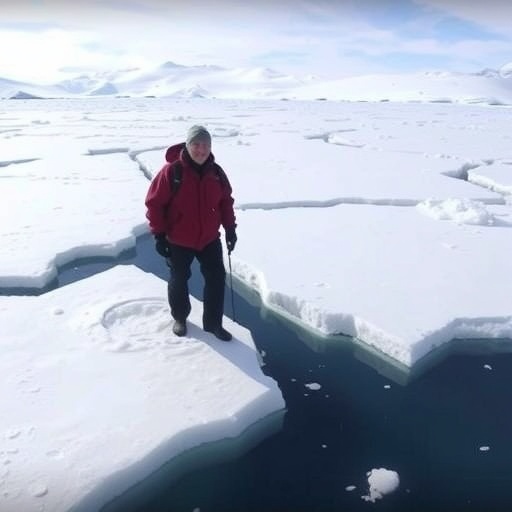
In a stunning reversal of longstanding scientific assumptions, researchers from the University of Washington have uncovered groundbreaking insights into the dynamics driving ice loss in the West Antarctic Ice Sheet. Contrary to decades of belief that westerly winds were chiefly responsible for accelerating ice melt in this critical region, new computational modeling reveals that it is, in fact, northerly winds that play the pivotal role in destabilizing Antarctica’s ice shelves. This revelation not only reshapes our understanding of Antarctic climatology but also underscores complex feedbacks between atmospheric circulation, ocean interactions, and ice sheet stability that influence global sea levels.
Antarctica is home to the vast majority of Earth’s fresh water, locked away in colossal ice masses. The West Antarctic Ice Sheet, which fringes the Amundsen Sea, has been continuously shrinking since the 1940s, but the precise atmospheric and oceanic drivers of this retreat remained elusive. By integrating proxy climate data — derived from ice cores, dendrochronology, and coral isotopes — with sophisticated, high-resolution climate models tailored specifically to the Antarctic system, scientists have elucidated how regional weather patterns affect ice shelf persistence and melt rates.
Published in the esteemed journal Nature Geoscience, the study leverages 30 distinct simulations of ice-ocean interactions, each representing a different scenario of persistent wind patterns over five-year intervals. These simulations systematically evaluated how angular variations in surface wind direction influence ice shelf mass loss. The data consistently demonstrated that meridional wind components — those blowing from the north — exert a more profound effect on accelerating ice loss than the traditionally cited zonal westerlies. This challenges the orthodoxy shaping climate projections until now.
Central to this process is the role of polynyas — localized, persistent openings within the sea ice cover surrounding Antarctica. These openings act as crucial “thermal valves,” facilitating heat exchange between the relatively warm ocean and the cold atmosphere. Northerly winds have the power to close these polynyas, effectively insulating the ocean surface beneath the sea ice and trapping heat in the ocean’s upper layers. As a result, warmer waters are preserved adjacent to the bases of ice shelves, enhancing basal melting and contributing to destabilization from below.
The physical mechanism propagates beyond simple insulation effects. When basal melting injects cold, fresh meltwater into the surrounding salty ocean, it generates a stratified layer exhibiting a density gradient. This gradient is fundamental in driving oceanic currents that draw warmer deep waters toward the ice shelf grounding lines, thereby reinforcing the melting feedback loop. The cascade of physical processes ultimately leads to accelerated thinning and retreat of ice shelves, which serve as buttresses supporting the interior ice sheet.
A key implication of this research concerns the connection between anthropogenic climate change and shifting atmospheric pressures over the Amundsen Sea. The study cites emerging evidence that increased greenhouse gas concentrations are reducing air pressures in this region, intensifying northerly wind speeds. This mechanistic pathway offers a tangible linkage between human activities and the observed escalation in ice mass loss — a connection previously obscured by assumptions about prevailing wind influences.
The University of Washington team, led by postdoctoral researcher Gemma O’Connor, emphasized that prior research focusing exclusively on strengthening westerlies missed the mark on this critical aspect of Antarctic climate dynamics. “We were off by 90 degrees,” stated Kyle Armour, a UW professor involved in the study. This new paradigm shifts the atmospheric perspective and demands reconsideration of predictive models used to forecast polar ice changes and subsequent sea level rise scenarios.
The sustained acceleration of West Antarctic ice loss carries profound implications globally. Should the entire Western Hemisphere portion of the Antarctic ice sheet melt, global sea levels could rise by as much as 20 feet, threatening coastal megacities, displacing millions, and disrupting climate patterns worldwide. The research underscores the necessity of incorporating refined wind-ocean-ice interactions into models to accurately estimate future sea level contributions and inform mitigation strategies.
This study also highlights the limitations inherent in Antarctic weather monitoring. Sparse direct observations necessitate reliance on computational simulations fortified by proxy datasets. The researchers mitigated these constraints by coupling extensive paleoclimate reconstructions with cutting-edge climate modeling, enabling robust insights despite observational gaps. This methodology marks a milestone in understanding the regional complexities of Antarctica’s atmosphere-ocean system.
In addition to their novel findings, the researchers identify future avenues for exploration, including deeper investigations into how projected emissions trajectories will influence regional pressure systems and meridional wind strength. Understanding the response timescales and nonlinear feedbacks within this system will be crucial for refining predictions and guiding policy decisions aimed at climate adaptation and mitigation.
Funding for this research was provided by an international consortium including the Washington Research Foundation, NASA Sea Level Change Team, the U.S. National Science Foundation, and Japan’s Ministry of Education, Culture, Sports, Science, and Technology, among others. Collaborators span multiple institutions, reflecting the interdisciplinary and global effort necessary to untangle Antarctica’s rapidly evolving climate story.
This discovery redefines scientific narratives on Antarctic ice dynamics and shines a spotlight on the subtle, yet significant, drivers of ice melt hidden within complex atmospheric circulation patterns. Highlighting the power of innovative modeling combined with proxy data, it opens a crucial window for researchers and policymakers alike to better anticipate the fate of polar ice and its cascading effects on the Earth system.
- https://www.nature.com/articles/s41561-025-01757-6
- https://climate.nasa.gov/vital-signs/ice-sheets/?intent=121
- https://nsidc.org/learn/parts-cryosphere/ice-sheets/ice-sheet-quick-facts#:~:text=Together%2C%20the%20Antarctic%20and%20Greenland,58%20meters%20(190%20feet).
References: Published article in Nature Geoscience (DOI: 10.1038/s41561-025-01757-6)
Image Credits: Peter Neff
Cite Scienmag News
Russell Cooper. (September 10, 2025). Scientists Discover Northern Winds as Crucial Factor Driving Antarctic Ice Loss. Scienmag. https://scienmag.com/scientists-discover-northern-winds-as-crucial-factor-driving-antarctic-ice-loss/
Russell Cooper. "Scientists Discover Northern Winds as Crucial Factor Driving Antarctic Ice Loss." Scienmag, 10 September 2025, https://scienmag.com/scientists-discover-northern-winds-as-crucial-factor-driving-antarctic-ice-loss/. Accessed 4 September 2026.
Russell Cooper. "Scientists Discover Northern Winds as Crucial Factor Driving Antarctic Ice Loss." Scienmag. September 10, 2025. https://scienmag.com/scientists-discover-northern-winds-as-crucial-factor-driving-antarctic-ice-loss/


