


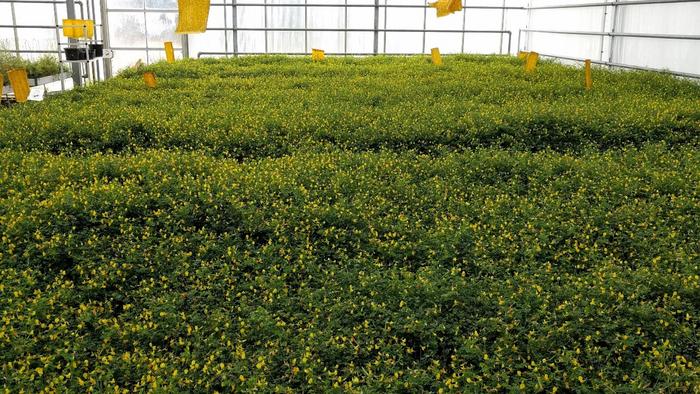
A genetic “off switch” that shuts down the process in which legume plants convert atmospheric nitrogen into nutrients has been identified for the first time by a team of international scientists.

Credit: Dugald Reid
A genetic “off switch” that shuts down the process in which legume plants convert atmospheric nitrogen into nutrients has been identified for the first time by a team of international scientists.
Legumes like beans, peas and lentils are unique among crops for their ability to interact with soil bacteria to convert or “fix” nitrogen into a usable form of nutrients. However, this energy-intensive biological process is reduced when nitrogen is already abundant in the soil either through natural processes or through the application of synthetic fertiliser.
The latest discovery of the genetic regulator that turns off nitrogen fixation when soil nitrate levels are high allowed scientists to remove the gene in model legumes, ensuring they continued to fix nitrogen regardless of the soil environment.
Increasing the biological ability of legumes to fix nitrogen could help increase crop growth and yield while also reducing the need for synthetic fertilisers, which contribute to agriculture’s environmental footprint.
The results of the research, which was carried out as part of the international Enabling Nutrient Symbioses in Agriculture (ENSA) project, were published in Nature.
“From an agricultural perspective, continued nitrogen fixation could be a beneficial trait that increases nitrogen availability, both for the legume and for future crops that rely on the nitrogen left behind in the soil after legumes are grown,” said lead author Dr Dugald Reid, La Trobe University lecturer and research group leader in La Trobe Institute for Sustainable Agriculture and Food (LISAF) and the Department of Animal Plant and Soil Science, and ENSA researcher.
“This helps lay the foundations for future research that provides new ways for us to manage our farming systems to reduce nitrogen fertiliser use, increase farm incomes and reduce the impact of nitrogen fertiliser use on the environment.”
The ENSA project is currently funded by Bill & Melinda Gates Agricultural Innovations (Gates Ag One), a non-profit organisation that invests in breakthrough agricultural research to meet the urgent and neglected needs of smallholder farmers in sub-Saharan Africa and South Asia.
The team discovered the regulator known as “Fixation Under Nitrate” (FUN) after screening 150,000 individual legume plants in which genes had been knocked out to identify how plants control the switch from nitrogen fixation to soil nitrogen uptake.
FUN, which is a type of gene known as a transcription factor and controls the levels of other genes, was found to be present in legumes regardless of whether it was active or inactive, and irrespective of nitrogen levels.
“As part of the study, we designed a genetic screen for thousands of plants in greenhouses to identify the genes that connect environmental triggers with biological signals,” said Dr Jieshun Lin, co-author of the paper and ENSA researcher.
“By increasing the nitrate levels available to the model legume, we were able to identify those with impaired nitrogen fixing regulation, and uncover the FUN mutant.”
The team then used a combination of biochemistry, gene expression studies and microscopy to find that FUN forms into long protein filaments when it is inactive.
This led to the secondary discovery that zinc levels play a role in triggering FUN to become active and shut down nitrogen fixation.
“We found that changing soil nitrogen alters the levels of zinc in the plant. Zinc had not previously been linked to the regulation of nitrogen fixation, but our study found that a change in zinc levels in turn activates FUN, which then controls a large number of genes that shut down nitrogen fixation,” said Dr Kasper Andersen, co-author and ENSA researcher.
“Removing FUN therefore creates a condition in which nitrogen fixation is no longer shut down by the plant.”
The study was led by scientists from La Trobe University, Australia and Aarhus University, Denmark and involved collaborations with the European Synchrotron Radiation Facility (ESRF), Centro de Biotecnología y Genómica de Plantas, Spain and Universidad Politécnica de Madrid (UPM).
The researchers are now investigating how common legume crops such as soybean and cowpea perform when they lose FUN activity.
MEDIA CONTACTS
Charisse Ede
La Trobe University
media@latrobe.edu.au
+61 404 030 698
Donna Bowater
Marchmont Communications
donna@marchmontcomms.com
+61 434 634 099
Journal
Nature
Method of Research
Randomized controlled/clinical trial
Subject of Research
Not applicable
Article Title
Zinc mediates control of nitrogen fixation via transcription factor filamentation
Article Publication Date
26-Jun-2024
COI Statement
Aarhus University has filed US provisional patent application 63/483,248
authored by J.L., P.K.B., J.S., K.R.A. and D.R. on use of the FUN gene and downstream targets to
improve nitrogen fixation in legumes. The other authors declare no competing interests.
Cite Scienmag News
Juliet Wilcox. (June 26, 2024). Scientists discover genetic ‘off switch’ in legume plants that limits biological ability to source nutrients. Scienmag. https://scienmag.com/scientists-discover-genetic-off-switch-in-legume-plants-that-limits-biological-ability-to-source-nutrients/
Juliet Wilcox. "Scientists discover genetic ‘off switch’ in legume plants that limits biological ability to source nutrients." Scienmag, 26 June 2024, https://scienmag.com/scientists-discover-genetic-off-switch-in-legume-plants-that-limits-biological-ability-to-source-nutrients/. Accessed 4 September 2026.
Juliet Wilcox. "Scientists discover genetic ‘off switch’ in legume plants that limits biological ability to source nutrients." Scienmag. June 26, 2024. https://scienmag.com/scientists-discover-genetic-off-switch-in-legume-plants-that-limits-biological-ability-to-source-nutrients/

