


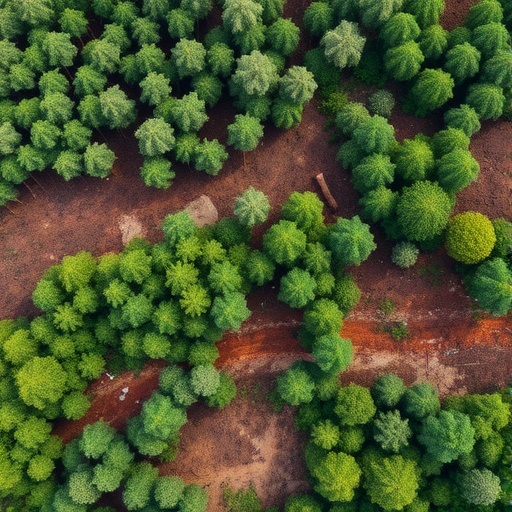
Timber harvesting may leave a forest standing while quietly damaging the plants needed to keep it alive. A new study from Nepal shows that tree felling and the movement of harvested logs affect different layers of the forest, with seedlings suffering particularly serious injuries along extraction routes. The findings suggest that relatively simple changes in logging practices could protect natural regeneration and reduce the long-term ecological cost of timber production.
The research focused on Sal forests dominated by Shorea robusta, a major tree species across Nepal and South Asia. Sal provides construction timber, fuelwood, wildlife habitat, carbon storage, and income for forest-dependent communities. Because the species is central to both local economies and forest structure, damage to young Sal plants can have consequences decades after a logging operation has ended. Seedlings that are bent, crushed, or uprooted may never develop into the mature trees required to replace harvested individuals.
Researchers carried out field assessments in the Saraswati Community Forest and Belakatari National Forest in Udayapur district. They examined two main sources of disturbance: the felling of selected trees and the extraction of logs after cutting. Around trees chosen for harvest, the team established 30 circular plots, while another 30 transects were placed along timber extraction routes. Vegetation was inspected before harvesting began, allowing the researchers to distinguish injuries caused by the current operation from damage that already existed.
The results revealed a strong contrast between the two stages of logging. Among damaged seedlings, timber extraction was associated with 45.41 percent of recorded injuries, slightly more than felling, which accounted for 43.35 percent. Other human activities contributed the remaining 11.24 percent. For residual mature trees—the living trees left standing after harvesting—the pattern was reversed. Felling caused 58.06 percent of observed damage, while extraction accounted for 22.58 percent.
Seedlings were most often bent down, struck at the stem, or pulled from the ground. During felling, 44.4 percent of damaged seedlings were bent, 38.4 percent suffered stem damage, and 17.2 percent were uprooted. Along extraction routes, bending was again the most common injury, accounting for 47.1 percent of cases, followed by stem damage at 29.6 percent and uprooting at 23.3 percent. These injuries may appear less dramatic than the loss of a mature tree, but they can remove the next generation of the forest before it has a chance to establish.
The remaining mature trees experienced a different kind of impact. During felling, crown damage represented 61.1 percent of recorded injuries, likely because falling trunks and branches collided with the canopies of neighboring trees. During log extraction, however, 71.4 percent of damaged trees suffered injuries around the butt end, the lower portion of the trunk. Dragged logs, cables, and machinery can strike standing trees at this height, creating wounds that may invite fungal infections, insects, and decay.
Severity measurements added another warning. Although most injuries to residual trees were classified as low severity, 53.4 percent of damaged seedlings along extraction routes experienced medium- or high-severity damage. This indicates that the movement of timber through the forest may be especially disruptive to regeneration, even when the surviving mature canopy appears largely intact. A forest can therefore look healthy from a distance while losing a substantial portion of its future tree population at ground level.
The researchers say the damage is not inevitable. Before harvesting begins, managers can map dense patches of regeneration and design extraction trails around them. Directional felling can guide trees toward existing gaps rather than neighboring crowns or seedling clusters. Machinery should remain on designated routes, while winches can be used to pull logs toward those routes instead of dragging them across broad areas of vegetation. Training operators to recognize vulnerable plants and plan each movement could substantially reduce avoidable injuries without eliminating timber production.
The study also recommends that Nepal’s forest management systems include routine records of post-harvest damage. Community forest user groups and government agencies could use these observations to compare harvesting methods, identify high-risk locations, and modify future plans. Protecting residual plants is more than a conservation gesture: seedlings and surviving trees determine future forest structure, productivity, carbon storage, biodiversity, and resilience. By treating regeneration as a central harvesting priority, reduced-impact logging could help Sal forests continue supplying timber and ecological benefits long after the current harvest is complete.
News Publication Date: 20-May-2026
Web References: https://doi.org/10.48130/aee-0026-0012; Agricultural Ecology and Environment
References: Dhungel N, Joshi R, Gautam J, Prabhakar A, Adhikari S, et al. 2026. “Damage to residual plants during felling and timber extraction on Sal (Shorea robusta Gaertn. f.) dominant forest in Nepal.” Agricultural Ecology and Environment 2: e015. DOI: 10.48130/aee-0026-0012
Cite Scienmag News
Alan Morgan. (July 31, 2026). Nepal’s Sal forests show distinct damage patterns from logging operations. Scienmag. https://scienmag.com/nepals-sal-forests-show-distinct-damage-patterns-from-logging-operations/
Alan Morgan. "Nepal’s Sal forests show distinct damage patterns from logging operations." Scienmag, 31 July 2026, https://scienmag.com/nepals-sal-forests-show-distinct-damage-patterns-from-logging-operations/. Accessed 4 September 2026.
Alan Morgan. "Nepal’s Sal forests show distinct damage patterns from logging operations." Scienmag. July 31, 2026. https://scienmag.com/nepals-sal-forests-show-distinct-damage-patterns-from-logging-operations/


