


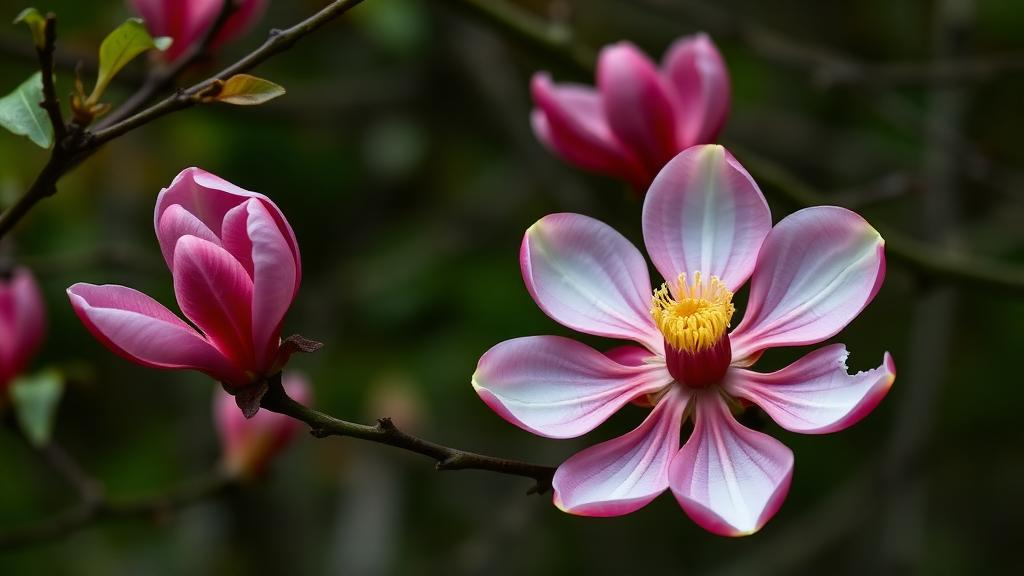
In the misty mountains of Wufeng County in China’s Hubei Province grows a tree so striking that botanists could hardly believe it had escaped scientific description for so long. Magnolia wufengensis, a newly discovered member of the ancient Magnoliaceae family, produces flowers of an unusual deep red, wrapped in a fragrance that has made it a prized ornamental species. Yet until now, almost nothing was known about the genetic machinery behind its most captivating traits. A team of Chinese researchers has changed that, publishing a chromosome-scale, haplotype-resolved genome assembly in BMC Plant Biology that opens the door to understanding, conserving, and ultimately breeding this remarkable tree.
The scale of the achievement is considerable. The team assembled a genome of 11.98 gigabases, one of the larger plant genomes sequenced to this level of quality, and organized it into 114 pseudochromosomes. That number alone tells a story: rather than the simple paired chromosomes of most familiar organisms, M. wufengensis is a hexaploid, carrying six complete sets of chromosomes. Resolving such a genome is a formidable technical challenge, because the six copies of each chromosome are similar enough to confuse assembly algorithms but different enough to matter biologically. The researchers overcame this by using high-fidelity long-read sequencing combined with chromatin conformation capture, producing what is known as a haplotype-resolved assembly, in which each of the six chromosome sets is reconstructed separately rather than collapsed into a single blended sequence.
Quality control metrics reported with the assembly suggest it meets the standards now expected of flagship plant genomes. The team verified genome size independently by flow cytometry, confirmed the karyotype, and assessed completeness using BUSCO analysis for both the haploid and the full hexaploid representations. A high long terminal repeat index indicates that the repetitive elements that litter large plant genomes were correctly resolved rather than fragmented. These details matter because a genome that is incomplete or misassembled can mislead every downstream analysis, from gene annotation to evolutionary inference. With this foundation in place, the researchers could begin asking the questions that make the genome scientifically valuable.
One of the most intriguing findings concerns the timing of the hexaploid event. Genome duplication analysis indicates that the whole-genome multiplication that made M. wufengensis hexaploid occurred approximately 6.8 million years ago, and, notably, after the species had already diverged from its closest relative, M. sieboldii. This ordering is significant for evolutionary biology. It means the polyploidy is not an ancient event shared across the lineage but a relatively recent innovation specific to this branch, one that may have shaped the species’ unique characteristics. Polyploidy is a major force in plant evolution, often associated with increased vigor, ecological flexibility, and the ability to colonize challenging environments, and dating these events precisely helps reconstruct how plant diversity has been generated.
Gene family analysis added another layer to the story. The researchers identified genes that are specific to M. wufengensis or expanded in number compared with related species, and their functions point to adaptations that could help explain the tree’s survival strategy. Enriched categories include genes involved in ultraviolet tolerance, chromosome maintenance, and cell regeneration. For a tree whose mountain habitat exposes it to intense high-altitude sunlight, enhanced ultraviolet tolerance is an intuitively plausible advantage. Expanded chromosome maintenance machinery may also reflect the cellular demands of managing a massive six-copy genome, in which DNA repair and segregation must operate reliably across 114 chromosomes in every dividing cell.
The red flowers that make the species famous were the next target. By combining gene expression profiling with metabolite assays across flowers of three different colors, the team narrowed the chemical basis of pigmentation to four anthocyanin-related compounds. Anthocyanins are the water-soluble pigments responsible for red, purple, and blue hues across the plant kingdom, and their exact chemical modifications determine the precise shade a petal displays. Among the candidate compounds identified were cyanidin-3-O-rutinoside, peonidin-3-O-glucoside, peonidin-3-O-(caffeoyl) rhamnoside, and a more elaborate delphinidin derivative, delphinidin-3-O-(6”-O-coumaroyl) rhamnoside-5-O-galactoside. Together, these four molecules emerged as the key determinants of flower color in the species.
To find the enzyme that builds them, the researchers turned to a gene annotated as Mwu49047, which encodes an anthocyanin UDP-glycosyltransferase, an enzyme family that decorates anthocyanin backbones with sugar groups, stabilizing the pigment and tuning its color. Enzyme assays revealed that Mwu49047 is unusually versatile: it accepts both cyanidin and delphinidin as substrates, two anthocyanin types that normally require distinct enzymes, yet it acts with strict regiospecificity, attaching sugars exclusively at the 3-OH position of the molecule. This combination of substrate promiscuity and positional precision is a fascinating enzymatic property, suggesting that a single gene could contribute to multiple pigment pathways simultaneously, a possible evolutionary shortcut in the construction of the species’ distinctive palette.
Fragrance proved to be an equally tractable puzzle. By measuring volatile metabolites across four different tissues and integrating the results with gene expression data, the team identified the major components of the floral scent as cis-farnesene, (E)-2-octenal, and nonanal. Farnesene is a sesquiterpene common in the perfumes of many flowers and fruits, while the two aldehydes contribute green, waxy notes characteristic of fresh floral bouquets. Using co-expression network analysis, the researchers went further and pinpointed a specific co-expression module whose member genes are implicated as regulators of the two aldehydes, providing a starting point for understanding how the tree coordinates the emission of its scent compounds.
The practical implications extend well beyond curiosity. M. wufengensis is a recently discovered species with significant ecological and ornamental value, and the lack of genomic resources had been a genuine obstacle to both its conservation and its use in horticulture. A reference genome of this quality enables breeders to trace the genes underlying flower color and fragrance through crossing programs, allows conservation geneticists to assess diversity across wild populations, and gives evolutionary biologists a new reference point for studying polyploidy in one of the world’s most ancient flowering plant families. Magnolias occupied the forests of the age of dinosaurs, pollinated by beetles before bees existed, and every high-quality genome from this lineage adds a page to the record of how flowering plants came to dominate the planet.
The study also demonstrates how far plant genomics has moved in a few years. Assembling an 11.98-gigabase hexaploid genome with each haplotype resolved would have been near-impossible a decade ago; today it is achievable by a team combining university laboratories with a local biotechnology company, supported by provincial and national funding programs in China. The work, led by researchers at Hubei University of Chinese Medicine together with colleagues at Huazhong Agricultural University and partners in Wufeng County, was conducted with permission from the local forestry administration and in compliance with national regulations for sampling. As sequencing technology continues to fall in cost, genomes of this caliber can be expected for an increasing share of the world’s rare and charismatic plants, many of which, like the red-flowered magnolia of Wufeng, hold their secrets in six copies of every chromosome.
Subject of Research: Haplotype-resolved genome assembly and flower color and fragrance biosynthesis in the hexaploid Magnolia wufengensis
Article Title: The haplotype-resolved, chromosome-scale genome assembly of the hexaploid Magnolia wufengensis provides valuable insights into genome evolution and the biosynthesis genes for flower color and fragrance
Article References: Du, Z., Zhang, M., Xu, L., Wang, X., Yao, Y., Liu, J., Chen, C., Meng, Y., Ye, L., Wang, N., & Shi, Z. (2026). The haplotype-resolved, chromosome-scale genome assembly of the hexaploid Magnolia wufengensis provides valuable insights into genome evolution and the biosynthesis genes for flower color and fragrance. BMC Plant Biology. https://doi.org/10.1186/s12870-026-10057-z
Image Credits: AI Generated
DOI: 10.1186/s12870-026-10057-z
Keywords: Magnolia wufengensis, genome assembly, hexaploid, haplotype-resolved, anthocyanin, flower color, floral fragrance, UDP-glycosyltransferase, polyploidy, plant genomics, volatile compounds, BMC Plant Biology
Cite Scienmag News
Juliet Wilcox. (October 2, 2026). Scientists Decode the Giant Genome of a Rare Red-Flowered Magnolia. Scienmag. https://scienmag.com/scientists-decode-the-giant-genome-of-a-rare-red-flowered-magnolia/
Juliet Wilcox. "Scientists Decode the Giant Genome of a Rare Red-Flowered Magnolia." Scienmag, 2 October 2026, https://scienmag.com/scientists-decode-the-giant-genome-of-a-rare-red-flowered-magnolia/. Accessed 4 October 2026.
Juliet Wilcox. "Scientists Decode the Giant Genome of a Rare Red-Flowered Magnolia." Scienmag. October 2, 2026. https://scienmag.com/scientists-decode-the-giant-genome-of-a-rare-red-flowered-magnolia/


