


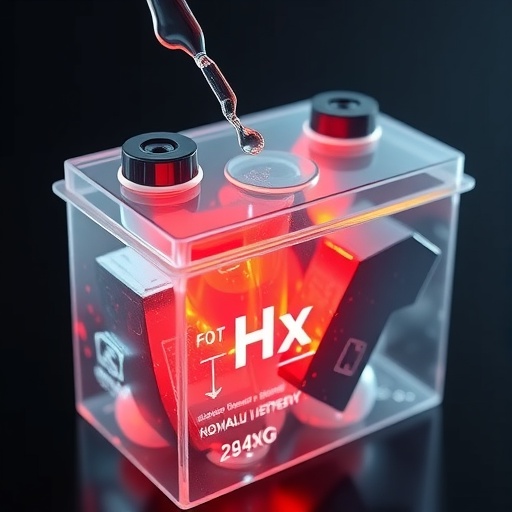
In a groundbreaking development poised to transform plastic waste management and energy generation, researchers at the University of Cambridge have unveiled an innovative solar-powered reactor that employs recovered car battery acid to break down notoriously difficult-to-recycle plastics. This pioneering approach, detailed in the latest issue of the journal Joule, promises a dual environmental benefit: converting plastic waste into clean hydrogen fuel and generating valuable chemical compounds, all powered by sunlight.
The novel technology centers on what the team terms “solar-powered acid photoreforming,” a process that leverages a specially engineered photocatalyst capable of operating in highly acidic conditions. Until now, acids—especially those as corrosive as sulfuric acid found in car batteries—posed a formidable challenge to photoreforming systems because conventional catalysts would quickly degrade, making the process impractical. This breakthrough allows the researchers not only to harness the chemical potency of used battery acid but also catalyze the depolymerization of plastic polymers as part of the reaction mechanism.
Global plastic production exceeds 400 million tonnes annually, yet a mere 18% undergoes recycling. The vast majority is incinerated, relegated to landfills, or escapes into natural ecosystems, contributing to pervasive pollution. The Cambridge team’s method addresses critical bottlenecks in plastic recycling by converting mixed and contaminated plastics—including polyethylene terephthalate (PET), nylon textiles, and polyurethane foams—into feedstocks for sustainable hydrogen fuel production. This capability represents a significant leap from current upcycling technologies, which often only process purified polymer streams.
Key to the process is the repurposing of sulfuric acid from spent car batteries. Traditionally, the acid in these batteries, which constitute 20-40% of battery volume, is neutralized and discarded as hazardous waste after lead extraction. By integrating this acid directly into the reactor, the process closes an important industrial loop—one waste product becomes the catalyst for transforming another. This circular approach not only reduces environmental burdens associated with acid neutralization but also enhances the economics of hydrogen production and chemical recovery.
The heart of the innovation lies in the robust photocatalyst developed by PhD candidate Kay Kwarteng and the research team led by Professor Erwin Reisner. Their catalyst endures the acidic environment, defying prior assumptions that photoreforming would be unfeasible under such corrosive conditions. This material selectively facilitates the cleavage of polymer bonds, converting complex plastic waste into simpler chemical building blocks such as ethylene glycol.
When exposed to sunlight, these breakdown products undergo further transformation into hydrogen gas—an increasingly important clean fuel—and acetic acid, a widely used industrial chemical best known as the main component of vinegar. Laboratory experiments demonstrate impressive longevity, with the reactor sustaining catalytic activity for over 260 hours without performance degradation. Hydrogen yields remain high, and acetic acid production exhibits remarkable selectivity, underscoring the system’s potential scalability.
Integrating sunlight as the primary energy input seamlessly aligns this technology with global sustainability goals. Utilizing solar irradiation reduces reliance on fossil fuels and circumvents the high energy costs associated with traditional thermal or chemical recycling processes. Moreover, the ability to operate with real-world battery acid and diverse plastic feedstocks indicates strong potential for industrial adaptation.
Despite these promising results, the researchers acknowledge engineering challenges ahead. Materials and reactor designs must evolve to withstand continuous operation in acidic conditions at scale. However, the team notes that industries handling hazardous acids have decades of experience with containment and safety protocols, suggesting that these obstacles are surmountable with targeted investment and design innovation.
This approach is not presented as a panacea for the global plastic pollution crisis but rather as a complementary technology to existing recycling infrastructures. In particular, it could address streams of contaminated or mixed plastics that currently lack economical recycling options, thus diverting more waste from landfills and natural environments.
The cost-effectiveness of solar-powered acid photoreforming also sets it apart. By reutilizing acid and achieving higher hydrogen production rates, the method offers an order-of-magnitude reduction in costs compared to other photoreforming techniques. This economic advantage could accelerate the adoption of solar-driven plastic upcycling technologies in regions grappling with both waste management and energy scarcity.
“This discovery emerged unexpectedly,” reflects Professor Reisner. “We had believed acidic environments would irreversibly damage solar catalysts. Overcoming this limitation opens new avenues for sustainable chemical transformations powered purely by sunlight.” Kay Kwarteng adds, “Harnessing battery acid, a widely available yet underutilized resource, to convert plastic waste into valuable products is a compelling example of circular economy principles in action.”
Building on their initial successes, the research team is collaborating with Cambridge Enterprise and supported by UKRI Impact Acceleration and other funding bodies to commercialize the technology. Their vision encompasses scalable, resilient reactors capable of continuous operation, potentially transforming waste management and clean energy sectors.
As nations worldwide seek innovative solutions to environmental and energy challenges, this solar-powered acid photoreforming technology emerges as a beacon of scientific ingenuity, demonstrating how waste streams can be reimagined as resources in a sustainable future.
News Publication Date: 6-Apr-2026
Web References: 10.1016/j.joule.2026.102347
Keywords
Plastics, Polymer engineering, Recycling, Batteries, Solar fuels, Fuel, Hydrogen fuel, Sustainability, Sustainable energy
Cite Scienmag News
Faith Mcneil. (April 6, 2026). Scientists Convert Used Car Battery Acid and Plastic Waste into Clean Hydrogen Fuel. Scienmag. https://scienmag.com/scientists-convert-used-car-battery-acid-and-plastic-waste-into-clean-hydrogen-fuel/
Faith Mcneil. "Scientists Convert Used Car Battery Acid and Plastic Waste into Clean Hydrogen Fuel." Scienmag, 6 April 2026, https://scienmag.com/scientists-convert-used-car-battery-acid-and-plastic-waste-into-clean-hydrogen-fuel/. Accessed 3 September 2026.
Faith Mcneil. "Scientists Convert Used Car Battery Acid and Plastic Waste into Clean Hydrogen Fuel." Scienmag. April 6, 2026. https://scienmag.com/scientists-convert-used-car-battery-acid-and-plastic-waste-into-clean-hydrogen-fuel/


