


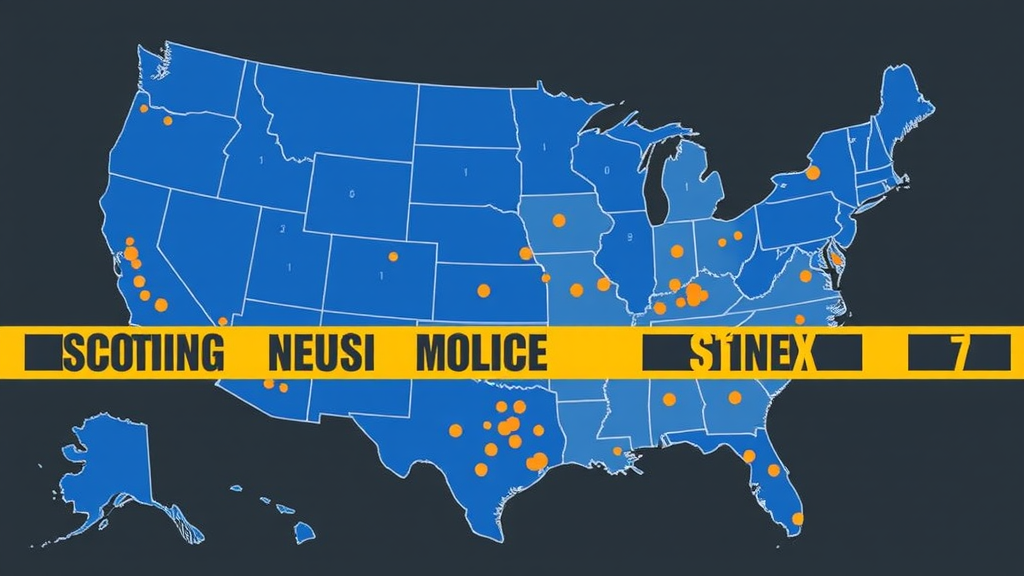
Can the locations of future mass shootings be anticipated before they occur? A new study published in PNAS Nexus suggests that, at least at a geographic scale, they can be modeled with meaningful accuracy. Mohammad R.K. Mofrad and colleagues developed an agent-based model of mass shootings embedded within a Bayesian inference framework, treating each potential event as the product of three converging conditions: the emergence of a motivated potential perpetrator, access to firearms, and the presence of a suitable target population. Rather than treating shootings as random, unpredictable tragedies, the model represents them as the outcome of interacting social and structural processes that can be quantified, calibrated against historical data, and projected forward. The approach marks a shift from purely descriptive statistics toward mechanistic simulation, in which the underlying drivers of violence are modeled explicitly and their relative contributions estimated from data.
The first component of the model concerns the emergence of potential perpetrators. Using demographic data drawn from the U.S. Census, the researchers estimated a per-capita rate at which motivated individuals arise in a given population, and this rate was estimated jointly with the other model parameters rather than fixed in advance. This joint estimation is a key strength of the Bayesian approach: uncertainty in one parameter, such as perpetrator emergence, can be constrained by observations that also bear on other parameters, such as firearm availability or population structure. By allowing all parameters to be inferred simultaneously from the historical record of events, the framework avoids the pitfalls of chaining together independently derived estimates and produces a coherent probabilistic picture of shooting risk across the United States.
The second component, access to firearms, proved to be the dominant predictor of risk in the model. Because comprehensive data on private gun ownership are difficult to obtain, the researchers used the local density of Federal Firearms License (FFL) holders as a proxy for firearm availability. This proxy emerged from the calibration as the single most influential factor shaping the geographic distribution of expected shootings, outweighing the contributions of population density alone or the estimated rate of perpetrator emergence. In practical terms, the model implies that the availability of a firearm may function as an important limiting factor in mass shooting risk: where guns are more accessible, the probability that a motivated individual can translate intent into a high-fatality event rises substantially, holding other conditions constant.
The third component captures the presence of suitable target populations, reflecting the observation that mass shootings typically occur in places where potential victims gather, such as schools, workplaces, retail spaces, and public venues. By combining these three ingredients within an agent-based architecture, the simulation generates stochastic realizations of shooting risk across counties, producing not just a single point estimate but a distribution of plausible outcomes. This probabilistic character is central to the study’s forecasting ambitions. Just as epidemic models produce ranges of possible outbreak trajectories rather than deterministic predictions, the shooting model yields expected event counts and their uncertainty, allowing researchers and policymakers to reason about risk in a statistically disciplined way.
To test the model, the authors compared its predictions against mass shooting events recorded in the Mother Jones database covering 1982 through 2024. This widely used database includes approximately 160 events with three or more fatalities, excluding the perpetrator, and deliberately excludes incidents categorized as terrorism, gang-related violence, or domestic disputes. The exclusion criteria matter: they define a specific and arguably more preventable class of public mass shootings, distinct from forms of gun violence with different underlying dynamics. The researchers found that the models assigned higher risks of shootings precisely to areas where shootings had historically occurred, demonstrating that the framework can discriminate between geographic areas with genuinely different levels of risk rather than merely reproducing population counts.
Beyond retrospective validation, the calibrated model identifies the areas facing the greatest expected burden in the coming years. The ten highest-risk areas by expected events per decade are Maricopa County, Arizona; Harris County, Texas; Dallas County, Texas; Los Angeles County, California; Kings County, New York; Clark County, Nevada; Orange County, California; Queens County, New York; Cook County, Illinois; and Philadelphia County, Pennsylvania. The list spans large metropolitan counties across the Sun Belt, the coasts, and the industrial Midwest, and reflects the combined influence of substantial populations, dense networks of firearm dealers, and the urban characteristics that concentrate suitable targets. Notably, several of these counties also rank among the most populous in the nation, but the model’s ranking is not a simple population map; the dominance of FFL density as a predictor reshapes the geography of expected risk in ways that pure demographic extrapolation would not.
According to the authors, agent-based models of this kind can outperform standard statistical baselines in identifying areas at elevated risk. The improvement arises from the models’ structural realism: instead of fitting a regression to correlate inputs with outcomes, the simulation encodes a causal narrative, a motivated perpetrator meeting a firearm and a target population, and lets the data determine how strongly each element drives observed events. When the fitted mechanism reproduces historical patterns better than atheoretical alternatives, confidence grows that the model captures something real about the process, not merely a statistical coincidence. That realism also makes the framework adaptable; as new data arrive or as policy environments change, parameters can be re-inferred and projections updated within the same Bayesian machinery.
The potential applications extend to the allocation of prevention resources. If the geographic distribution of risk can be estimated with quantified uncertainty, interventions such as threat assessment programs, community-based violence prevention, extreme risk protection orders, and law enforcement preparedness could, in principle, be targeted toward the communities where expected benefits are largest. The model’s emphasis on firearm access as the dominant predictor also speaks directly to ongoing policy debates. If access to a firearm is an important limiting factor in whether mass shootings occur, then measures that reduce availability in high-risk areas, or that introduce friction into the acquisition process, may carry disproportionate preventive value relative to interventions focused solely on identifying perpetrators in advance, a task that remains notoriously difficult given the rarity and unpredictability of individual events.
The study also carries important caveats and a broader scientific significance. An agent-based model calibrated on roughly 160 events over four decades cannot predict when or where any specific attack will happen, and the use of FFL density as a proxy for gun availability introduces measurement uncertainty that the Bayesian framework represents but cannot eliminate. Mass shootings are rare, socially complex events shaped by factors, including mental health, social contagion, media dynamics, and economic conditions, that no single model fully captures. Yet the value of the work lies in demonstrating that even deeply troubling social phenomena can be brought within the reach of formal, mechanistic, data-constrained science. By combining agent-based simulation with Bayesian calibration, the researchers offer a template for rigorously reasoning about rare violent events, and a tool that, its authors argue, may help direct scarce prevention resources toward the places where they can do the most good.
Subject of Research: Bayesian agent-based modeling of the geographic risk and potential severity of mass shootings in the United States
Article Title: Forecasting mass shootings
Article References: Forecasting mass shootings. (n.d.). Original publication
Image Credits: AI Generated
DOI: Not provided
Keywords: mass shootings, agent-based modeling, Bayesian inference, firearm availability, geographic risk, PNAS Nexus, gun violence prevention, Federal Firearms License, Mother Jones database, risk forecasting, public health, United States
Cite Scienmag News
Courtney Benton. (September 22, 2026). Scientists Build Bayesian Model to Forecast Where Mass Shootings May Strike Next. Scienmag. https://scienmag.com/scientists-build-bayesian-model-to-forecast-where-mass-shootings-may-strike-next/
Courtney Benton. "Scientists Build Bayesian Model to Forecast Where Mass Shootings May Strike Next." Scienmag, 22 September 2026, https://scienmag.com/scientists-build-bayesian-model-to-forecast-where-mass-shootings-may-strike-next/. Accessed 5 October 2026.
Courtney Benton. "Scientists Build Bayesian Model to Forecast Where Mass Shootings May Strike Next." Scienmag. September 22, 2026. https://scienmag.com/scientists-build-bayesian-model-to-forecast-where-mass-shootings-may-strike-next/


