


A major obstacle for net zero technologies in combatting climate change is bridging the gap between fundamental research and its application in the real world.

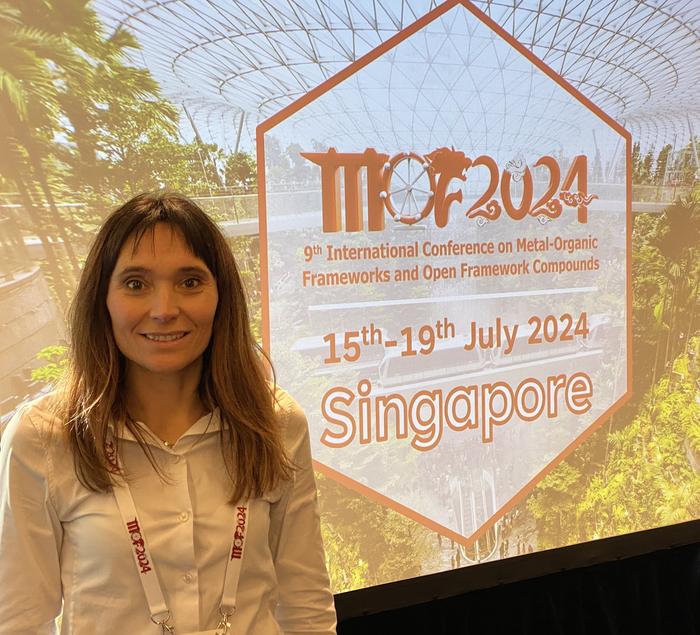
Credit: Heriot-Watt University
A major obstacle for net zero technologies in combatting climate change is bridging the gap between fundamental research and its application in the real world.
This gap, sometimes referred to as ‘the valley of death’, is common in the field of carbon capture, where novel materials are used to remove carbon dioxide from flue gasses produced by industrial processes. This prevents carbon from entering the atmosphere, helping to mitigate the effects of climate change.
Chemists have proposed and synthesised thousands of novel materials, such as metal-organic frameworks, with the specific purpose of capturing as much carbon dioxide as possible. But while results may look promising in a lab setting, it is difficult to know how effective these materials will perform in actual scenarios. As a result, chances are slim that any will ever cross the valley of death.
Now, a team of scientists from Heriot-Watt University is behind a pioneering platform named PrISMa (Process-Informed design of tailor-made Sorbent Materials) which uses advanced simulations and machine learning to find the most cost-effective and sustainable material-capture process combinations prior to implementation.
The platform and its associated research have been published today (July 17) in the internationally renowned journal, Nature.
Professor Susana Garcia led the study and is the project coordinator for PrISMa. She is also the Associate Director of Carbon Capture, Utilisation and Storage (CCUS) at the Research Centre for Carbon Solutions (RCCS) at Heriot-Watt University in Edinburgh, Scotland.
She explains: “Over the past decade, there has been a huge amount of effort devoted to identifying promising materials capable of capturing CO2.
“Chemists have proposed thousands of novel porous materials, but we did not have the tools to quickly evaluate if any materials are promising for a carbon capture process. Evaluating such materials requires a lot of experimental data and detailed knowledge of the capture process. And a careful evaluation of the economics and life-cycle assessment of the process.
“We cannot expect chemists to have all that knowledge. Here is where PrISMa can make a huge difference. The PrISMa platform is a modelling tool that integrates different aspects of carbon capture, including materials, process design, economic analysis, and life cycle assessment. We use quantum chemistry, molecular simulation, and Machine Learning to predict, for new materials, all the data that is needed to design a process. Alternatively, we can use the experimental data from materials synthesised in a lab. The platform then evaluated their performance in over 60 different case studies from around the world.”
Professor Garcia continues: “This innovative approach accelerates the discovery of top-performing materials for carbon capture, surpassing traditional trial-and-error methods. The platform can also inform the different stakeholders by providing engineers with options to identify economically and environmentally challenging factors in the design phase of optimal capture technologies, molecular design targets for chemists and environmental hotspots for materials, local integration benefits for CO2 producers, and the best locations for investors.”
PrISMa is already yielding impressive results with the platform having been used to accurately simulate the implementation of carbon capture technologies in cement plants located in different regions of the world. It found suitable materials for each location, cutting costs by half when compared with previous technologies.
PrISMa also offers an interactive tool that allows users to explore the potential of over 1,200 materials for carbon capture applications.
“Identifying more top-performing carbon capture materials increases the likelihood of advancing some of them to the next Technological Readiness Level,” continues Professor Garcia.
Fergus Mcilwaine, a PhD student leading the Machine Learning activities in Professor Garcia’s team, added: ” Screening such a large number of materials requires huge amounts of computational time. We developed a Machine Learning model that significantly accelerates this process, allowing us to discover cost-effective materials from enormous chemical design spaces.”
PrISMa has been led by Heriot-Watt University in partnership with scientists from the Swiss Federal Institute of Technology Lausanne (EPFL) and ETH Zurich, Lawrence Berkeley National Laboratory and the University of California Berkeley in the US, and the Institut des Matériaux Poreux de Paris in France. The project has received funding from the ACT Programme, the Grantham Foundation for the Protection of the Environment and the Industrial Decarbonisation Research and Innovation Centre (IDRIC).
Professor Garcia concluded: “This study highlights the need to follow a holistic approach when evaluating technologies to achieve our net-zero targets. The platform speeds up materials discovery for carbon capture applications and focuses Research and Development efforts towards achievable performance targets at scale.
“The tool can help tremendously our current industrial decarbonisation efforts. It can play a key role in informing investment strategies and policy decisions on more sustainable and cost-effective carbon-capture solutions.”
Journal
Nature
Article Title
A holistic platform for accelerating sorbent-based carbon capture
Article Publication Date
17-Jul-2024
Cite Scienmag News
Sloane Callahan. (July 17, 2024). Scientists bridge the ‘valley of death’ for carbon capture technologies. Scienmag. https://scienmag.com/scientists-bridge-the-valley-of-death-for-carbon-capture-technologies/
Sloane Callahan. "Scientists bridge the ‘valley of death’ for carbon capture technologies." Scienmag, 17 July 2024, https://scienmag.com/scientists-bridge-the-valley-of-death-for-carbon-capture-technologies/. Accessed 4 September 2026.
Sloane Callahan. "Scientists bridge the ‘valley of death’ for carbon capture technologies." Scienmag. July 17, 2024. https://scienmag.com/scientists-bridge-the-valley-of-death-for-carbon-capture-technologies/

