

Monday, August 3, 2026
Science
No Result
View All Result
  • Login
  • HOME
  • SCIENCE NEWS
  • CONTACT US
  • HOME
  • SCIENCE NEWS
  • CONTACT US
No Result
View All Result
Scienmag
No Result
View All Result
Home Science News Technology and Engineering

Scaling Language Models Enhances Protein Fitness Predictions

July 13, 2026
in Technology and Engineering
Reading Time: 2 mins read
0
Scaling Language Models Enhances Protein Fitness Predictions

Scaling Language Models Enhances Protein Fitness Predictions

65
SHARES
587
VIEWS
Share on FacebookShare on Twitter
ADVERTISEMENT

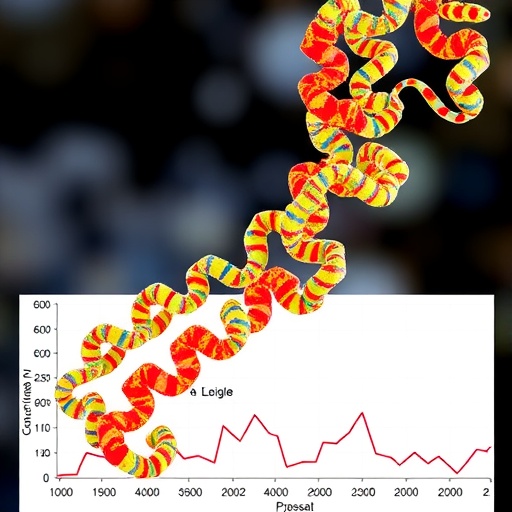
In recent years, protein language models have emerged as powerful tools for predicting the fitness landscape of proteins, a critical step in guiding mutation effect prediction and protein design. These models estimate the likelihood of a given amino acid sequence, denoted as p(sequence), which serves as a proxy for how evolutionarily viable and functional a protein is. Conventional wisdom in the deep learning community holds that larger models, trained on more extensive datasets, consistently yield better performance across tasks. However, new research challenges this assumption in the context of protein fitness prediction.

Hou et al. have uncovered a surprising phenomenon: beyond a certain scale, enlarging protein language models actually diminishes their predictive accuracy for protein fitness. The team’s study reveals that model size, the nature of the training dataset, and inherent stochastic elements introduce systematic biases in how these models estimate p(sequence). This bias drives the predicted likelihood values away from the true biological fitness landscape, undermining the utility of these models when scaled up indiscriminately.

The key insight is that effective protein fitness prediction hinges not simply on achieving the highest sequence likelihood but on how well these likelihoods capture evolutionary constraints observed in homologous sequences—proteins related by descent that share structural and functional traits. Optimal performance arises when p(sequence) aligns at a moderate level. When the predicted wild-type sequence likelihood skews too high or too low, the model tends to assign uniformly extreme likelihoods to nearly all mutations. This phenomenon obscures the nuanced variations in mutation fitness critical for real-world applications.

Interestingly, larger protein language models tend to produce higher predicted sequence likelihoods overall. This shift pushes the prediction out of the moderate range where the best alignment with evolutionary biology occurs, resulting in poorer fitness predictions. Thus, model scaling does not guarantee improved understanding of protein function and may even degrade the model’s practical performance.

These findings offer crucial clarification for the burgeoning field of protein language modeling. They emphasize the importance of balancing model complexity with biologically relevant calibration of likelihood estimates, rather than simply maximizing data and parameter count. The study suggests practical guidelines for future model development and application, cautioning researchers against uncritically pursuing larger model sizes without considering their impact on biological interpretability.

Beyond just identifying scaling pitfalls, the research opens new avenues for designing language models tailored specifically for protein biology. Adjusting training procedures, incorporating homologous sequence data more effectively, and controlling likelihood calibration could produce models that better reflect the complex fitness landscapes that govern protein evolution.

In summary, the work of Hou and colleagues challenges the deep learning dogma that bigger is always better, at least in the realm of protein fitness prediction. Their nuanced analysis paves the way for more sophisticated, biologically informed machine learning approaches that can unlock the full potential of computational protein engineering.

Subject of Research: Protein language model scaling and fitness prediction

Article Title: Understanding language model scaling for protein fitness prediction

Article References:
Hou, C., Liu, D., Zafar, A. et al. Understanding language model scaling for protein fitness prediction. Nat Comput Sci (2026). https://doi.org/10.1038/s43588-026-01010-z

DOI: https://doi.org/10.1038/s43588-026-01010-z

Tags: biases in language modelsbiological fitness landscape modelingdeep learning in biologyevolutionary constraints in proteinslarge-scale protein datasetsmodel size and predictive accuracymutation effect predictionprotein designprotein fitness predictionprotein language modelsscaling effects on protein modelsstochastic elements in machine learning
Share26Tweet16
Previous Post

A Call for Advancing Sustainability in Robotics Technology

Next Post

Machine Learning Supports Dementia Caregivers in Managing Behavioral Symptoms

Related Posts

KAIST AI Generates Feasible Delivery, Production, and Workforce Schedules
Technology and Engineering

KAIST AI Generates Feasible Delivery, Production, and Workforce Schedules

August 3, 2026
Bentham Science Launches International Journal of Wireless and Communication Engineering Innovation
Technology and Engineering

Bentham Science Launches International Journal of Wireless and Communication Engineering Innovation

August 2, 2026
What Long-Term Evidence Reveals About Hypoglycemia in Late-Preterm Infants
Technology and Engineering

What Long-Term Evidence Reveals About Hypoglycemia in Late-Preterm Infants

August 2, 2026
Scalable In-Process Inspection for Direct-Ink-Writing Additive Manufacturing
Technology and Engineering

Scalable In-Process Inspection for Direct-Ink-Writing Additive Manufacturing

August 1, 2026
New study finds shampoo routines may increase household water waste
Technology and Engineering

New study finds shampoo routines may increase household water waste

August 1, 2026
Johns Hopkins study finds deep disagreement on AI priorities for older adults
Technology and Engineering

Johns Hopkins study finds deep disagreement on AI priorities for older adults

August 1, 2026
Next Post
Machine Learning Supports Dementia Caregivers in Managing Behavioral Symptoms

Machine Learning Supports Dementia Caregivers in Managing Behavioral Symptoms

  • Mothers who receive childcare support from maternal grandparents show more

    Mothers who receive childcare support from maternal grandparents show more parental warmth, finds NTU Singapore study

    27656 shares
    Share 11059 Tweet 6912
  • University of Seville Breaks 120-Year-Old Mystery, Revises a Key Einstein Concept

    1061 shares
    Share 424 Tweet 265
  • Bee body mass, pathogens and local climate influence heat tolerance

    682 shares
    Share 273 Tweet 171
  • Researchers record first-ever images and data of a shark experiencing a boat strike

    546 shares
    Share 218 Tweet 137
  • Groundbreaking Clinical Trial Reveals Lubiprostone Enhances Kidney Function

    531 shares
    Share 212 Tweet 133
Science

Embark on a thrilling journey of discovery with Scienmag.com—your ultimate source for cutting-edge breakthroughs. Immerse yourself in a world where curiosity knows no limits and tomorrow’s possibilities become today’s reality!

RECENT NEWS

  • KAIST AI Generates Feasible Delivery, Production, and Workforce Schedules
  • Genetic evidence shows British Risso’s dolphins form a single population
  • Managing Brain Function May Help Prevent Delirium in Critically Ill Older Adults
  • Machine Learning Predicts Falls in Older Adults Using Dual-Task Gait Measures

Categories

  • Agriculture
  • Anthropology
  • Archaeology
  • Athmospheric
  • Biology
  • Biotechnology
  • Blog
  • Bussines
  • Cancer
  • Chemistry
  • Climate
  • Earth Science
  • Editorial Policy
  • Marine
  • Mathematics
  • Medicine
  • Pediatry
  • Policy
  • Psychology & Psychiatry
  • Science Education
  • Social Science
  • Space
  • Technology and Engineering

Subscribe to Blog via Email

Success! An email was just sent to confirm your subscription. Please find the email now and click 'Confirm Follow' to start subscribing.

Join 5,147 other subscribers

© 2025 Scienmag - Science Magazine

Welcome Back!

Login to your account below

Forgotten Password?

Retrieve your password

Please enter your username or email address to reset your password.

Log In
No Result
View All Result
  • HOME
  • SCIENCE NEWS
  • CONTACT US

© 2025 Scienmag - Science Magazine
