


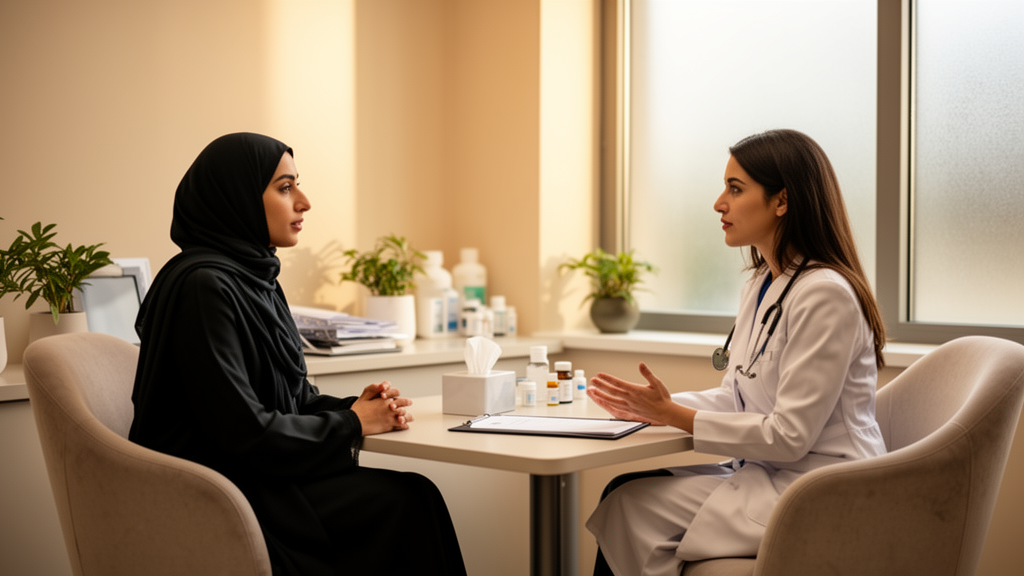
Saudi women show higher reported rates of severe anxiety than men—9.0% versus 6.9%—according to national surveillance data analyzed in a multi-source study of women’s mental health. The same analysis found only 13.6% of Saudis with a lifetime mental disorder had ever sought treatment, while about 80% of people with severe disorders received no care. Rather than conducting a new survey or clinical trial, the researchers compared published aggregate indicators from four official Saudi sources with a structured, theory-informed synthesis of peer-reviewed evidence. Their results point to a compound problem: psychological distress may be underreported, expressed through physical symptoms, poorly detected in primary care and constrained by family, social and spiritual factors that shape whether women disclose it.
The study used Health Status Statistics 2025, Women’s Health and Reproductive Care Statistics for 2024 and 2025, and the Saudi National Mental Health Survey technical report. The national indicators were extracted and compared narratively rather than pooled because the sources used different instruments, populations and reporting periods. General Authority for Statistics estimates came from self-reported severity categories, whereas the national survey used the Saudi-Arabic Composite International Diagnostic Interview 3.0, a structured diagnostic interview. No individual-level microdata were reanalyzed, no new pooled prevalence estimates were generated, and no significance tests were performed. The complementary literature search screened 1,000 abstracts, but full texts could not be retrieved for 275 of the 521 records considered potentially eligible, so the authors describe it as a narrative synthesis rather than a completed systematic review.
The reported gender difference is smaller than patterns often found with diagnostic interviews, suggesting that self-report may compress the measured female burden. Severe anxiety affected 9.0% of women and 6.9% of men, while moderate anxiety was reported by 1.1% of women and 0.8% of men. Moderate depression was reported by 0.2% of women and 0.1% of men, and mild depression was identical at 0.7% for both sexes. At the same time, 99.2% of Saudi adults rated their general health as good or better. The investigators interpret this combination as a potential measurement problem rather than evidence of low need: norms favoring composure, limited disclosure of emotional distress and the expression of distress through bodily complaints can all cause psychological illness to remain outside conventional prevalence estimates.
Clinical evidence supports the concern about missed cases. In Arab primary care, an early United Arab Emirates study estimated that somatized mental disorders accounted for approximately 48% of psychiatric presentations, with headache, backache and abdominal pain prominent. A Riyadh study found only slight agreement between physicians’ diagnoses and standardized diagnoses for somatized depression, with a kappa value of 0.27, below accepted clinical thresholds. Among women screened in Riyadh gastroenterology clinics, 44% were positive for depression and 34% for anxiety, yet most sought subsequent help from private clinics or religious practitioners rather than mental-health services. These findings do not quantify how much Saudi national surveillance undercounts women, but they show a plausible detection pathway: women may be present in medical clinics while their psychological condition is recorded, or overlooked, as a physical problem.
Family structure appears to operate in two directions at once, providing support while also influencing disclosure and access to care. Evidence from Saudi and other Gulf settings associates limited family support and poor spousal support with postpartum depression. One Saudi study found family conflict associated with roughly six times higher odds of postpartum depression, while an unsupportive spouse was associated with two- to four times higher odds depending on region. In a cross-sectional survey of 241 married Saudi women, emotional divorce—cohabitation without psychological connection—accounted for 61% of the variance in combined depression, anxiety and loneliness scores. Kuwait interviews provide comparative evidence that gossip, stigma and family reputation can outweigh cost or service availability in decisions about seeking psychiatric care. These associations do not establish causation, and much of the stigma evidence comes from other Gulf countries rather than Saudi women specifically.
Reproductive transitions further complicate mental-health surveillance. Two recent systematic reviews covering 22 and 32 Saudi studies found widely varying postpartum depression prevalence, from about 15% in some Jeddah samples to 76% in a rural Jazan sample, with intermediate estimates of roughly 25%–38% in Riyadh studies. The broad spread reflects differences in settings and diagnostic thresholds, so these figures cannot be treated as a single national prevalence. Limited family and spousal support and unplanned pregnancy emerged as more consistent correlates than delivery mode or hormonal status. In an Asir cross-sectional survey, 65% of menopausal women reported depressive symptoms and 52% reported anxiety symptoms. National reproductive-health data show high contact with maternity services: in 2025, 89.6% of mothers attended at least four antenatal visits, 99.6% of deliveries were attended by skilled personnel in 2024, and 68.2% occurred in government facilities in 2025. These are contextual indicators, not measures of mental-healthcare quality.
Religion may facilitate or complicate professional help-seeking, depending on how distress is interpreted. Saudi-specific evidence on this relationship remains limited, so the analysis draws cautiously on evidence from other Muslim and Arab populations. Among Emirati female college students, religiosity was negatively correlated with depressive symptoms, and practices such as prayer, supplication and Qur’anic recitation were associated with lower perinatal anxiety, depression and pain in a synthesis of nine studies. But a multi-religious study found that negative religious coping—attributing illness to divine punishment, experiencing spiritual struggle or questioning God’s love—independently predicted anxiety and depression, whereas positive coping showed no independent effect after full adjustment. Across 9,782 Arab Muslim participants in 16 countries, religiosity was associated with more favorable help-seeking attitudes when stigma was low to moderate, but that association disappeared where stigma was high. These findings do not show that religiosity is inherently protective or harmful.
Saudi Vision 2030 has expanded women’s participation in the labor market, with female labor-force participation rising from about 19% in 2017 to more than 35% by 2022. Yet available studies cannot establish that these reforms have reduced psychological distress or caused a change in mental-health outcomes. In a survey of 580 working women in Riyadh, about half screened positive for mild-to-moderate depression and anxiety, and 65% said they needed longer maternity leave than they received. A structural-equation study of 593 Saudi women found mobility, social interaction and social support associated with lower depression risk, while possession of a driving licence was not independently associated after those broader factors were considered. These cross-sectional observations are consistent with a possible role-overload pattern, in which expanded employment opportunities coexist with domestic responsibilities and insufficient institutional support, but they cannot establish the direction or cause of that relationship.
To organize these mechanisms, the authors propose an Islamic Biopsychosocial–Spiritual model, or BPSS-I, extending Engel’s biopsychosocial approach with a culturally situated spiritual domain. Its biological component covers pregnancy, postpartum life, infertility and menopause; its psychological component includes depression, anxiety, coping and somatization; its social component emphasizes family systems, honor-based stigma, mobility, employment and changing gender roles; and its spiritual component includes nafs, sabr, tawakkul, dhikr and positive or negative religious coping. The model treats these domains as interacting rather than assigning any one factor a universally protective or harmful effect. It remains a theory-generating heuristic, not a validated or prespecified causal model. Culturally adapted cognitive behavioral therapy and internet-delivered interpersonal therapy have produced encouraging results in other Arab populations, but the synthesis identified no randomized controlled trial focused specifically on Saudi or Gulf women with anxiety or depression as the principal clinical outcome.
The central research priority is therefore not simply to count more cases, but to determine how distress is hidden, recognized and translated into care. The study supports longitudinal Saudi cohorts, clinician-administered diagnostic surveys, validated Arabic instruments sensitive to somatic presentations, and direct tests of culturally and spiritually responsive interventions. It also highlights information-system bias: service data reportedly overrepresent psychotic disorders while under-documenting depression and anxiety, the predominant presentation among women. The BPSS-I framework must be tested prospectively in Saudi primary-care, community and occupational settings, with greater separation between Saudi and non-Saudi women. Until then, the reported gender gaps and treatment disparities should be treated as important signals, while the proposed mechanisms—including the role of family, stigma, somatization and religious coping—remain hypotheses requiring local validation rather than established causal explanations.
Subject of Research: Saudi women’s anxiety, depression, care barriers and a proposed culturally integrated mental-health framework
Article Title: Women’s mental health in Saudi Arabia: gender gaps, barriers to care, and a culturally integrated framework
Article References: Alsuhaymi, A. O., & Atallah, F. A. (2026). Women’s mental health in Saudi Arabia: gender gaps, barriers to care, and a culturally integrated framework. Frontiers in Psychology, 17, Article 1943335. https://doi.org/10.3389/fpsyg.2026.1943335
Image Credits: AI Generated
DOI: 10.3389/fpsyg.2026.1943335
Keywords: Saudi Arabia, women’s mental health, anxiety, depression, treatment gap, somatization, mental-health stigma, postpartum depression, religious coping, Vision 2030, Women, mental
Cite Scienmag News
Glenn Wilkins. (October 26, 2026). Saudi women face a compounded mental-health detection and treatment gap. Scienmag. https://scienmag.com/saudi-women-face-a-compounded-mental-health-detection-and-treatment-gap/
Glenn Wilkins. "Saudi women face a compounded mental-health detection and treatment gap." Scienmag, 26 October 2026, https://scienmag.com/saudi-women-face-a-compounded-mental-health-detection-and-treatment-gap/. Accessed 26 October 2026.
Glenn Wilkins. "Saudi women face a compounded mental-health detection and treatment gap." Scienmag. October 26, 2026. https://scienmag.com/saudi-women-face-a-compounded-mental-health-detection-and-treatment-gap/


