


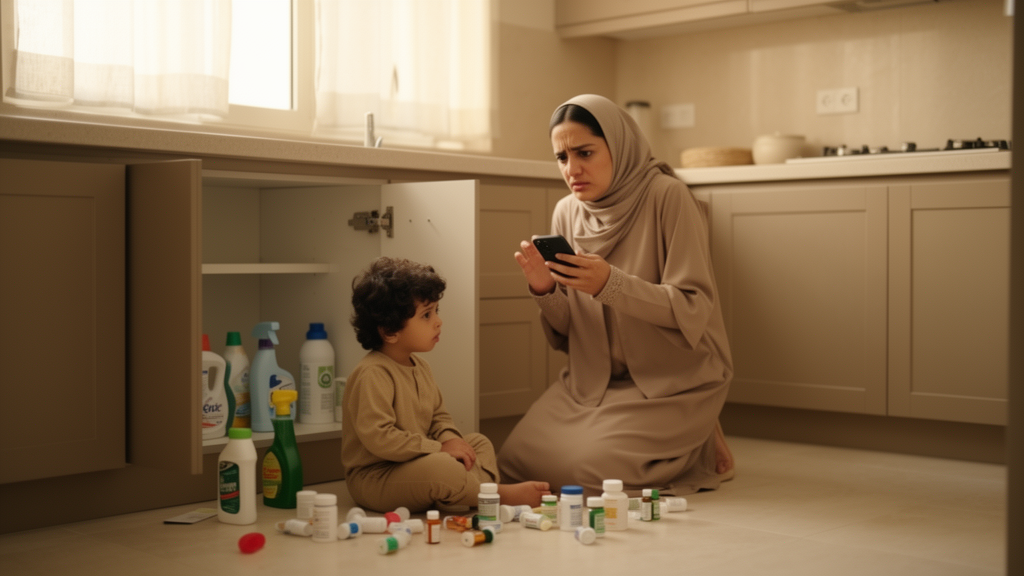
A sweeping survey of nearly 2,000 caregivers across Saudi Arabia has uncovered a striking paradox at the heart of household child safety: while parents and guardians overwhelmingly hold positive attitudes toward protecting children from toxic products and report adopting safe storage habits, only about a third possess adequate knowledge of which everyday items can poison a child or what to do when a poisoning occurs. The cross-sectional study, published in Frontiers in Public Health, evaluated the knowledge, attitudes, and practices of 1,917 caregivers and found that just 37 percent achieved a satisfactory knowledge score, compared with 86 percent for attitudes and 87 percent for practices.
The research, conducted by Hanouf S. Bafhaid of Umm Al-Qura University between December 2024 and March 2025, recruited participants through the Ministry of Education’s official research service, distributing an online questionnaire via schools to reach caregivers of children under 12 across the kingdom’s five regions. The 26-item instrument, validated through expert review, pilot testing, and back-translation, assessed four domains: demographics, knowledge of household product and medication hazards, attitudes toward child safety, and preventive practices. Overall reliability was good, with a Cronbach’s alpha of 0.817.
The knowledge gap revealed by the study is both broad and specific. Respondents correctly identified bleach, insecticides, cleaning products, mothballs, and button batteries as highly harmful, and appropriately rated shampoo and toothpaste as low risk. Yet the survey exposed dangerous blind spots. Roughly 62 percent of caregivers underestimated the toxicity of iron supplements, a well-documented cause of serious pediatric morbidity, and 78 percent failed to recognize that mouthwashes, some of which contain alcohol concentrations as high as 27 percent, can cause severe intoxication even in small amounts. Conversely, caregivers overestimated the dangers of relatively benign items such as hand soap, play dough, glue, and nail polish, suggesting that unfamiliar chemical terminology drives misperception in both directions.
Perhaps the most alarming finding concerned chemical identification. Caregivers recognized corrosive products almost exclusively by brand name: 91.7 percent identified Flash as corrosive and 63.4 percent identified Clorox, but only 0.4 percent knew that caustic soda, or sodium hydroxide, a common household chemical, is corrosive. This reliance on branding rather than chemistry means that safety knowledge collapses entirely when a product appears under an unfamiliar label or in an unmarked container, a scenario that international evidence has repeatedly linked to poisoning incidents.
Misconceptions extended to emergency management, with potentially harmful consequences. Two-thirds of respondents, 66.7 percent, believed that a child who ingests a corrosive cleaning product should drink milk, and 59.7 percent recommended drinking large quantities of water. Neither intervention is recommended; both can provoke vomiting and re-exposure to the caustic agent. Some respondents suggested saltwater, vinegar, or lemon juice, home remedies that are contraindicated because exothermic neutralization reactions can worsen mucosal burns. Another 14.3 percent endorsed activated charcoal, which is ineffective for corrosives and can interfere with endoscopic assessment. Only 41.1 percent of caregivers knew the poison control center’s contact number, undermining timely expert consultation precisely when it matters most.
Attitudes, by contrast, were largely reassuring. Nearly 89 percent of respondents agreed that keeping medications out of children’s reach is a shared household responsibility, and 81 percent acknowledged that improperly stored cleaners and cosmetics pose a risk. Yet ambivalence surfaced around child-resistant packaging, with only 39 percent believing children would struggle to open it, a view that aligns with evidence that such designs frequently fail. Roughly a fifth of respondents still endorsed storing cleaners under the kitchen sink, and a third considered visible placement acceptable, prioritizing convenience over safety. Half relied on social media as a primary source of safety information, a channel the author flags as prone to misinformation.
Reported practices were similarly strong on the surface. Most caregivers said they used locked or elevated storage, put products away immediately after use, read safety warnings, and never repurposed cleaning product containers. But 14.3 percent reported at least one poisoning incident in the home, and the author cautions that high practice scores may partly reflect habitual household organization rather than risk-based decision-making, behaviors that may falter when caregivers encounter unfamiliar products outside their routines.
Multivariable logistic regression identified clear demographic patterns. Male caregivers had 39 percent lower odds of a satisfactory total knowledge-attitude-practice score than women, and caregivers under 25 had 38 percent lower odds. Healthcare-related employment doubled the odds of a satisfactory score, while each step up in educational attainment raised the odds by 27 percent, and having three or more children increased them by roughly 25 percent, consistent with experience-based learning in larger households. Being a mother more than doubled the odds of satisfactory practice, whereas employing a domestic helper reduced them, suggesting that households with helpers are less directly engaged in safety measures. Notably, women outperformed men in knowledge but not in attitudes or practices, indicating comparable behavior despite weaker hazard awareness among men.
The study’s regional breakdown adds another layer of concern. Nearly half of respondents came from the northern region, which previous Saudi surveillance data identify as the source of about 40 percent of acute chemical exposures in children, far exceeding other regions. While the survey did not measure incidence directly, the geographic overlap suggests that targeted awareness campaigns in high-exposure areas could yield outsized benefits. Practice scores were lowest in the southern and western regions, hinting at uneven safety norms across the country.
The author concludes that closing the gap between confident behavior and accurate understanding demands more than one-off awareness campaigns. The recommended strategy integrates behavioral design to make safe habits automatic, technology-based tools offering instant guidance during emergencies, and regulatory measures such as clearer labeling, all embedded in routine pediatric care. Given that self-reported attitudes and practices are vulnerable to social desirability bias while knowledge items are objectively scored, the 37 percent knowledge figure may be the study’s most trustworthy signal, and its most urgent call to action: caregivers who feel prepared but cannot name the hazard, or the correct response, remain the weakest link in household poison prevention.
Subject of Research: Caregiver knowledge, attitudes, and practices regarding household product poisoning prevention in children in Saudi Arabia
Article Title: Caregivers’ knowledge, attitudes, and practices regarding household product safety and poisoning prevention in children in Saudi Arabia
Article References: Bafhaid, H. S. (2026). Caregivers’ knowledge, attitudes, and practices regarding household product safety and poisoning prevention in children in Saudi Arabia. Frontiers in Public Health, 14, Article 1937239. https://doi.org/10.3389/fpubh.2026.1937239
Image Credits: AI Generated
DOI: 10.3389/fpubh.2026.1937239
Keywords: childhood poisoning, household products, caregivers, Saudi Arabia, poison prevention, KAP study, corrosive substances, medication safety, public health, cross-sectional survey, emergency management, child safety
Cite Scienmag News
Ophelia Keating. (October 19, 2026). Saudi Survey Finds Most Caregivers Unprepared for Child Poisoning Emergencies. Scienmag. https://scienmag.com/saudi-survey-finds-most-caregivers-unprepared-for-child-poisoning-emergencies/
Ophelia Keating. "Saudi Survey Finds Most Caregivers Unprepared for Child Poisoning Emergencies." Scienmag, 19 October 2026, https://scienmag.com/saudi-survey-finds-most-caregivers-unprepared-for-child-poisoning-emergencies/. Accessed 19 October 2026.
Ophelia Keating. "Saudi Survey Finds Most Caregivers Unprepared for Child Poisoning Emergencies." Scienmag. October 19, 2026. https://scienmag.com/saudi-survey-finds-most-caregivers-unprepared-for-child-poisoning-emergencies/


