


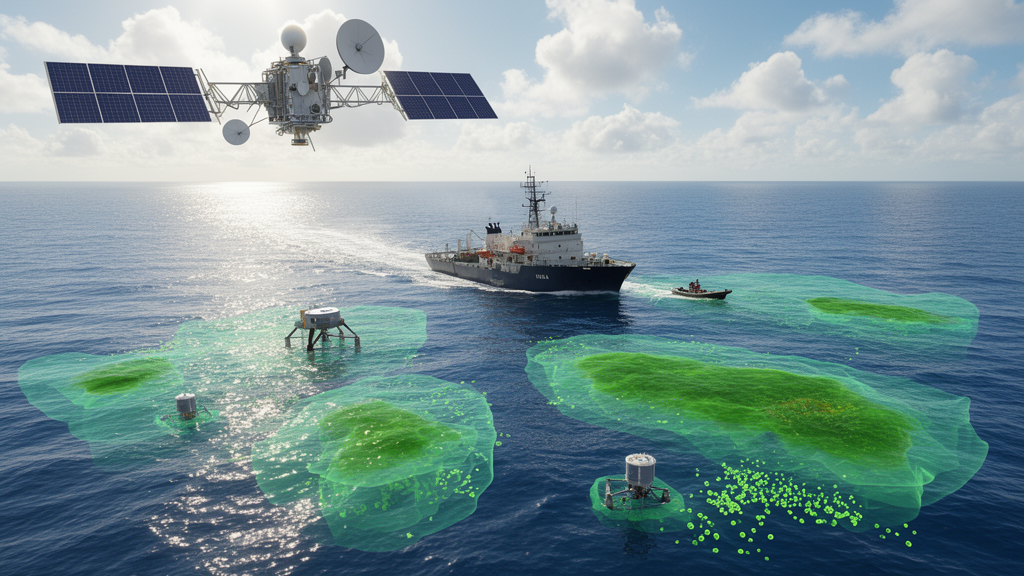
Positive Indian Ocean Dipole events produced a larger basin-wide increase in phytoplankton biomass along the eastern Indian Ocean coast than the decrease associated with negative events, according to a study combining three decades of satellite observations, shipboard measurements and biogeochemical model estimates. Relative to neutral conditions, model-derived euphotic-zone biomass increased by 27.0 ± 17.0% during positive phases but declined by 13.1 ± 5.2% during negative phases. The analysis found that coastally trapped Kelvin waves generated by equatorial wind anomalies were the main physical pathway linking the Dipole to coastal phytoplankton.
During positive events, upwelling waves shoaled the thermocline and increased mixing, while negative events produced downwelling waves that deepened nutrient-bearing layers and limited biological change in already nutrient-poor waters. The study examined the Indian Ocean Dipole, a climate mode expressed as an east-west contrast in tropical sea-surface temperature anomalies. Its model comparison covered 1993–2022 and included five positive events, four negative events and five neutral years.
Satellite chlorophyll-a records showed a coherent coastal response over the event life cycle: enhanced chlorophyll first appeared off Sumatra and Java during boreal summer and expanded along the eastern coastline during autumn and winter. Positive-phase anomalies consistently exceeded the magnitude of negative-phase anomalies. Because ocean-color satellites mainly observe the upper surface, the researchers used the validated NEMO-PISCES physical-biogeochemical model to estimate chlorophyll integrated through the euphotic zone and to characterize subsurface responses that could be missed from space.
Along the coastal Kelvin-wave pathway, model estimates indicated that average depth-integrated chlorophyll rose from 25.2 ± 1.6 mg m−2 in neutral years to 32.0 ± 4.3 mg m−2 during positive Dipole phases. Negative phases averaged 21.9 ± 1.3 mg m−2. A persistent subsurface chlorophyll maximum was present along much of the coastline from summer through winter, showing that the basin-scale response included a biological layer not fully resolved by surface satellite observations.
The model reproduced the broad phase-dependent patterns seen in remote-sensing and field data. Validation comparisons also showed that it tended to underestimate the magnitude of differences between positive and neutral conditions, an important qualification for interpreting the numerical estimates and the limited number of events included. Field surveys in the strongly stratified Preparis Channel, between the Andaman Sea and Bay of Bengal, tested the proposed pathway with direct hydrographic and biogeochemical observations.
Winter measurements from the neutral 2017/2018 season and the extreme positive 2019/2020 event showed marked differences in water-column structure, nutrients and phytoplankton. The subsurface chlorophyll maximum reached 2.01 ± 1.49 μg L−1 and shoaled to about 10 m in 2020, compared with 0.32 μg L−1 at roughly 40 m in 2018. Euphotic-zone integrated chlorophyll increased from 19.51 to 70.72 mg m−2, a 3.6-fold enhancement.
The comparison involved two stations in 2018 and five within the regional 1° × 1° comparison box in 2020, so it was based on limited seasonal sampling. The positive-event observations coincided with changes consistent with enhanced vertical nutrient delivery. The thermocline was 36 m shallower, at 68 ± 8 m in 2020 compared with 104 m in 2018, while the nitrate inventory increased by about 46%, from 913.23 to 1,333.63 mmol m−2.
Turbulent dissipation rose from 6.0 × 10⁻⁸ to 4.8 × 10⁻⁷ W kg−1, and diapycnal diffusivity increased from 2.9 × 10⁻⁵ to 1.0 × 10⁻³ m² s−1. These measurements describe conditions compatible with stronger upward diffusion of nutrients and a shallower nitracline during the positive event. In the neutral-year comparison, the deeper thermocline and nitracline were consistent with reduced nutrient access for phytoplankton.
The findings support the proposed nutrient-mediated mechanism, although the small number of cruises limits how broadly the two-year contrast can be generalized. Spatial patterns and timing supported Kelvin waves as the dominant link between equatorial climate variability and distant coastal waters. During the 2019/2020 positive event, persistent equatorial easterly anomalies generated upwelling waves that propagated eastward and divided into northern and southern coastal branches.
The northern branch travelled roughly 3,500 km through the Andaman Sea before reaching the Preparis Channel. The local Ekman effect did not follow the same pattern: over the two weeks before the respective cruises, cumulative Ekman pumping lifted the layer by 3.8 m in 2018 but deepened it by only 0.08 m in 2020. Along the full pathway, correlations with Kelvin-wave variability were stronger than those with local wind forcing, although they weakened with propagation distance and lag times increased to about two weeks downstream.
Local seabed topography amplified the response where Kelvin waves encountered islands, narrow channels and steep slopes. During the 2019/2020 positive event, the Preparis Channel supported a chlorophyll maximum of 2.85 μg L−1, compared with 0.57 μg L−1 in the central Bay of Bengal and 0.82 μg L−1 in the central Andaman Sea. Upper-100-m chlorophyll over the channel reached 81.33 mg m−2, versus 21.05 and 30.77 mg m−2 in those open-water regions.
A subsurface current flowing from the Andaman Sea toward the Bay of Bengal at 0.48 m s−1 generated isotherm jumps and enhanced mixing over the channel, consistent with Lee-wave dynamics. The nitracline lay at 13 m above the channel, compared with 71 m in the Bay of Bengal and 36 m in the Andaman Sea. These topographic effects coincided with two changes that could increase nitrate access.
A shallower nitracline corresponded to a larger nutrient inventory within the upper 100 m, reaching 1,651 mmol m−2 above the channel compared with 509 mmol m−2 in the Bay of Bengal and 1,206 mmol m−2 in the Andaman Sea. Enhanced mixing also coincided with greater diapycnal nitrate flux into the euphotic zone. Across the broader propagation pathway, integrated chlorophyll responses increased with the magnitude of topographically induced vertical motion, with a reported correlation of 0.67 and p < 0.01.
This association indicates that local topography can magnify the biological response to remotely generated waves. A one-dimensional biogeochemical model reproduced the asymmetric response under oligotrophic conditions, while a model-derived nutrient budget attributed less than 10% of euphotic-zone nutrient supply to horizontal advection. The analysis also separated the Dipole’s influence from that of the El Niño–Southern Oscillation.
Independent positive Dipole events produced larger coastal phytoplankton increases than independent extreme El Niño events, while independent negative Dipole events had stronger suppressive effects than independent La Niña events. When positive Dipole conditions coincided with El Niño, or negative Dipole conditions coincided with La Niña, chlorophyll anomalies were larger than those associated with either climate mode acting alone. These are event-based associations derived from a relatively small number of cases, not experimental causal estimates, but they indicate that the Dipole can exert a particularly strong influence on this regional ecosystem.
The authors project that a shift toward more frequent extreme positive events could enhance eastern Indian Ocean primary production, while the study itself did not test future productivity or fishery outcomes. That projection carries an important ecological qualification. Phytoplankton form the base of marine food webs, and previous studies have reported positive relationships between chlorophyll-a concentrations and catches of yellowfin tuna and sardines in the region.
The present study measured phytoplankton and examined its physical and chemical drivers rather than fishery yields, so it does not establish a commercial benefit. Its central result is instead a measured and model-supported basin-scale asymmetry: positive Dipole events generate upwelling Kelvin waves that shoal the thermocline, increase nutrient supply and support greater phytoplankton biomass, whereas negative events deepen nutrient-bearing layers in waters where the already low biomass limits the magnitude of the decrease.
Subject of Research: How Indian Ocean Dipole-driven Kelvin waves affect phytoplankton biomass along the eastern Indian Ocean coast
Article Title: Asymmetric basin-wide responses of coastal phytoplankton biomass to the Indian Ocean dipole
Article References: Wang, X., Li, H., Zhang, J., Kao, S.-J., Zhou, F., Ruiz-Pino, D., Xuan, J., Ding, R., Lazar, A., Mejia, C. E., Qiu, Y., Zhou, X., Wang, L., Shou, L., Zhu, Y., Than, W. W., Lwin, S. M., Thu, C. A., Cai, W., & Chen, J. (2026). Asymmetric basin-wide responses of coastal phytoplankton biomass to the Indian Ocean dipole. Nature Communications, 17(1), Article 10921. https://doi.org/10.1038/s41467-026-77809-1
Image Credits: AI Generated
DOI: 10.1038/s41467-026-77809-1
Keywords: Indian Ocean Dipole, phytoplankton biomass, Kelvin waves, eastern Indian Ocean, nutrient supply, coastal topography, ocean stratification, chlorophyll-a, upwelling, climate variability, Asymmetric, basin-wide
Cite Scienmag News
Violet Maxwell. (October 21, 2026). Satellite, field and model study maps asymmetric Indian Ocean phytoplankton response. Scienmag. https://scienmag.com/satellite-field-and-model-study-maps-asymmetric-indian-ocean-phytoplankton-response/
Violet Maxwell. "Satellite, field and model study maps asymmetric Indian Ocean phytoplankton response." Scienmag, 21 October 2026, https://scienmag.com/satellite-field-and-model-study-maps-asymmetric-indian-ocean-phytoplankton-response/. Accessed 21 October 2026.
Violet Maxwell. "Satellite, field and model study maps asymmetric Indian Ocean phytoplankton response." Scienmag. October 21, 2026. https://scienmag.com/satellite-field-and-model-study-maps-asymmetric-indian-ocean-phytoplankton-response/


