


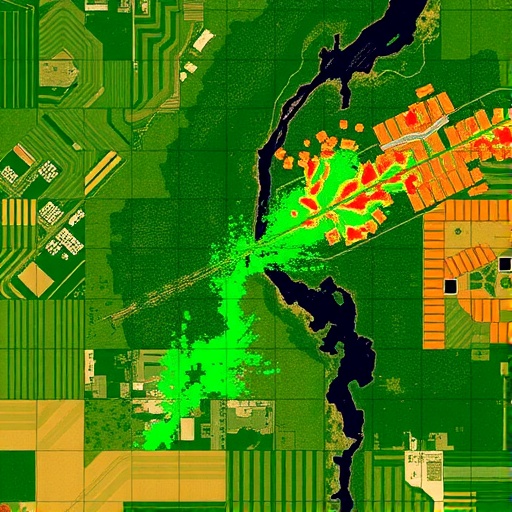
In an era where precision agriculture is becoming paramount to meeting global food demands, a groundbreaking satellite-based analytical framework has been developed to accurately estimate crop sowing and emergence dates at the field scale. This innovative approach harnesses daily synthetic satellite imagery derived from the Harmonized Landsat Sentinel-2 (HLS) dataset, integrating it with sophisticated machine learning models to reconstruct crop vegetation dynamics in unprecedented detail. Such capability marks a significant stride in agricultural monitoring, providing crucial early growth stage data that have long eluded traditional remote sensing methods.
Crop phenology—the sequence and timing of critical developmental phases such as germination, growth, flowering, and senescence—serves as a cornerstone for optimizing agricultural management and forecasting yields. Historically, determining these stages relied heavily on labor-intensive field observations, which are neither scalable nor feasible for large agricultural landscapes. Satellite remote sensing offers broad spatial coverage but faces technical challenges when detecting early crop stages. These initial phases are characterized by sparse vegetation and are often masked by the soil background, resulting in mixed satellite pixel signals. Moreover, data acquisition is frequently hindered by atmospheric conditions like cloud cover, creating discontinuities in time-series analysis.
Addressing these challenges, researchers from Mississippi State University, in collaboration with multiple institutions, introduced an operational framework detailed in the Journal of Remote Sensing. The methodology fuses high-temporal resolution HLS imagery—combining observations from Landsat 8/9 and Sentinel-2 satellites with a fine 30-meter spatial resolution—with powerful machine learning algorithms. This fusion reconstructs detailed vegetation index trajectories that trace the subtle changes of crop growth, enabling indirect inference of crucial sowing and emergence timings. This innovation tackles a long-standing bottleneck in remote sensing: the accurate identification of crop growth onset at expansive scales.
Central to the framework is an advanced pipeline that marries satellite-derived vegetation index reconstruction with phenological modeling. Raw satellite data, often fragmented by cloud interference, undergo four distinct gap-filling techniques: median interpolation, polynomial regression, harmonic modeling, and a gradient boosting machine known as LightGBM. Through rigorous testing, polynomial regression emerged as the superior method, effectively restoring continuous Enhanced Vegetation Index (EVI) data while preserving the natural seasonal patterns and suppressing noise—essential for precise phenological extraction.
From these reconstructed EVI time series, six key phenological stages—greenup, mid-greenup, maturity, senescence, mid-greendown, and dormancy—are pinpointed using an asymmetric double-sigmoid function. This mathematical model captures the typical growth cycles of crops, enabling fine-scale temporal resolution of development phases. Subsequently, machine learning models, including multiple linear regression, elastic net regression, and support vector machines, leverage these phenological markers to estimate sowing and emergence dates. Among these, elastic net regression demonstrated superior predictive accuracy, achieving an average uncertainty margin of approximately ±10 days.
Validation of this hybrid remote sensing and machine learning technique was conducted using in-situ observations from 20 PhenoCam monitoring sites dispersed across 13 U.S. states. PhenoCams provide ground-level phenological data through time-lapse imagery, serving as an invaluable benchmark for satellite-derived estimates. The comparison yielded an impressive coefficient of determination (R²) of 0.94, signifying strong concordance between satellite predictions and field observations, with only minor biases in timing.
Beyond methodological rigor, the practical implications of this work are profound. Accurate knowledge of sowing and emergence dates enhances the fidelity of crop growth models, enabling more reliable yield forecasts and refined irrigation and fertilization scheduling. Furthermore, the capacity to detect early crop stress or disease via phenological deviations opens new avenues for proactive agricultural interventions. The framework’s scalability facilitates monitoring at regional or even national levels, transforming raw satellite data into actionable agronomic intelligence.
The study’s time frame spanned 2021 to 2023, encompassing diverse planting years and climatic conditions to bolster model robustness. The synthetic time series, essentially a high-frequency composite of satellite data interpolated to daily intervals, addresses significant data gaps that previously compromised phenological analyses. The careful integration of temporal reconstruction, phenological curve fitting, and machine learning classification constitutes a paradigm shift in remote sensing applications for agriculture.
Researchers underscore that sowing and emergence are inherently challenging to observe directly from space due to minimal vegetation cover and high soil visibility during these stages. However, the intrinsic seasonal growth trajectory of crops embeds indirect signals that, when decoded with advanced modeling and AI, fill this observation gap effectively. This insight opens possibilities for similar approaches targeting other phenological challenges, fueling advances in crop science.
The implications extend beyond U.S. corn and soybean systems tested in this study; the modularity of the framework suggests adaptability to various crops and geographic regions, contingent on availability of robust satellite datasets and ground-truth validation points. As satellite constellations expand in number and capability, and artificial intelligence methodologies evolve, this fusion model exemplifies the next frontier in precision agriculture, promising enhanced food security and sustainable farming practices globally.
In tandem with ongoing technological improvements, the integration of such frameworks into global agricultural monitoring platforms and precision farming software can revolutionize real-time crop monitoring. Early, accurate phenological data could inform policy decisions, market predictions, and climate resilience strategies. The USDA and NASA’s support underscores the strategic importance of employing advanced remote sensing and data science for the agricultural sector’s future.
This research exemplifies the fruitful intersection of Earth observation technologies, machine learning analytics, and agronomic expertise. By overcoming traditional limitations, it paves the way for data-driven agriculture that is more efficient, responsive, and able to meet the challenges presented by climate change, resource constraints, and growing population demands. The ability to remotely and promptly discern crop calendars at field resolution represents a major leap forward in Earth system science and agricultural sustainability.
News Publication Date: 11-Mar-2026
References: 10.34133/remotesensing.0878
Keywords
Artificial satellites, Crop phenology, Machine learning, Remote sensing, Harmonized Landsat Sentinel-2 (HLS), Enhanced Vegetation Index (EVI), Phenological modeling, Agricultural monitoring, Precision agriculture
Cite Scienmag News
Alan Morgan. (April 17, 2026). Satellite Data Uncovers Hidden Timelines of Crop Planting. Scienmag. https://scienmag.com/satellite-data-uncovers-hidden-timelines-of-crop-planting/
Alan Morgan. "Satellite Data Uncovers Hidden Timelines of Crop Planting." Scienmag, 17 April 2026, https://scienmag.com/satellite-data-uncovers-hidden-timelines-of-crop-planting/. Accessed 4 September 2026.
Alan Morgan. "Satellite Data Uncovers Hidden Timelines of Crop Planting." Scienmag. April 17, 2026. https://scienmag.com/satellite-data-uncovers-hidden-timelines-of-crop-planting/


