


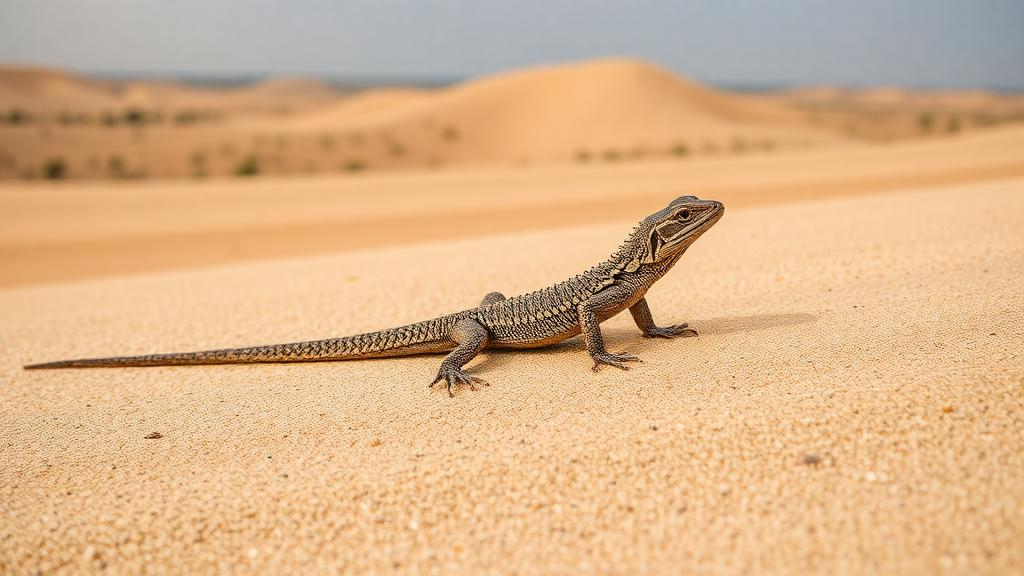
Grasslands across the planet are disappearing at an alarming rate, but the ecological consequences are not always identical for every species living within them. A rapid survey of six open sand-steppe sites in Hungary offers a revealing snapshot of how two lizard species respond to a new wave of habitat change. The Balkan wall lizard, a specialist of sparse, sun-exposed grasslands, declined as the invasive North American grass sand dropseed spread across the landscape. The more adaptable Eastern green lizard showed a different response, benefiting from the encroachment of native shrubs and trees. The findings, published in NeoBiota, suggest that the same transformation of a habitat can harm one reptile while helping another, underscoring the need for conservation measures tailored to the species most at risk.
The study focused on Pannonian sand steppes within Kiskunság National Park in central Hungary. This priority habitat, protected under the European Union’s Habit Directive, consists largely of dry, nutrient-poor grasslands that historically supported little woody vegetation. Large tracts were converted to cropland during the nineteenth and twentieth centuries, and the surviving fragments are now under pressure from altered water regimes, intensified agriculture, abandonment of traditional grazing, and the spread of alien plants. The habitat is officially classified as being in an “unfavourable-bad” conservation status, meaning that it faces a substantial risk of further deterioration or disappearance.
Sand dropseed, or Sporobolus cryptandrus, first appeared in the study area in 2016 and then expanded rapidly. Unlike many invasive plants that require heavily disturbed ground, this C4 grass can invade intact, species-rich grassland. Its dense stands displace native perennial grasses, reduce plant diversity and homogenize the structure of the vegetation. Another alien species, common milkweed, was also present at the surveyed sites, although it generally favors degraded meadows, roadsides and formerly ploughed or overgrazed land. Native and introduced woody plants were simultaneously advancing into the grasslands as traditional grazing declined.
Researchers selected 48 plots, each measuring 25 by 25 meters, across the six study sites. The design deliberately included plots with little or no sand dropseed alongside heavily invaded patches. In September 2024, teams of six or seven observers walked parallel transects through each plot and recorded every reptile seen, including its species, age class, sex, position and time. The investigators also measured the cover of sand dropseed, common milkweed and woody vegetation, then assigned each plot a naturalness score reflecting its plant composition, structure and ecological functioning.
Counting animals directly is notoriously difficult for reptiles. Many are elusive or cryptically colored, and their activity changes with temperature, particularly because they depend on external heat to regulate their bodies. The researchers therefore used single-visit N-mixture models, a statistical approach designed to estimate population abundance while explicitly accounting for imperfect detection. Vegetation variables were placed in the abundance component of the models, while operative temperature and observer effort were used to explain the likelihood that an individual present would actually be seen. Separate models were fitted for the two lizard species.
Surveyors recorded 56 Balkan wall lizards and 28 Eastern green lizards. The Balkan wall lizard appeared in 30 of the 48 plots and was detected more reliably than the Eastern green lizard, which appeared in 18 plots. Model results showed a statistically significant negative association between sand dropseed cover and Balkan wall lizard abundance. The effect of common milkweed was not significant. For the Eastern green lizard, invasive-plant cover had no significant effect, but increasing woody encroachment was associated with greater abundance. Mean detection probabilities were estimated at 0.82 for the Balkan wall lizard and 0.51 for the Eastern green lizard, while estimated mean densities were 48.5 and 11.2 individuals per hectare, respectively.
The results are consistent with the different ecological demands of the two reptiles. Balkan wall lizards in this region depend on open, sandy and loess grasslands with low, sparse vegetation. As sand dropseed expands, it creates more uniform stands that may offer less varied shade, refuge and thermal conditions. The invader also supports fewer and less diverse arthropod communities, potentially reducing prey availability and the habitat’s overall carrying capacity. By contrast, Eastern green lizards are generalists that occupy grasslands, forest edges and a wide range of wetter and drier environments. Shrubs and trees create the more structurally diverse habitat this species can exploit, even as they replace the treeless conditions favored by the wall lizard.
The study also illustrates why the impact of an invasive species cannot be inferred simply from the fact that it is spreading. A plant may transform habitat without affecting every resident in the same way, and vegetation encroachment can itself generate winners and losers. The authors note several limitations: the sampling was concentrated in only six sites, the number of plots was modest, and there was no temporal replication. Stratification by sand dropseed abundance may also have limited the precision of estimates for milkweed and woody encroachment. Nevertheless, complementary generalized linear mixed models assuming perfect detection produced patterns similar to the N-mixture results, supporting the main conclusions.
Because sand dropseed has already spread extensively, researchers argue that total eradication is unrealistic and that management should focus on preventing further expansion while limiting ecological damage. Mapping colonies and identifying the forces driving their spread could improve forecasting and early intervention. Restricting vehicle movement on sandy roads may help, because seeds are readily transported on tires. Small founder populations could potentially be removed manually, while grazing, mowing, burning, chemical treatment and combinations of these methods require urgent testing in larger stands. Repeated surveys across multiple seasons and years would also help determine whether the observed lizard responses persist as invasion progresses.
For now, the study provides an early warning from one of Europe’s most distinctive and threatened grassland types. Sand dropseed appears to be eroding the habitat of the Balkan wall lizard not merely by replacing native plants, but by simplifying the structure and food web on which the species depends. The Eastern green lizard’s apparent benefit from woody growth should not be mistaken for ecosystem recovery: shrubs can improve cover for a generalist while simultaneously pushing a threatened specialist out of its preferred habitat. Protecting Pannonian sand steppes will therefore require more than stopping the spread of a single invasive grass. It will demand active maintenance of open, thermally varied and prey-rich grassland, alongside targeted control of the plants and vegetation changes reshaping one of Central Europe’s vanishing ecological arenas.
Subject of Research: Effects of invasive sand dropseed and woody encroachment on two lizard species in Pannonian sand steppes
Article Title: Effect of plant-related threats on lizards of open sand steppes: a snapshot at the beginning of the spread of a novel invader
Article References: Mizsei, E., Adorjáni, C., Bancsik, B., Kovács, G., Rák, G., Babocsay, G., & Budai, M. (2025). Effect of plant-related threats on lizards of open sand steppes: a snapshot at the beginning of the spread of a novel invader. NeoBiota, 104, 95-111. https://doi.org/10.3897/neobiota.104.159611
Image Credits: AI Generated
DOI: 10.3897/neobiota.104.159611
Keywords: sand dropseed, Balkan wall lizard, Eastern green lizard, invasive plants, grassland degradation, Pannonian sand steppe, woody encroachment, reptile ecology, N-mixture models, Hungary, Effect, plant-related
Cite Scienmag News
Gavin Prescott. (October 19, 2026). Sand dropseed invasion reshapes lizard communities in Hungary’s sand steppes. Scienmag. https://scienmag.com/sand-dropseed-invasion-reshapes-lizard-communities-in-hungarys-sand-steppes/
Gavin Prescott. "Sand dropseed invasion reshapes lizard communities in Hungary’s sand steppes." Scienmag, 19 October 2026, https://scienmag.com/sand-dropseed-invasion-reshapes-lizard-communities-in-hungarys-sand-steppes/. Accessed 19 October 2026.
Gavin Prescott. "Sand dropseed invasion reshapes lizard communities in Hungary’s sand steppes." Scienmag. October 19, 2026. https://scienmag.com/sand-dropseed-invasion-reshapes-lizard-communities-in-hungarys-sand-steppes/


