


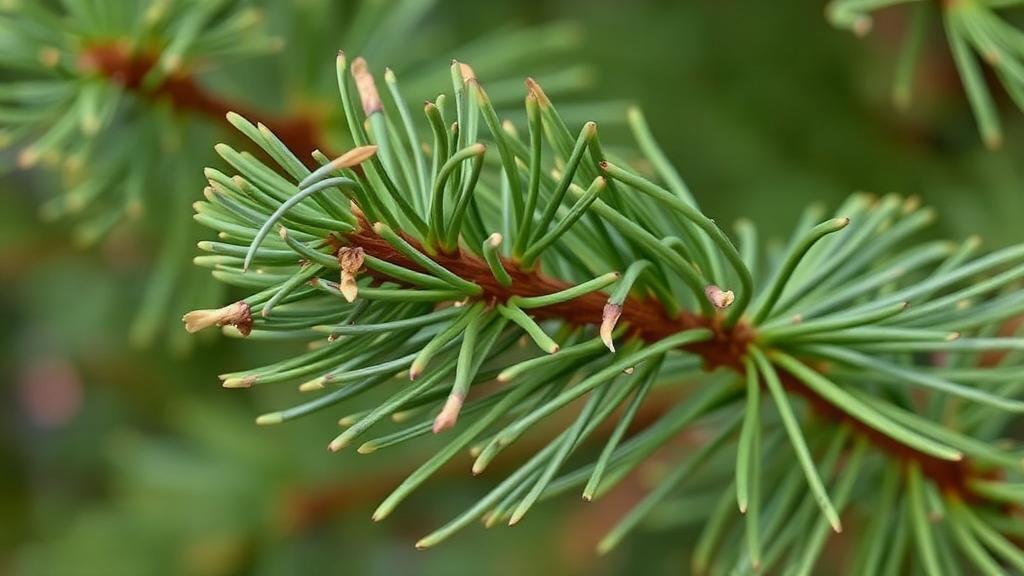
A species-specific molecular assay has found the pine-killing fungus Dothistroma septosporum in only one of four natural Scots pine stands examined in Slovakia, despite the pathogen’s wide distribution across Europe and its growing importance in plantation forestry. In the affected stand, at Vernár in Slovak Paradise National Park, 11 of 16 fallen-needle samples tested positive and visible symptoms of Dothistroma needle blight were present. The pathogen was not detected in the other three symptomless natural stands, challenging the idea that it routinely persists as a hidden, harmless component of native pine fungal communities.
Dothistroma septosporum causes reddish-brown bands, premature needle death and, in severe infections, reductions in tree growth that can translate into substantial losses for timber production. It has an unusually broad host range among pines and occurs in both hemispheres. Because the pathogen can be present before symptoms become obvious, the new study combined quantitative polymerase chain reaction, or qPCR, with high-throughput sequencing of fungal DNA. The first method provided targeted evidence for D. septosporum; the second revealed the wider community of fungi living on or colonizing Scots pine needles.
The researchers collected at least 50 fallen needles from each of 57 trees across the natural stands of Hrabušice, Vernár, Danišovce and Spišský Hrhov. They also assembled a comparison group of 15 archived samples from seven planted or otherwise human-altered stands in which D. septosporum had previously been confirmed. Sequencing of the fungal internal transcribed spacer region produced 1,058,455 high-quality sequences and 1,676 operational taxonomic units. These community profiles made it possible to ask not only whether the pathogen was present, but also whether its occurrence coincided with a distinct ecological neighborhood among the hundreds of fungi detected.
The comparison group provided the clearest signal. Every sample was positive by qPCR, and Dothistroma accounted for 27.1% of its fungal sequences. By contrast, the pathogen represented less than 1% of the sequences from the natural Vernár stand, where 11 samples tested positive, and was absent from the other natural groups. It was also absent from the visibly affected stand’s qPCR-negative samples. This distinction is important: a positive molecular result does not necessarily mean that a pathogen is abundant enough to dominate the tissue community, and detection at the stand level can conceal substantial variation among individual trees.
Most natural-stand fungi belonged to the class Leotiomycetes, which represented 71.0% to 84.8% of sequences, while the family Rhytismataceae accounted for 26% to 55%. Lophodermium was the most abundant genus across all locations, ranging from 17.2% to 54.8% of the community. The human-altered comparison group looked markedly different: Leotiomycetes fell to 26.0%, Dothideomycetes became the leading class at 41.2%, and Mycosphaerellaceae reached 27.2%, largely reflecting the abundance of Dothistroma. The difference was therefore not simply a loss of fungal richness in diseased material, but a marked shift in the identities and relative abundances of community members.
Statistical comparisons confirmed that fungal composition varied significantly among the five sample groups. A permutation multivariate analysis of variance based on Bray–Curtis dissimilarity produced an R-squared value of 0.287 and a p-value of 0.001. The greatest separation occurred between Hrabušice and the non-natural reference group, and between Danišovce and the same group. A random forest classifier also separated the groups with an overall out-of-bag error rate of 0.111. The reference group was classified without error, whereas errors occurred mainly among the natural stands. Dothistroma was the most influential classifier, but several operational taxonomic units assigned to Lophodermium and Neocatenulostroma also contributed substantially.
A genus-level co-occurrence network added another view of the ecosystem. It contained about 30 fungal genera connected by roughly 80 significant associations, most of them positive, with correlation coefficients ranging from 0.52 to 0.76. Dothistroma was positively associated with Genolevuria and Alternaria but negatively associated with Lophodermium and Phacidium, two prominent needle-associated fungi. Such patterns may reflect shared environmental preferences, differences in ecological niches or indirect competition, but correlations alone cannot establish direct biological interactions. The network was driven chiefly by the pathogen-rich reference group, whereas Dothistroma was a minor component of the community at Vernár.
The findings fit a broader picture in which northeastern Europe and western Asia are considered the pathogen’s likely center of origin, overlapping the native range of Scots pine. Earlier genetic work found high diversity and a low clonal fraction in Slovak populations, conditions consistent with a long association between pathogen and host. The Vernár stand, however, was close to a busy road and settlement, contained Austrian pine reported to be susceptible to the disease, and lay outside a designated nature conservation zone. These characteristics could facilitate human-mediated introduction or local spread, although the study could not determine whether transport, natural dispersal or another factor was responsible.
Several limitations prevent the results from being read as a simple comparison between diseased and healthy forests. Natural stands were sampled in one season, whereas the reference material came from several localities and years and had been selected because it was already known to contain the pathogen. Stand type, location, collection period, pathogen status and sample history were therefore intertwined. Fallen needles also present special difficulties: fungi may colonize them after abscission, so the sequencing results describe communities associated with needle litter rather than a direct snapshot of living foliage. Larger, replicated studies using fresh needles from living and asymptomatic trees, repeated across seasons and localities, will be needed to resolve the pathogen’s true ecological footprint.
Subject of Research: Occurrence of Dothistroma septosporum and fungal community structure in Slovak Scots pine stands
Article Title: Fungal Needle Communities and Dothistroma septosporum Occurrence in Pinus sylvestris Stands in Slovakia
Article References: Artimová, R., Adamčíková, K., Medo, J., Kobza, M., Ondrušková, E., & Jánošíková, Z. (2026). Fungal Needle Communities and Dothistroma septosporum Occurrence in Pinus sylvestris Stands in Slovakia. Ecology and Evolution, 16(10), Article e74481. https://doi.org/10.1002/ece3.74481
Image Credits: AI Generated
DOI: 10.1002/ece3.74481
Keywords: Dothistroma septosporum, Scots pine, pine needle blight, fungal communities, ITS metabarcoding, quantitative PCR, mycobiome, Slovakia, forest pathology, co-occurrence networks, Fungal, Needle
Cite Scienmag News
Kristina Jarvis. (October 19, 2026). Pine Blight Pathogen Found Mostly Where Disease Symptoms Show. Scienmag. https://scienmag.com/pine-blight-pathogen-found-mostly-where-disease-symptoms-show/
Kristina Jarvis. "Pine Blight Pathogen Found Mostly Where Disease Symptoms Show." Scienmag, 19 October 2026, https://scienmag.com/pine-blight-pathogen-found-mostly-where-disease-symptoms-show/. Accessed 19 October 2026.
Kristina Jarvis. "Pine Blight Pathogen Found Mostly Where Disease Symptoms Show." Scienmag. October 19, 2026. https://scienmag.com/pine-blight-pathogen-found-mostly-where-disease-symptoms-show/


