


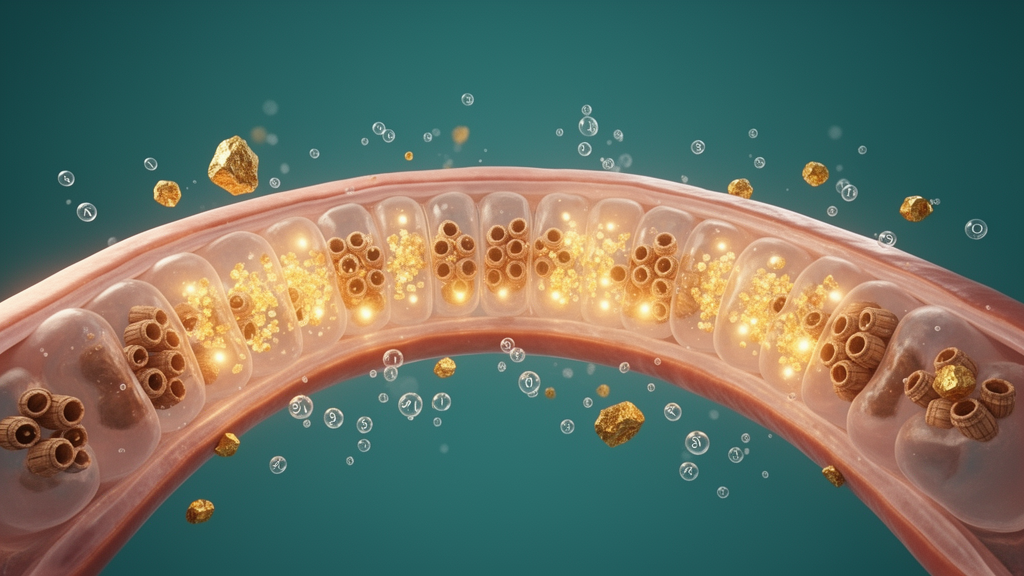
One of the deepest puzzles in developmental biology is how an organ stops being a sketch and becomes a working machine. For the kidney, that transition is dramatic: a newborn mammal cannot concentrate its urine, yet within days the organ acquires the ability to reclaim water with astonishing efficiency, producing urine up to ten times saltier than blood. A team at Kumamoto University reporting in Nature Communications has now identified the trigger for this transformation, and it is not a growth factor, a hormone, or a gene program switched on by a master transcription factor in the conventional sense. It is salt itself. The physical stress of a hyperosmotic environment, the researchers show, actively drives the maturation of the collecting duct, the final gate through which the body fine-tunes its water balance.
The collecting duct runs from the kidney’s cortex down into the medulla, an inner zone where sodium chloride and urea accumulate to extraordinary levels. While the cortical interstitium sits near the serum value of roughly 300 mOsm/kg, the inner medulla in humans can reach about 1200 mOsm/kg, and in mice up to 4000 mOsm/kg. This gradient is built by the loops of Henle, which pump salt into the surrounding tissue, allowing water to be drawn osmotically out of the urine as it flows through the medullary collecting ducts. The process is governed by the hormone arginine vasopressin, which triggers the water channel aquaporin 2 to move to the apical membrane of duct cells. What has remained unclear is whether this brutal hypertonic environment, long viewed as a challenge the kidney must simply survive, might instead be an instruction the kidney uses to build itself.
To test the idea, the team isolated ureteric buds, the embryonic progenitors of the collecting duct, from day 11.5 mouse kidneys and grew them in culture while stepping the medium’s osmolality upward with sodium chloride, reaching 750 mOsm/kg. The effect was unmistakable. The ducts dilated their lumens, their epithelial cells grew taller and broader, and they upregulated polarized epithelial markers such as basolateral cadherin-16 and apical mucin 1. Their primary cilia, sensory antennae on the cell surface, elongated significantly. Crucially, adding pure water to achieve the same dilution did nothing, and urea, which diffuses across cell membranes, failed to reproduce the changes. Only non-permeating solutes, which exert what physiologists call effective osmolality or tonicity, worked. Tonicity, not mere osmolality, is the developmental cue.
Single-cell RNA sequencing revealed how deep the transformation goes. High tonicity upregulated nearly 4,000 genes spanning transcription factors, channels, transporters, metabolic enzymes, and extracellular matrix molecules. Of the maturation markers that distinguish embryonic collecting ducts from their postnatal counterparts, 43 percent were switched on by tonicity alone. Unbiased clustering showed that ducts grown in salty medium shifted their transcriptional identity away from the immature profile of embryonic day 15.5 and toward that of postnatal day 7 medullary principal cells. The cells also acquired real physiological functions: they responded to vasopressin by shuttling aquaporin 2 to their apical surfaces, they upregulated the urea transporter UT-A, and they survived a punishing 450 millimolar urea challenge that destroyed ducts raised at normal tonicity. Even prostaglandin E2 production, a metabolic signature of mature ducts, rose measurably by mass spectrometry.
The molecular conductor of this program is NFAT5, also known as tonicity-responsive enhancer binding protein, the only known transcription factor that converts hypertonic stress into gene expression. In postnatal kidneys, NFAT5 protein appeared in the nuclei of medullary but not cortical cells, and in culture it accumulated in duct cell nuclei as tonicity climbed. When the researchers deleted Nfat5 specifically in the ureteric bud lineage, ducts grown at high tonicity grew poorly and lost epithelial organization. Single-cell analysis showed that NFAT5 governed 35 percent of the tonicity-induced genes and, more strikingly, 55 percent of the tonicity-driven maturation markers, particularly those involved in ion transport and osmoprotective molecules such as aldose reductase. The remaining tonicity responses proceed through NFAT5-independent pathways, indicating a layered regulatory architecture in which salt stress recruits both a dedicated hypertonicity sensor and broader developmental circuits.
To confirm the mechanism inside a living animal, the team interfered with the kidney’s salt-building machinery in newborn mice. The transporter NKCC2, encoded by Slc12a1 in the thick ascending limb, is responsible for loading sodium chloride into the medullary interstitium. Genetic deletion of Slc12a1 causes severe hydronephrosis, so the researchers instead treated neonatal mice with furosemide, the common diuretic that inhibits NKCC2. By postnatal day 7, the treated animals showed impaired inner medullary development, reduced NFAT5 signaling, and diminished expression of the very maturation markers that tonicity had induced in culture, including Hif1a and Col4a3 in both epithelial and stromal compartments. The medulla, in short, fails to mature when its salt is taken away, establishing tonicity as a genuine in vivo developmental signal rather than a culture artifact.
Tonicity alone, however, could not fully induce Aqp2, the gene encoding the apical water channel that is the functional heart of the collecting duct. The missing ingredient turned out to be hormonal. When the researchers combined the salt protocol with vasopressin and aldosterone, Aqp2 expression rose to levels approaching those of postnatal ducts, while hormones alone barely moved other maturation markers. The two signals act on largely separate target sets, sharing only about seven percent of their regulated genes, with water-related channels and transporters sitting in the overlap. Ducts cultured at 750 mOsm/kg with hormones mapped, in integrated single-cell analyses, onto postnatal day 7 inner medullary principal cells, with marker expression statistically indistinguishable from the native tissue. Interestingly, different osmolalities appeared to specify different medullary domains: 450 mOsm/kg favored vasopressin responsiveness and Aqp2, while 750 mOsm/kg drove markers of the saltiest papillary region, mirroring the zonal organization of the real kidney.
The team then translated the protocol to human induced pluripotent stem cells, applying a gentler, extended version of the tonicity ramp to ureteric bud organoids, supplemented with forskolin to help the immature tissue tolerate the stress. Human collecting duct organoids cultured at 900 mOsm/kg with vasopressin and aldosterone developed dilated lumens, taller epithelia, apically localized AQP2, basolateral AQP3, and a roughly 120-fold increase in AVPR2, the vasopressin receptor that is normally undetectable in conventional organoids. In single-cell comparisons, the combined-protocol organoids expressed higher levels of collecting duct genes than both established hormone-based organoids and recently developed kidney assembloids, which remain frozen at a second-trimester stage of maturity. Against the Kidney Precision Medicine Project reference atlas, the organoid cells clustered with adult human medullary principal cells and matched their expression of medulla-specific markers such as SLC14A2, PTGS1, and HIF1A, suggesting the protocol pushes human tissue potentially all the way to the adult stage.
Maturity brought function, and function brought disease modeling. The researchers generated NFAT5 knockout human organoids, which could not survive the full 900 mOsm/kg stress and showed reduced AQP2 along with elevated expression of the sodium channel subunits SCNN1A and SCNN1G, a pattern that may explain why human genetic studies link NFAT5 variants to serum osmolality and salt-sensitive hypertension. Treating mature organoids with lithium chloride, the most common cause of acquired nephrogenic diabetes insipidus, cut AQP2 and AQP3 protein levels and blunted the organoids’ swelling response to a hypotonic challenge from a 25.9 percent volume increase to just 12.0 percent. The team also engineered organoids carrying the Q174R mutation in AVPR2, which causes severe congenital nephrogenic diabetes insipidus. These mutant organoids failed to move AQP2 to their apical membranes in response to the vasopressin analog ddAVP and showed markedly reduced water permeability, reproducing the patients’ pathophysiology in a dish for the first time in a three-dimensional human system.
Beyond the clinic, the study reframes how biologists think about organ maturation itself. The maturation state, the authors note, behaves not as a terminal endpoint but as a fluid continuum of reversible adaptive states, and physical environmental cues may be as instructive as the soluble factors that have dominated the field. The parallels extend to evolution: reptilian kidneys lack a medulla and cannot concentrate urine, amphibians build a primitive salt-only medulla, and mammals added urea on top of salt, a sequence that echoes the developmental order in which Slc12a1 turns on before Slc14a2. The researchers suggest that low pH and hypoxia, the medulla’s other signature stresses, may prove to be additional maturation signals, and that similar physical cues await discovery in the bladder, the gut, and beyond. For a field long stuck growing fetal fragments of organs, the message is bracing: sometimes the environment does not merely test an organ. It teaches it.
Subject of Research: Tonicity-driven maturation of the mammalian kidney collecting duct via NFAT5
Article Title: Tonicity drives collecting duct maturation in the mammalian kidney
Article References: Inoue, D., Miike, K., Tanigawa, S., Yasunaga, K.-I., Maeda, R., Ohmori, T., Fujimura, S., Mukoyama, M., Kamba, T., Aramburu, J., Lopez-Rodriguez, C., Sugiura, Y., Izumi, Y., & Nishinakamura, R. (2026). Tonicity drives collecting duct maturation in the mammalian kidney. Nature Communications, 17(1), Article 10130. https://doi.org/10.1038/s41467-026-77903-4
Image Credits: AI Generated
DOI: 10.1038/s41467-026-77903-4
Keywords: kidney, collecting duct, organoids, tonicity, NFAT5, aquaporin 2, vasopressin, renal medulla, nephrogenic diabetes insipidus, lithium, urine concentration, organ maturation
Cite Scienmag News
Ophelia Keating. (October 18, 2026). Salt stress revealed as the hidden signal that matures the kidney’s water gate. Scienmag. https://scienmag.com/salt-stress-revealed-as-the-hidden-signal-that-matures-the-kidneys-water-gate/
Ophelia Keating. "Salt stress revealed as the hidden signal that matures the kidney’s water gate." Scienmag, 18 October 2026, https://scienmag.com/salt-stress-revealed-as-the-hidden-signal-that-matures-the-kidneys-water-gate/. Accessed 18 October 2026.
Ophelia Keating. "Salt stress revealed as the hidden signal that matures the kidney’s water gate." Scienmag. October 18, 2026. https://scienmag.com/salt-stress-revealed-as-the-hidden-signal-that-matures-the-kidneys-water-gate/


