


Diabetic retinopathy, a complication of diabetes that damages the light-sensitive tissue at the back of the eye, is quietly becoming one of the most alarming epidemics of our time. While wealthy nations have organised screening programmes to catch the disease before it steals vision, most low- and middle-income countries have struggled to build any systematic response at all. Now a sweeping scoping review published in BMC Health Services Research has mapped, for the first time on this scale, exactly how poorer nations are improvising their way through this crisis — and the picture that emerges is one of remarkable ingenuity built on task-sharing, digital imaging, telemedicine and artificial intelligence.
The research team, led by Shaffi Mdala of the International Centre for Eye Health at the London School of Hygiene and Tropical Medicine, together with colleagues from Kamuzu University of Health Sciences in Malawi and partner institutions, analysed 129 reports from 58 countries. Using the Arksey and O’Malley scoping review framework and reporting according to PRISMA-ScR guidelines, they searched MEDLINE, Embase, Global Health and CENTRAL for studies published between 2000 and December 2025, supplementing their search with targeted grey literature. Their goal was to describe operational service delivery models across the entire continuum of diabetic retinopathy care — screening, referral and treatment — and to assess the nature and scope of evidence on their effectiveness in resource-limited settings.
The burden driving this work is projected to increase disproportionately in low- and middle-income countries, precisely where health systems are least equipped to respond. Blindness from diabetic retinopathy is preventable through organised screening and prompt treatment, yet most of these nations lack structured service delivery models because of resource constraints. The review reveals that most of the documented programmes were conducted in lower-middle-income countries, which accounted for 50.4 percent of reports, and upper-middle-income countries, which accounted for 42.6 percent — a distribution that itself highlights how thin the evidence base remains for the poorest nations.
Perhaps the most striking technical finding concerns how screening is actually delivered. In the majority of programmes, screening was opportunistic, meaning patients were examined when they happened to come into contact with the health system rather than through systematic recall, and this approach accounted for 61.1 percent of reports. Screening was most commonly delivered at the primary level of care, representing 50.9 percent of reports. In most programmes, screening was offered alongside routine diabetes services at various levels of the health system, documented in 77 of 94 reports, or 81.9 percent. Physically, screening was delivered within diabetes or non-communicable disease clinic settings in 36 of 109 reports, or 33.0 percent — a decentralisation strategy that embeds eye care directly into the clinics patients already visit.
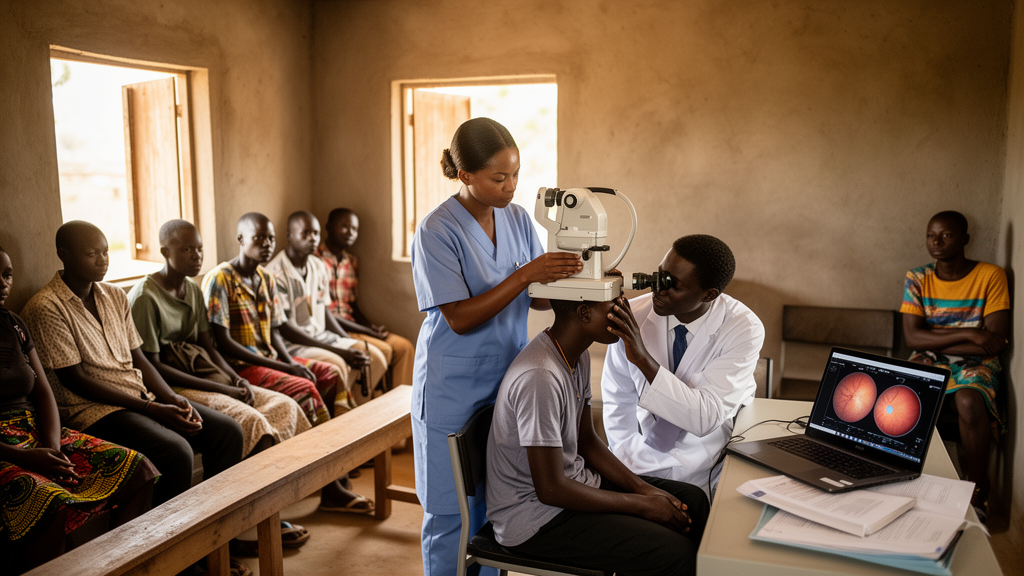
The review also documents a profound restructuring of the workforce delivering these services. Task-sharing with non-eye health cadres was documented in 28.6 percent of reports, while task-shifting models appeared in 16.1 percent. These approaches delegate retinal examination and grading to nurses, general practitioners, or community health workers rather than relying solely on ophthalmologists, who remain scarce across much of the developing world. This workforce redesign is supported by a technological backbone: digital retinal imaging was used in 75.5 percent of reports, telemedicine in 42.9 percent, and artificial intelligence-assisted grading in 9.8 percent. Together, these tools allow fundus photographs to be captured by minimally trained personnel, transmitted to remote reading centres, and graded either by human graders working at a distance or, increasingly, by algorithms trained to detect retinopathy.
Yet the review exposes a critical asymmetry at the heart of diabetic retinopathy care in poorer nations. While screening has become increasingly decentralised, treatment services remain largely centralised, concentrated in tertiary hospitals and specialised eye centres that many patients cannot easily reach. Referral pathways were described in the literature, but the evidence on whether those pathways actually function is startlingly thin. Only five studies reported referral adherence, seven reported treatment uptake, and nine reported post-treatment visual outcomes. This means that for the vast majority of documented programmes, researchers simply do not know whether patients identified with sight-threatening retinopathy ever received the laser treatment, injections, or surgery they needed — or whether that treatment preserved their vision.
The economic evidence offers a brighter thread. Organised screening and combined screening and treatment programmes were reported as cost-effective in the reviewed literature, suggesting that systematic approaches can deliver value for money even in severely constrained budgets. This finding matters enormously for policy makers weighing whether to invest scarce resources in structured programmes rather than continuing with opportunistic, ad hoc responses. However, the review notes that evidence on the performance of referral pathways or treatment outcomes remains limited, tempering the confidence with which any single model can be recommended.
What emerges from this review is a portrait of health systems adapting under pressure, using whatever cadres, technologies and integration points are available. The convergence of decentralised screening, workforce task-sharing and technology-assisted approaches represents a coherent response to the fundamental constraint: too few eye health specialists for too many people living with diabetes. The integration of screening within routine diabetes care, documented in over 80 percent of programmes, reflects a pragmatic recognition that patients are already in the system — the challenge is to add retinal examination without adding separate infrastructure.
The implications for the coming decade are significant. As diabetes prevalence continues to climb in low- and middle-income countries, the number of people at risk of retinopathy will grow in tandem, and the window for building organised services before the epidemic overwhelms available capacity is narrowing. The review’s mapping of existing models — from primary-level opportunistic screening supported by digital imaging to telemedicine-linked grading networks — provides policy makers and programme designers with a technical catalogue of what has actually been implemented, rather than what might theoretically work. The researchers, funded by the National Institute for Health and Care Research as part of a Global Health project, with Matthew Burton supported by the Wellcome Trust, emphasise that their synthesis is intended to inform policy and programme design in resource-limited settings.
The gaps the review identifies may prove as consequential as the models it documents. Without better evidence on referral adherence, treatment uptake and post-treatment visual outcomes, health systems cannot know whether their screening investments translate into saved vision. The researchers suggest that future work must close this evidence loop, tracking patients from identification through treatment and beyond. For now, the review stands as the most comprehensive technical map of how the world’s poorer nations are confronting a preventable cause of blindness — revealing both the ingenuity of their adaptations and the distance still to travel.
Subject of Research: Delivery models of diabetic retinopathy services in low- and middle-income countries: a scoping review
Article Title: Delivery models of diabetic retinopathy services in low- and middle-income countries: a scoping review
Article References: Mdala, S., Kayange, P., Zungu, T., Heatley, A. C., Maluwa-Yairo, C., Siwinda, S., Puddu, M., Gordon, I., Evans, J. R., Marques, A. P., Burton, M., & Bascaran, C. (2026). Delivery models of diabetic retinopathy services in low- and middle-income countries: a scoping review. BMC Health Services Research. https://doi.org/10.1186/s12913-026-15711-8
Image Credits: AI Generated
DOI: 10.1186/s12913-026-15711-8
Keywords: Delivery, models, diabetic, retinopathy, services, low-, middle-income, countries, scoping, review, scientific research
Cite Scienmag News
Ophelia Keating. (October 18, 2026). Delivery models of diabetic retinopathy services in low- and middle-income countries: a scoping review. Scienmag. https://scienmag.com/delivery-models-of-diabetic-retinopathy-services-in-low-and-middle-income-countries-a-scoping-review/
Ophelia Keating. "Delivery models of diabetic retinopathy services in low- and middle-income countries: a scoping review." Scienmag, 18 October 2026, https://scienmag.com/delivery-models-of-diabetic-retinopathy-services-in-low-and-middle-income-countries-a-scoping-review/. Accessed 18 October 2026.
Ophelia Keating. "Delivery models of diabetic retinopathy services in low- and middle-income countries: a scoping review." Scienmag. October 18, 2026. https://scienmag.com/delivery-models-of-diabetic-retinopathy-services-in-low-and-middle-income-countries-a-scoping-review/


