


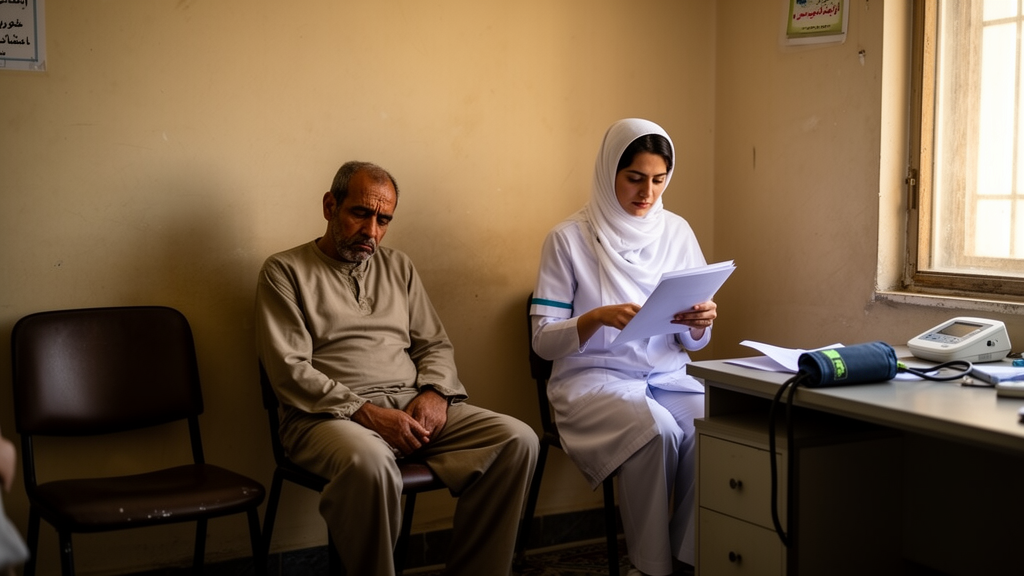
When people living with HIV in Shiraz, Iran’s largest city in the south, first walk through the doors of the regional referral center, many are already carrying a dangerous secret in their blood. A retrospective study of 112 HIV-infected patients treated there in 2023 and 2024 has found that 46 percent arrived with CD4+ T-cell counts below 200 cells per microliter, the threshold that defines severe immunosuppression and marks the clinical boundary of AIDS. The findings, published in BMC Infectious Diseases by researchers at the HIV/AIDS Research Center of Shiraz University of Medical Sciences, offer one of the most detailed clinical portraits yet of people living with HIV in the Middle East and North Africa region, where the pandemic continues to expand even as it stabilizes elsewhere.
The numbers tell a story of late diagnosis. Of the 112 patients included in the cohort, 72, or 64 percent, were male and 40, or 36 percent, were female, with a mean age of 39 plus or minus 11 years. Heterosexual contact was the most frequently documented route of transmission, accounting for 73 of the 112 infections, or 65 percent. That figure is significant for a region where HIV has historically been associated with injection drug use; it suggests the epidemic in southern Iran has shifted decisively toward sexual transmission, mirroring patterns seen across the MENA region where new infections increasingly occur through heterosexual contact.
At the time of their first visit, 48 patients, or 43 percent, showed asymptomatic HIV infection, classified as stage 1 under the World Health Organization’s clinical staging system. The remaining 64 patients, or 57 percent, presented with clinical symptoms distributed across stage 2, stage 3, and stage 4 of the disease. Stage 4, the most advanced category, accounted for 43 of those 64 symptomatic patients, meaning that more than a third of the entire cohort arrived at the referral center already in the most severe clinical stage of HIV infection. This distribution is a technical marker of delayed linkage to care, the interval between infection and the moment a person enters the treatment system.
The immunological data reinforce that picture. Among the 112 patients, 52, or 46 percent, had CD4+ T-cell counts below 200 cells per microliter at their first assessment. CD4+ T cells are the immune system’s coordinators, the cells that HIV preferentially destroys as it replicates. When their number falls below 200 per microliter, the body loses its ability to mount effective defenses against pathogens that healthy immune systems routinely suppress. The count is measured by flow cytometry, a laboratory technique that labels immune cells with fluorescent antibodies and counts them one by one as they pass through a laser beam. It remains the single most important laboratory indicator of how far HIV has progressed in a given patient.
Cerebral toxoplasmosis emerged as the most common opportunistic infection in the cohort, documented in 39 cases, or 35 percent of the study population. Toxoplasmosis is caused by the parasite Toxoplasma gondii, a single-celled organism that infects an estimated one-third of the global population but remains dormant in healthy individuals. When CD4+ T-cell counts collapse, the parasite reactivates in the brain, causing seizures, headaches, confusion, and focal neurological deficits that can be fatal without treatment. The association between low CD4 counts and cerebral toxoplasmosis was striking: among the 64 patients with clinical symptoms, 45 had CD4+ cell counts below 200 cells per microliter.
Multivariable logistic regression, a statistical technique that isolates the independent effect of each variable while controlling for confounders such as age, sex, and disease stage, confirmed the strength of that relationship. Patients with CD4+ T-cell counts below 200 cells per microliter had an adjusted odds ratio of 11.25 for cerebral toxoplasmosis, with a 95 percent confidence interval of 4.41 to 28.64 and a P value below 0.001. In practical terms, a person whose CD4 count had fallen below that threshold was more than eleven times as likely to develop the brain infection as someone whose count remained above it. That magnitude of association is rare in clinical epidemiology and underscores how precisely the CD4 count predicts vulnerability to specific opportunistic pathogens.
Co-infections added another layer of complexity to the clinical picture. Hepatitis C virus was the most common co-infection, documented in 20 of the 112 patients, or 18 percent. HCV and HIV share transmission routes, and co-infection accelerates liver damage in ways that complicate antiretroviral therapy. The relatively low HCV prevalence in this cohort, compared with historical figures from Iranian HIV populations where injection drug use drove transmission, further supports the conclusion that sexual contact now dominates the local epidemic. The study also collected data on hepatitis B virus co-infection, sexually transmitted infections, and other opportunistic conditions, though cerebral toxoplasmosis stood out as the most frequently documented opportunistic condition overall.
Antiretroviral therapy, the cornerstone of modern HIV treatment, suppresses viral replication and allows CD4+ T-cell counts to recover, restoring immune function over months to years. The study collected data on antiretroviral regimens and treatment outcomes, though the retrospective design means the analysis captures patients at the moment of their first visit rather than tracking long-term treatment response. Only 2 of the 112 patients died during the observation period, one from ovarian cancer and the other from immunological and hematological disorders, a mortality figure that reflects both the effectiveness of available treatment and the young mean age of the cohort.
The authors conclude that their findings support earlier HIV diagnosis, timely linkage to care, and targeted prevention strategies. Nearly half of the patients arriving at the referral center had already lost the immune defenses that antiretroviral therapy preserves, and cerebral toxoplasmosis, a preventable condition, was the most common manifestation of that loss. The study was approved by the Ethics Committee of Shiraz University of Medical Sciences and conducted in accordance with the Declaration of Helsinki, with patient identities coded and data anonymized throughout.
The researchers caution that the single-center design and substantial exclusion of records due to incomplete documentation limit how far these findings can be generalized to the wider Iranian HIV population. Shiraz serves as a regional referral hub, and the patients who reach it may differ systematically from those who never enter care. Still, the clinical portrait is technically consistent with regional patterns: sexual transmission dominates, late presentation is common, and opportunistic infections cluster around the CD4 threshold of 200 cells per microliter. For a MENA region where HIV burden is growing, the message is that diagnosis must arrive before the immune system collapses, not after.
Subject of Research: Infectious Diseases
Article Title: Clinical and epidemiological characterization of patients with HIV/AIDS in Shiraz, Iran
Article References: Sohrabi, M., Ghahramani, N., Shekiba, M. J., Bemani, S., Nekoi, E., Hajirajabi, M., Motamedifar, M., & Ghasemi, H. (2026). Clinical and epidemiological characterization of patients with HIV/AIDS in Shiraz, Iran. BMC Infectious Diseases. https://doi.org/10.1186/s12879-026-14651-2
Image Credits: AI Generated
DOI: 10.1186/s12879-026-14651-2
Keywords: HIV, AIDS, CD4 T-cell count, cerebral toxoplasmosis, hepatitis C, Iran, MENA, opportunistic infections, antiretroviral therapy, late diagnosis, Clinical, epidemiological
Cite Scienmag News
Ophelia Keating. (October 18, 2026). HIV Patients in Southern Iran Arrive Late: Nearly Half Show Severe Immunosuppression at First Visit. Scienmag. https://scienmag.com/hiv-patients-in-southern-iran-arrive-late-nearly-half-show-severe-immunosuppression-at-first-visit/
Ophelia Keating. "HIV Patients in Southern Iran Arrive Late: Nearly Half Show Severe Immunosuppression at First Visit." Scienmag, 18 October 2026, https://scienmag.com/hiv-patients-in-southern-iran-arrive-late-nearly-half-show-severe-immunosuppression-at-first-visit/. Accessed 18 October 2026.
Ophelia Keating. "HIV Patients in Southern Iran Arrive Late: Nearly Half Show Severe Immunosuppression at First Visit." Scienmag. October 18, 2026. https://scienmag.com/hiv-patients-in-southern-iran-arrive-late-nearly-half-show-severe-immunosuppression-at-first-visit/


