


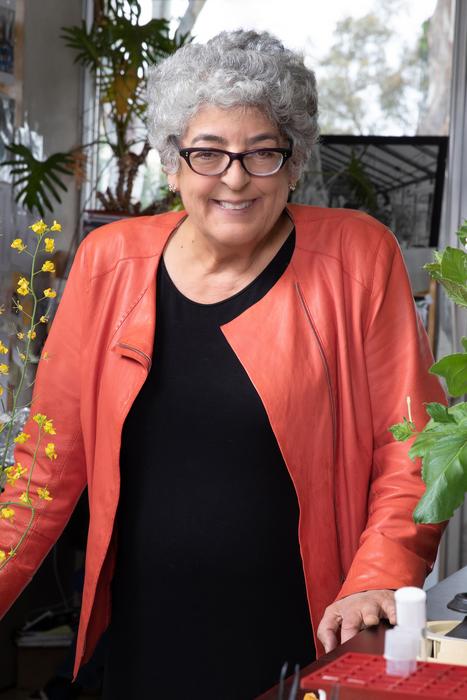
LA JOLLA (July 8, 2024)—Salk Institute Professor Joanne Chory has been selected by the Wolf Foundation to receive a 2024 Wolf Prize in the field of agriculture for her “key discoveries on plant developmental biology of relevance for crop improvements.” The award is endowed annually to scientists and artists worldwide for their “outstanding achievements in advancing science and the arts for the betterment of humanity.”

Credit: Salk Institute
LA JOLLA (July 8, 2024)—Salk Institute Professor Joanne Chory has been selected by the Wolf Foundation to receive a 2024 Wolf Prize in the field of agriculture for her “key discoveries on plant developmental biology of relevance for crop improvements.” The award is endowed annually to scientists and artists worldwide for their “outstanding achievements in advancing science and the arts for the betterment of humanity.”
Announced on July 3, Chory’s award in agriculture is shared with two other professors, Elliot Meyerowitz of the California Institute of Technology and Venkatesan Sundaresan of UC Davis. Chory will be the third Salk faculty member to receive the Wolf Prize, following Professors Tony Hunter (2005) and Ronald Evans (2012).
“The progression of plant science at Salk and around the world is inextricably linked to Joanne’s work as a scientist and mentor,” says Salk President Gerald Joyce. “This recognition from the Wolf Foundation for her work on plant growth, development, and environmental response is beyond well-deserved.”
Chory is director of Salk’s Plant Molecular and Cellular Biology Laboratory, founding director of Salk’s Harnessing Plants Initiative, the Howard H. and Maryam R. Newman Chair in Plant Biology, and a Howard Hughes Medical Institute investigator.
At the center of Chory’s work is a small flowering plant called Arabidopsis thaliana, which has facilitated many of her foundational discoveries in plant biology. Through studying this model organism, Chory has identified many of the genes and molecules that plants use to alter their size, shape, and form in response to different environmental conditions. Her studies have revealed a map for the entire plant steroid hormone signaling system, a daily rhythm of genetic expression in Arabidopsis thaliana with seasonal shifts that can inform farmers’ practices, a mechanism that shaded plants use to outgrow their neighbors, and far more.
Chory has been instrumental in advancing scientists’ understanding of the molecular pathways that control plant adaptation and growth in diverse environments. These discoveries are now being used by researchers to engineer hearty, nutritious crops in the face of environmental stress. The Wolf Prize recognizes the significant impact this research will have on future food security worldwide.
Chory has previously received the 2024 Benjamin Franklin Medal in Life Science, the 2020 Pearl Meister Greengard Prize, the 2018 Breakthrough Prize in Life Sciences, and a 2018 Gruber Genetics Prize. She is a member of nine scientific academies, including the National Academy of Sciences, the American Philosophical Society, and the Royal Society.
About the Wolf Foundation:
The Wolf Foundation is a prestigious organization that celebrates and promotes exceptional achievements in the sciences and the arts worldwide. Founded in 1975 with an endowment from the Wolf family, the Foundation’s major donors were Dr. Ricardo Subirana y Lobo Wolf and his wife, Francisca. Since its inception, the Wolf Foundation has recognized and celebrated outstanding contributions to humanity through the Wolf Prize.
About the Salk Institute for Biological Studies:
Unlocking the secrets of life itself is the driving force behind the Salk Institute. Our team of world-class, award-winning scientists pushes the boundaries of knowledge in areas such as neuroscience, cancer research, aging, immunobiology, plant biology, computational biology, and more. Founded by Jonas Salk, developer of the first safe and effective polio vaccine, the Institute is an independent, nonprofit research organization and architectural landmark: small by choice, intimate by nature, and fearless in the face of any challenge. Learn more at www.salk.edu.
Cite Scienmag News
Alan Morgan. (July 8, 2024). Salk Professor Joanne Chory named 2024 Wolf Prize Laureate in Agriculture. Scienmag. https://scienmag.com/salk-professor-joanne-chory-named-2024-wolf-prize-laureate-in-agriculture/
Alan Morgan. "Salk Professor Joanne Chory named 2024 Wolf Prize Laureate in Agriculture." Scienmag, 8 July 2024, https://scienmag.com/salk-professor-joanne-chory-named-2024-wolf-prize-laureate-in-agriculture/. Accessed 4 September 2026.
Alan Morgan. "Salk Professor Joanne Chory named 2024 Wolf Prize Laureate in Agriculture." Scienmag. July 8, 2024. https://scienmag.com/salk-professor-joanne-chory-named-2024-wolf-prize-laureate-in-agriculture/

