


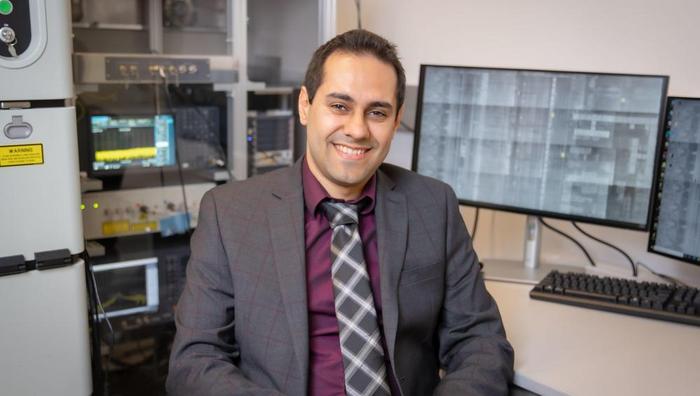
Worcester, Mass. – May 30, 2024 – Worcester Polytechnic Institute (WPI) researcher Shahin Tajik has been awarded a prestigious CAREER Award of $594,081 by the National Science Foundation to develop new technologies to monitor and protect computer chips and other hardware from malicious attacks.

Credit: WPI Photo/Matt Burgos
Worcester, Mass. – May 30, 2024 – Worcester Polytechnic Institute (WPI) researcher Shahin Tajik has been awarded a prestigious CAREER Award of $594,081 by the National Science Foundation to develop new technologies to monitor and protect computer chips and other hardware from malicious attacks.
The grant will enable Tajik, assistant professor in the Department of Electrical and Computer Engineering, to expand his research into hardware security, a field that focuses on physical threats to computing systems that attackers can hijack by tampering with chips, motherboards, and other electronic components traveling through global supply chains.
“When we talk about computer security, many people will think about hacking attacks that target software vulnerabilities,” Tajik said. “However, computers are made of physical components, and they are vulnerable, too. By tampering with chips and motherboards, attackers can essentially spy on processed data on chips or disrupt the functionality of computer chips. This vulnerability is a critical challenge for businesses, infrastructure operators, and national security.”
Computer hardware is vulnerable to tampering because multiple individuals and companies in far-flung locations, including overseas factories, can be involved in the design, production, and assembly of computer components. Ensuring the integrity of components as they travel through supply chains is critical, but tampering can be hard to spot.
Tajik’s five-year project will investigate technologies that could potentially thwart hardware attacks by creating better metrics to verify that a computer’s physical parts are manufactured to design standards, correctly installed, and operating without interference. He also will use information theory to advance understanding about “side-channel attacks,” which involve extracting secrets from a chip or system using physical characteristics of the computing hardware. Finally, Tajik will create physically unclonable functions, also known as PUFs, to monitor the activity of chips in computers.
The project builds on Tajik’s previous research into the use of lasers for side-channel attacks on electronic systems and laser-assisted countermeasures. He is part of a team that received nearly $361,000 in NSF funding to acquire a powerfulmicroscope for hardware security research at WPI, and he leads a team that was awarded nearly $1 million in funding from the Massachusetts Technology Collaborative to acquire a second microscope and launch a WPI center focused on semiconductor security research. The center offers testing services to business and academic researchers to support the semiconductor security industry in Massachusetts.
As part of his project, Tajik will develop a new graduate-level course at WPI on the physical security of microelectronic systems, and he will recruit undergraduates to teams that will conduct research related to the project.
“Research into hardware security is fascinating work, like solving a puzzle and then confronting an even harder puzzle that a hacker has created,” Tajik said. “It’s also important work. The physical layer of computers has been overlooked in security research for a long time, so we have a great opportunity to explore and seek solutions that can address a real need.”
About WPI
WPI is a top-tier STEM-focused research university and a recognized pioneer and global leader in project-based learning. Founded in 1865 on the principle that students learn most effectively by applying the theory learned in the classroom to the practice of solving real-world problems, WPI’s continued mission is to transform lives, turn knowledge into action to confront global challenges, and revolutionize STEM through distinctive and inclusive education, projects, and research. WPI’s project-based curriculum engages undergraduates in solving important scientific, technological, and societal problems throughout their education and at more than 50 project centers around the world. Today WPI offers more than 70 bachelor’s, master’s, and doctoral degree programs across 18 academic departments in science, engineering, technology, business, the social sciences, and the humanities and arts. Its faculty and students pursue groundbreaking research to meet ongoing challenges in health and biotechnology; robotics and the internet of things; advanced materials and manufacturing; cyber, data, and security systems; learning science; and more. www.wpi.edu
Cite Scienmag News
Courtney Benton. (May 30, 2024). Safer computing: WPI researcher receives $594,081 to develop tools to protect hardware from hackers. Scienmag. https://scienmag.com/safer-computing-wpi-researcher-receives-594081-to-develop-tools-to-protect-hardware-from-hackers/
Courtney Benton. "Safer computing: WPI researcher receives $594,081 to develop tools to protect hardware from hackers." Scienmag, 30 May 2024, https://scienmag.com/safer-computing-wpi-researcher-receives-594081-to-develop-tools-to-protect-hardware-from-hackers/. Accessed 3 September 2026.
Courtney Benton. "Safer computing: WPI researcher receives $594,081 to develop tools to protect hardware from hackers." Scienmag. May 30, 2024. https://scienmag.com/safer-computing-wpi-researcher-receives-594081-to-develop-tools-to-protect-hardware-from-hackers/

