


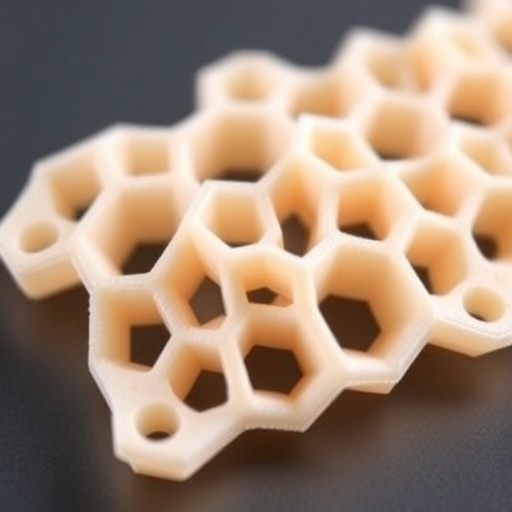
In a groundbreaking advancement poised to transform the landscape of additive manufacturing, a team of researchers has unveiled an innovative method for creating biocemented porous structures. This approach leverages selective binding combined with an active print bed compaction technique, pushing the boundaries of how we fabricate complex, durable, and environmentally friendly materials. This pioneering work offers promising implications for fields ranging from construction and biomedical engineering to sustainable manufacturing practices.
Additive manufacturing, or 3D printing, has already disrupted traditional construction and fabrication processes by enabling intricate designs and customizability. However, the production of porous structures with high mechanical integrity has remained a formidable challenge. Porosity often compromises strength and durability, limiting practical applications where both lightness and resilience are essential. The research team confronted this challenge head-on by integrating biocementation processes into selective binding mechanisms during printing, thereby creating materials that are not only porous but also significantly more robust.
At the core of this technological breakthrough is the utilization of biocement—a bio-inspired binding agent produced through biologically mediating processes that precipitate calcium carbonate to bind particles together. Unlike conventional cement, biocement provides a sustainable, eco-compatible adhesive mechanism that can be tuned through biological activity. By embedding this process into a controlled additive manufacturing environment, the team achieved unparalleled control over microstructural properties within printed parts.
The selective binding method employed entails targeted deposition of the biocement from a printing nozzle onto powder substrates layer by layer. This achieves spatially controlled adhesion, permitting engineered porosity within the resulting structure. Unlike traditional cement extrusion or casting, this process allows the creation of complex geometries with tailored internal architectures that enhance mechanical performance while reducing overall weight. Selectivity ensures that binding only occurs where necessary, preserving void spaces critical for porous configurations.
Complementing selective binding, the active print bed compaction technique is a major innovation that mitigates one of the largest hurdles in powder-based additive manufacturing—particle stability during printing. As each layer is laid down, the print bed actively compacts the powder particles with calibrated pressure. This compaction increases particle packing density, reducing defects and porosity irregularities that can cause structural weaknesses. The synergy between selective binding and compaction creates a composite effect, improving strength without sacrificing porosity.
Experimental validation of this method demonstrated exceptional mechanical properties in the final biocemented structures. Compression tests revealed significant enhancements in strength and stiffness compared to previous porous printed materials, while scanning electron microscopy confirmed uniform microstructural consistency. The researchers reported that even highly porous iterations resisted cracking and mechanical deformation under substantial loads, underscoring the effectiveness of their dual-process printing approach.
Moreover, the environmental implications of this work cannot be overstated. Conventional cement production is a major carbon emitter worldwide, contributing substantially to climate change concerns. The biocement approach significantly reduces the carbon footprint by replacing traditional chemical cements with biomimetic, low-energy processes. Additionally, by enabling additive manufacturing of complex structures, this method reduces material waste characteristic of subtractive manufacturing techniques. The potential for creating sustainable construction materials with tailored mechanical properties offers a promising solution to the dual goals of environmental responsibility and high-performance engineering.
Beyond construction, the biomedical arena stands to benefit greatly from this research. Porous scaffolds are essential in tissue engineering, where nutrient flow, cellular infiltration, and vascularization depend on optimal pore architecture. The ability to precisely engineer porosity alongside mechanical stability offers exciting opportunities for creating customized implants and tissue supports that biologically integrate into the human body. The print bed compaction ensures structural integrity crucial for load-bearing applications, while selective binding controls the bioavailability of scaffold components.
The integration of biological processes within an additive manufacturing workflow represents a true convergence of material science, biology, and mechanical engineering. Managing live biological agents capable of mediating mineral formation under precise spatial and temporal conditions requires a deep understanding of both biochemistry and print system dynamics. The researchers developed sophisticated control algorithms to modulate print speed, binding agent deposition volume, and compaction forces, synchronizing these parameters to optimize the output material properties. This multidisciplinary orchestration exemplifies the complexity and innovation required to achieve such a feat.
Scalability is another aspect rigorously addressed by the team. While many advances in additive manufacturing remain confined to laboratory-scale prototypes, this method has been engineered with industrial applicability in mind. The print bed compaction mechanism is modular and adaptable to existing powder-based printers, and the biocement composition can be tailored to various powder substrates, including sand, ceramics, and recycled materials. Such versatility hints at the rapid adoption potential across multiple industry sectors, including construction, aerospace, and biomedical manufacturing.
Economic viability is often the ultimate test of new manufacturing technologies, and the researchers have made strides in this area as well. Biocement’s raw materials are abundant and inexpensive, and the process operates under ambient temperature and pressure conditions, minimizing energy costs. Furthermore, the printing process’s inherent efficiency in material usage and speed of production promises to reduce labor and operational expenses, potentially enabling wider market penetration. The cost-effectiveness coupled with performance benefits presents this method as a compelling alternative to traditional 3D printing and cementation techniques.
Mesh design and control over pore morphology were pivotal aspects analyzed in detail. By adjusting selective binding parameters and compaction forces, the researchers could deftly modulate pore size distribution, interconnectivity, and overall porosity percentage. This level of control is crucial for applications where fluid flow or mechanical properties must be finely tuned, such as filters, bone implants, or lightweight structural panels. The adaptable nature of the method allows for custom-designed materials specific to an application’s unique requirements, signaling a major shift from “one-size-fits-all” to bespoke manufacturing.
In essence, this research opens the door to a new class of engineered materials where traditional boundaries between biological and mechanical material synthesis blur. The team’s method showcases how bioinspired chemistry can be harnessed within advanced manufacturing platforms to create novel porous structures with unparalleled properties. It represents a leap toward the next generation of smart materials—ones that not only perform but do so sustainably, efficiently, and reliably.
From a broader perspective, the success of this additive manufacturing strategy suggests a future where materials can be printed on-demand with embedded functionality driven by biological processes. Imagine construction materials that self-heal or medical scaffolds that dynamically adapt to biological cues—these futures feel ever more tangible due to the foundational techniques introduced herein. Such visionary potential reflects the transformative impact of merging biology and manufacturing in previously unimagined ways.
As the technology matures, its impact will extend beyond initial applications. The foundational principles of selective binding combined with active print bed compaction could inspire new hybrid manufacturing workflows incorporating living organisms, responsive compounds, or adaptive architectures. This paradigm shift holds promise for addressing global challenges in sustainable development, healthcare innovation, and industrial fabrication, illustrating how cutting-edge research translates into real-world solutions.
In conclusion, the advent of additive manufacturing utilizing biocemented porous structures synthesized through selective binding and active print bed compaction marks a pivotal technological milestone. This research integrates biological mineralization with precision printing and mechanical compaction, producing structures possessing unmatched mechanical robustness, environmental sustainability, and design flexibility. Its implications ripple across multiple disciplines, heralding a transformative era in materials science and manufacturing technology for both present and future generations.
Cite Scienmag News
Denise Maddox. (June 15, 2026). 3D Printing Biocemented Porous Structures with Precision. Scienmag. https://scienmag.com/3d-printing-biocemented-porous-structures-with-precision/
Denise Maddox. "3D Printing Biocemented Porous Structures with Precision." Scienmag, 15 June 2026, https://scienmag.com/3d-printing-biocemented-porous-structures-with-precision/. Accessed 3 September 2026.
Denise Maddox. "3D Printing Biocemented Porous Structures with Precision." Scienmag. June 15, 2026. https://scienmag.com/3d-printing-biocemented-porous-structures-with-precision/


