


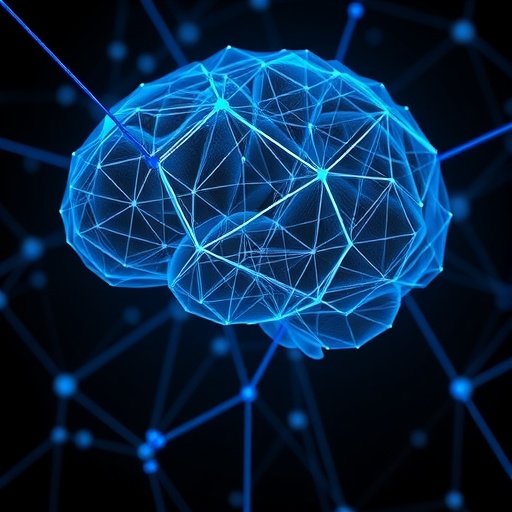
In the rapidly evolving landscape of neuroscience and artificial intelligence, the quest to unravel the mysteries of the human brain’s resting-state connectivity has taken a significant leap forward. Recently, a groundbreaking study by Ma, J., Luo, J., Liu, D., and colleagues has introduced an innovative computational framework known as the Hypergraph Neural Field-Fourier Deep Neural Network (HNFF-DNN). Their work promises to refine our understanding of the brain’s intrinsic functional networks with unprecedented accuracy, opening new avenues for research into cognitive functions, neurological disorders, and brain-machine interfaces.
Resting-brain functional connectivity refers to the spontaneous, synchronized activity patterns observed across different brain regions when the brain is not engaged in any specific external task. This intrinsic activity forms complex networks, often conceptualized as the brain’s default mode of operation, underpinning a wide array of cognitive processes from memory consolidation to self-referential thought. Accurately modeling this connectivity remains one of the most challenging endeavors in computational neuroscience due to the brain’s inherent complexity and the nonlinear nature of neural interactions.
Traditional approaches to modeling resting-state connectivity have employed various graph-theoretic and machine learning techniques, yet these methods often struggle to capture the high-dimensional and dynamic relationships intrinsic to brain activity. The novelty of Ma et al.’s approach lies in the integration of hypergraph theory with neural field models, combined through an advanced Fourier-based deep neural network architecture. This hybrid model not only preserves the multifaceted interactions across multiple brain regions but also enhances interpretability and computational efficiency, crucial for processing vast neuroimaging datasets.
Hypergraphs extend classical graph representations by allowing edges (called hyperedges) to connect more than two nodes, thus elegantly encapsulating the brain’s polyadic interactions. This richer representation aligns more closely with the brain’s actual functional topology, where groups of regions can act together synergistically rather than simply in pairs. By embedding this hypergraph structure into neural field equations, the authors simulate the spatiotemporal evolution of brain activity fields over these complex networks, mimicking biological neural fields more realistically than conventional graph-based models.
The application of Fourier transformations within this framework enables the decomposition of neural signals into their constituent frequency components, an essential advantage given the frequency-dependent nature of brain connectivity patterns. The deep neural network component then serves to learn intricate mappings from hypergraph-based neural fields to observed functional connectivity measurements, effectively bridging the theoretical modeling with empirical data from functional magnetic resonance imaging (fMRI) and other neuroimaging modalities.
Remarkably, the HNFF-DNN model demonstrates superior performance not only in terms of fitting empirical data but also in predicting unseen connectivity patterns across individuals. This generalizability is critical for translational applications such as personalized medicine, where modeling individual-specific brain networks can aid in the diagnosis and treatment of psychiatric and neurodegenerative disorders. The model’s ability to distill complex connectivity signatures offers potential biomarkers that are both sensitive and robust.
Further technical innovations include the model’s training paradigm, which leverages large-scale neuroimaging datasets while incorporating regularization strategies to prevent overfitting. The authors also propose a novel loss function tailored to the peculiarities of brain connectivity data, which balances spatial and temporal fidelity in the reconstructions. This methodological rigor ensures the model’s applicability to diverse datasets, including resting-state scans from varied populations and clinical cohorts.
Importantly, this approach addresses longstanding challenges in neural modeling, such as handling noisy and incomplete data, which are pervasive issues in neuroscientific measurements. By operating within a hypergraph neural field framework augmented by Fourier analysis, the model filters out noise while preserving meaningful connectivity patterns. This denoising capability underscores the practical utility of the HNFF-DNN, especially when integrating multimodal brain imaging data.
From a broader perspective, the integration of hypergraph theory with neural dynamics could revolutionize how we conceptualize brain networks. Instead of linear or pairwise interactions, this paradigm embraces a holistic view acknowledging higher-order relationships, reflecting a more biologically plausible network architecture. This shift mirrors trends across complex systems science, where higher-order interactions are recognized as fundamental in systems ranging from social networks to ecological communities.
The implications of Ma and colleagues’ work stretch beyond neuroscience into artificial intelligence and machine learning. By demonstrating an effective way to integrate advanced mathematical modeling with data-driven learning, they provide a blueprint for future interdisciplinary research. The HNFF-DNN framework could inspire novel architectures in AI that better capture relationships in complex, high-dimensional data, potentially surpassing current graph neural networks in tasks requiring nuanced relational reasoning.
Moreover, this research opens exciting possibilities for brain-computer interfaces (BCIs). Enhanced models of resting-state connectivity could improve the decoding of neural signals in ongoing, unattended brain activity, thereby advancing passive BCI paradigms. Such advancements could facilitate non-intrusive neurotechnology applications, enhancing communication and control for individuals with disabilities or in augmented cognition frameworks.
While the study marks a significant advance, Ma et al. also acknowledge the need for further validation across varying experimental conditions, including task-based connectivity and developmental or aging populations. Future work will likely explore the model’s adaptability to dynamic functional connectivity, where temporal fluctuations add another layer of complexity. Integrating electrophysiological data, such as EEG or MEG, could further enrich the model’s temporal resolution and biological fidelity.
In conclusion, the introduction of the Hypergraph Neural Field-Fourier Deep Neural Network by Ma, J., Luo, J., Liu, D. et al. stands as a transformative milestone in the endeavor to decode the brain’s resting-state functional architecture. By harnessing sophisticated mathematical constructs and cutting-edge machine learning techniques, their work transcends traditional limitations, offering a powerful tool for both theoretical exploration and practical application. As neuroscience continues to intersect with artificial intelligence, such innovations will be pivotal in unlocking the secrets of brain connectivity and ushering in new generations of neurotechnologies.
Cite Scienmag News
Cassandra Pierce. (June 15, 2026). Modeling Resting-Brain Connectivity with Hypergraph Neural Network. Scienmag. https://scienmag.com/modeling-resting-brain-connectivity-with-hypergraph-neural-network/
Cassandra Pierce. "Modeling Resting-Brain Connectivity with Hypergraph Neural Network." Scienmag, 15 June 2026, https://scienmag.com/modeling-resting-brain-connectivity-with-hypergraph-neural-network/. Accessed 3 September 2026.
Cassandra Pierce. "Modeling Resting-Brain Connectivity with Hypergraph Neural Network." Scienmag. June 15, 2026. https://scienmag.com/modeling-resting-brain-connectivity-with-hypergraph-neural-network/


