


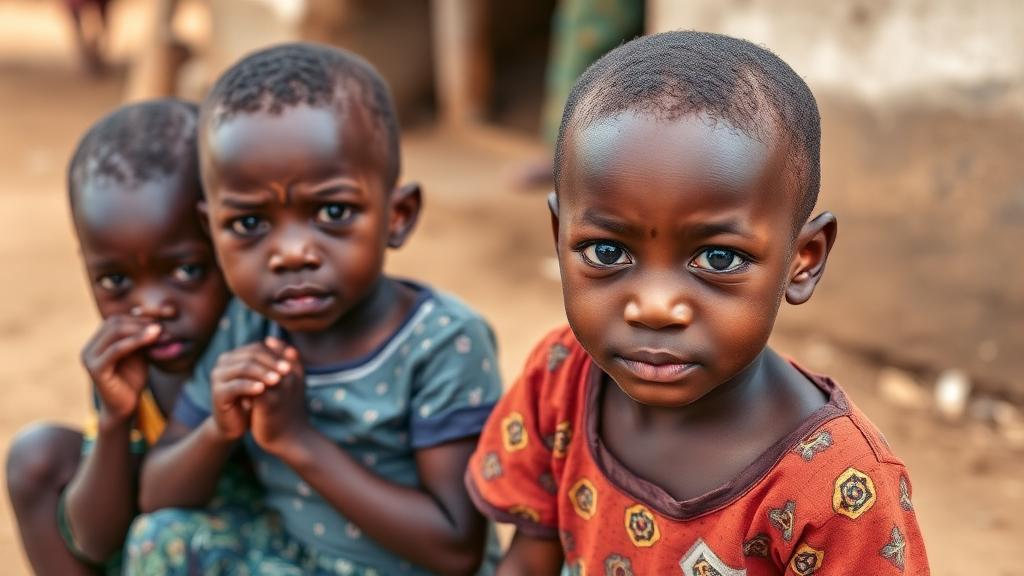
In the rural communities of Akpabuyo, a local government district in Nigeria’s Cross River State, fewer than half of the children between twelve and fifty-nine months of age have received every vaccine their national schedule recommends. That is the central finding of a community-based cross-sectional study published in BMC Infectious Diseases, in which researchers led by Vivien Mesembe Otu of the University of Calabar Teaching Hospital surveyed 1,700 children across 22 communities and inspected their immunization records one by one. Full immunization coverage stood at just 47.4 percent, a figure that falls well short of the levels global health authorities consider necessary to protect communities against vaccine-preventable diseases such as measles, pertussis, and tetanus. The result is not merely a statistic; it represents hundreds of children in a single district whose immune defenses are incomplete during the most vulnerable years of their lives.
The study’s design gives its findings unusual weight for a subnational survey. Rather than relying on maternal recall alone, the team used interviewer-administered questionnaires combined with physical inspection of immunization cards, the gold-standard documentary evidence of each dose a child has received. Children were enrolled through multistage sampling, a technique that first selects larger administrative units and then narrows down to households, giving every eligible child in the district a known chance of inclusion. Slightly more than half of the recruited children were aged twelve to twenty-three months, the age window in which the routine schedule demands the densest series of visits, and 51.3 percent were female. Because the sampling frame was anchored in communities rather than clinics, the survey captured children who never reach health facilities, a population that facility-based studies systematically miss.
Timeliness, the second pillar of the analysis, proved as troubling as coverage itself. A vaccine administered late leaves a child exposed during the interval when protection should already be in place, so immunization programs track not only whether doses are given but whether they arrive on schedule. In this district, timeliness varied sharply by vaccine type, ranging from 40.8 percent for the birth dose of hepatitis B vaccine, known as HBV0, to 65.2 percent for the first dose of oral polio vaccine, OPV1. The pattern is telling: OPV1 is often delivered through mass campaigns and at the first postnatal contact, while the hepatitis B birth dose depends on a facility delivery and a functioning cold chain on the very day of birth. Where the schedule depends on early, facility-linked contact, the system faltered most.
Dropout rates, the third metric, quantify the attrition between a child’s first and last scheduled doses, and they expose where families disengage from the program. The dropout from BCG, given at birth, to the measles vaccine, given near nine months, was 16.1 percent. For the pentavalent vaccine series, which protects against diphtheria, pertussis, tetanus, hepatitis B, and Haemophilus influenzae type b, dropout from the first to the third dose was 10.3 percent, while dropout from pentavalent dose one to measles reached 16.5 percent. These figures indicate that roughly one child in six who starts the schedule in Akpabuyo does not finish it, a leak in the pipeline that no amount of initial mobilization alone can fix.
To understand which children were most likely to be fully immunized, the researchers employed a two-level mixed-effects logistic regression model, a statistical approach that accounts for the fact that children living in the same community share facilities, vaccine supplies, and social norms, and therefore do not behave as independent observations. The model treated children as nested within communities and reported adjusted odds ratios with 95 percent confidence intervals. As sensitivity analyses, the team compared the results against simpler ordinary binary logistic regression and against models adjusting for ward-level clustering, a robustness check that guards against conclusions driven by the choice of statistical technique alone.
The predictors that emerged paint a coherent picture of advantage and access. Children from upper socioeconomic status households had 1.81 times the odds of full immunization compared with their less advantaged peers, and each increment in family income raised the odds by 6 percent. Delivery attended by a healthcare professional increased the odds by 1.7 times, and maternal attendance at postnatal care raised them 1.72-fold, both reflecting the fact that the health system’s first contact with a newborn is also its best chance to launch the vaccination schedule. Caregivers who reported that the timing of immunization sessions was convenient for them had 1.82 times the odds of completing their child’s schedule, suggesting that service hours themselves are a modifiable determinant, not a fixed constraint.
On the other side of the ledger, several factors significantly reduced the likelihood of full immunization. Each additional month of child age was associated with slightly lower odds, an effect consistent with the accumulating risk of falling behind as the schedule stretches across months. Living more than two kilometers from a health facility cut the odds to 0.66, a distance penalty that in rural terrain with poor roads can translate into hours of travel. Most striking were the supply-side failures: children whose caregivers reported ever missing a vaccination because no vaccine was available had only 0.31 times the odds of full immunization, and those who had missed a session because no vaccinator was present had just 0.20 times the odds. These are not failures of parental motivation but failures of the delivery system itself.
The authors conclude that full immunization coverage and timeliness in the district were low, with high dropout rates recorded, and they identify a set of concrete remedies: strengthening the vaccine supply chain, ensuring health worker availability in facilities, encouraging delivery by skilled professionals, and reinforcing caregiver counselling after delivery. Each recommendation maps directly onto a predictor in the regression model. Stock-outs and absent vaccinators are logistical problems with logistical solutions, while the strong effect of facility delivery and postnatal care suggests that linking immunization to the perinatal cascade of services could capture children at the moment families are already in contact with the health system.
The broader significance of the study lies in its demonstration that rural immunization gaps are not monolithic. Coverage, timeliness, and dropout are distinct failure modes that require distinct interventions, and a district can perform adequately on one while failing on another. By measuring all three simultaneously in a large, card-verified, community-representative sample, and by modeling community-level clustering explicitly, the researchers have produced a template for the kind of granular diagnosis that national averages conceal. For the children of Akpabuyo, the message is sobering: more than half remain incompletely protected. But for program planners across Nigeria and similar settings, the study offers a precise map of where the pipeline leaks, from the cold chain at birth to the long walk to the nearest clinic, and a reminder that every dose delivered on time is a child shielded from diseases that vaccines have long since made preventable.
Subject of Research: Full immunization coverage, timeliness, and dropout rates among children aged 12–59 months in a rural Nigerian district
Article Title: Full immunization coverage, timeliness and dropout rates among children aged 12–59 months: a community-based cross-sectional study in a rural subnational district in Nigeria
Article References: Otu, V. M., Fajola, A. O., Ikobah, J. M., Ita-Lincoln, F., Bassey, G. E., & Ekanem, E. E. (2026). Full immunization coverage, timeliness and dropout rates among children aged 12–59 months: a community-based cross-sectional study in a rural subnational district in Nigeria. BMC Infectious Diseases. https://doi.org/10.1186/s12879-026-14556-0
Image Credits: AI Generated
DOI: 10.1186/s12879-026-14556-0
Keywords: immunization, vaccination coverage, Nigeria, child health, dropout rates, vaccine timeliness, rural health, public health, cross-sectional study, vaccine-preventable diseases, supply chain, maternal and child health
Cite Scienmag News
Ophelia Keating. (October 2, 2026). Rural Nigerian Children Fall Short of Full Vaccination, Study Finds. Scienmag. https://scienmag.com/rural-nigerian-children-fall-short-of-full-vaccination-study-finds/
Ophelia Keating. "Rural Nigerian Children Fall Short of Full Vaccination, Study Finds." Scienmag, 2 October 2026, https://scienmag.com/rural-nigerian-children-fall-short-of-full-vaccination-study-finds/. Accessed 4 October 2026.
Ophelia Keating. "Rural Nigerian Children Fall Short of Full Vaccination, Study Finds." Scienmag. October 2, 2026. https://scienmag.com/rural-nigerian-children-fall-short-of-full-vaccination-study-finds/


