


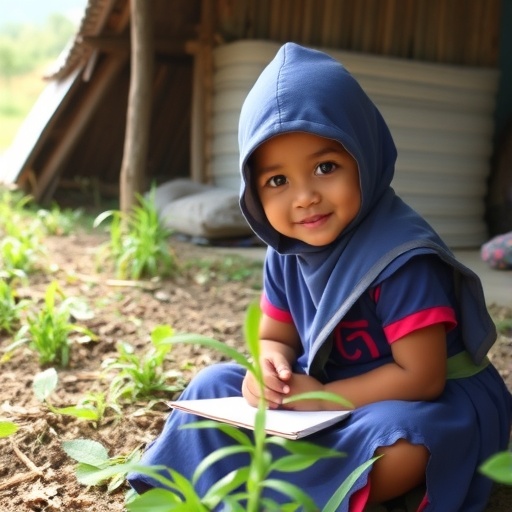
In a significant exploration of child development dynamics, a groundbreaking study by Klaas M.A.N. delves into the intricate relationships between neighborhood characteristics, the quality of early childhood education, and childhood developmental outcomes in the rural context of Indonesia. This multifaceted investigation sheds light on how these interrelated factors play a pivotal role in shaping the developmental trajectories of children, contributing valuable insights to the discourse on early education and community impacts.
The study is particularly timely, considering the global shift towards understanding the contextual influences on early childhood development. In rural Indonesia, where the socio-economic landscape is both diverse and complex, the research reveals that neighborhood environments are not merely backdrops but active elements in the developmental processes of young children. The nuanced findings serve as a call to action for policymakers and educators alike, urging them to consider environmental factors when developing and implementing early childhood education programs.
One of the key themes of the study is the characterization of neighborhoods—encompassing socio-economic status, infrastructure, and community cohesion. The research indicates that neighborhoods with higher socio-economic resources tend to facilitate better access to quality early childhood education. This not only enhances educational opportunities but also fosters an environment where children’s social and emotional skills can flourish. The implications are profound; investing in neighborhood improvements could yield significant benefits in early childhood outcomes, particularly for those in disadvantaged settings.
Furthermore, the quality of early childhood education emerges as a critical determinant of child development. The findings underscore that it is not just access to education that matters, but the caliber of educational experiences that children receive. High-quality early childhood education programs that engage children through play-based learning, qualified educators, and enriched curricula are shown to support cognitive and emotional development. In rural areas, where such resources may be scarce, the urgency to uplift educational standards becomes apparent.
Additionally, the study reveals the vital role of community involvement in supporting educational outcomes. Engaged communities that prioritize early childhood education create networks of support that benefit families and children alike. This sense of belonging and community cohesion is instrumental in fostering an environment conducive to learning and development. The findings highlight that stakeholders—including parents, local leaders, and educators—must collaborate to create a robust framework that champions early childhood education quality.
As the research unfolds, it delves deeper into the specific elements of education quality that are most impactful on child cognitive and social-emotional development. It identifies not only the structural aspects of educational institutions but also the relational dynamics within classrooms, such as teacher-child interactions. These interpersonal relationships significantly shape how children perceive themselves and their capabilities, thereby influencing their confidence and motivation to learn.
The correlation between neighborhood characteristics and educational quality presents a compelling case for targeted interventions. By addressing the disparities in neighborhood resources, communities can effectively enhance educational experiences. This underscores the importance of integrating social policies with educational reforms, ensuring that children from all walks of life have access to high-quality early education that prepares them for future academic success.
Moreover, the study doesn’t shy away from the implications of socio-economic disparities that exist within rural Indonesia. These disparities create a multifaceted dilemma, where children from low-income families often face compounding challenges that extend beyond education, including health and nutrition concerns. Early childhood education policies must, therefore, be designed with an awareness of these socio-economic realities, fostering holistic approaches that address the interconnectedness of these various factors.
In conclusion, Klaas M.A.N.’s research provides crucial insights into the critical interplay between neighborhood characteristics, early childhood education quality, and child development in rural Indonesia. The findings advocate for a paradigm shift in how early education is approached, emphasizing the integration of community resources and policies to support children’s learning journeys. As we move forward, the call for innovative solutions that adapt to local contexts and empower communities to uplift their educational standards becomes paramount. By harnessing the power of collective action, there is a tangible opportunity to transform the landscape of early childhood education in rural Indonesia and beyond.
Through this work, a vision emerges where neighborhoods, education quality, and child development intertwine to create a brighter future for all children. It serves as a pivotal bridge to understanding how local contexts can either hinder or enhance the developmental prospects of the youngest members of society, urging stakeholders to act decisively and compassionately.
This study ultimately paves the way for further research into the intersections of environment, education, and child outcomes, encouraging a dialogue that prioritizes the needs of vulnerable populations. In doing so, it aligns with global efforts to champion equitable education systems that recognize and address the diverse realities faced by children around the world.
Cite Scienmag News
Courtney Benton. (October 17, 2025). Rural Indonesia: Impact of Education on Child Development. Scienmag. https://scienmag.com/rural-indonesia-impact-of-education-on-child-development/
Courtney Benton. "Rural Indonesia: Impact of Education on Child Development." Scienmag, 17 October 2025, https://scienmag.com/rural-indonesia-impact-of-education-on-child-development/. Accessed 4 September 2026.
Courtney Benton. "Rural Indonesia: Impact of Education on Child Development." Scienmag. October 17, 2025. https://scienmag.com/rural-indonesia-impact-of-education-on-child-development/


