


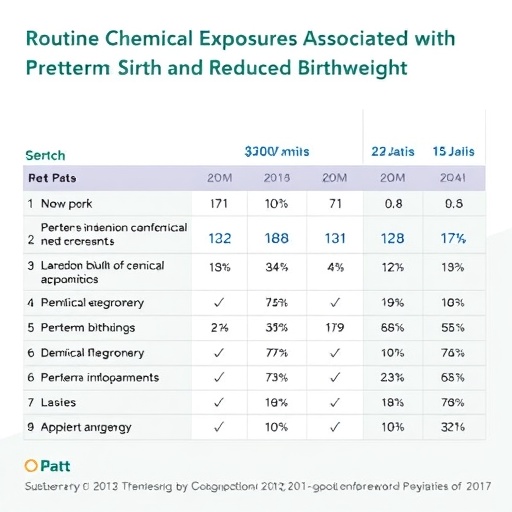
A groundbreaking new study has unveiled the pervasive exposure of pregnant women to an extensive range of chemicals that are routinely found in everyday environments, revealing profound implications for birth outcomes and child health. Conducted collaboratively by research teams at the University of North Carolina’s Gillings School of Global Public Health, Stanford University School of Medicine, and the Woods Institute for the Environment, this expansive epidemiological investigation analyzed thousands of mother-child pairs to dissect the influence of chemical exposures on gestational duration and neonatal birth weight.
Published in the prestigious journal JAMA Network Open on June 17, 2026, the study harnessed data gathered from over 5,000 mother-infant pairs born across two decades, from 2000 through 2021. Researchers performed detailed chemical profiling using maternal urine samples collected during pregnancy, screening for a broad panel of 113 chemicals spanning multiple classes including phthalates, replacement plasticizers, polycyclic aromatic hydrocarbons (PAHs), and halogenated phenols. Notably, each sample contained an average of 45 detected chemicals, with some samples containing as many as 64 distinct compounds.
These chemicals inhabit a wide array of sources encompassing food, water, air pollution, personal care products, synthetic fragrances, and household items — many of which remain hidden from consumer awareness and are notoriously difficult to avoid. Phthalates, a class of plasticizers widely used to soften plastics, alongside their newer replacement chemicals, were of particular concern given their ubiquity and documented endocrine-disrupting properties. Despite regulatory actions such as the U.S. Consumer Product Safety Commission’s permanent ban on several phthalates in children’s toys in 2017, the study reveals that pregnant women continue to be exposed to both legacy and substitute compounds.
The research meticulously linked chemical exposure profiles to critical birth outcomes, uncovering that several phthalates and alternative plasticizers correlated robustly with reductions in gestational length, thereby increasing the risk of preterm birth. Likewise, exposure to these chemicals, along with PAHs and halogenated phenols, was also associated with decreased birth weight—an established predictor of poor health trajectories later in life. The detection of halogenated phenols, lesser-studied yet potentially toxic compounds, further complicates the landscape of prenatal chemical exposure and warrants urgent toxicological scrutiny.
Intriguingly, the investigation highlighted that substitute plasticizers, introduced ostensibly to mitigate the hazards linked to banned phthalates, exhibited health effects strikingly similar to their predecessors. This finding underscores the complex unintended consequences of chemical substitutions, an area of growing concern within environmental health circles. These replacement chemicals, though marketed as safer alternatives, may perpetuate exposure risks absent thorough premarket evaluation.
Lead author Dr. Jessie Buckley, a distinguished epidemiologist at UNC Gillings, emphasized the critical challenge faced in mitigating these exposures. She noted the limited agency individuals have in completely avoiding such chemicals due to their pervasive presence in consumer products and the environment. “While consumers can take certain practical steps, ultimate protection hinges on upstream regulatory interventions that curtail toxic chemical use at the source,” Dr. Buckley asserted.
Complementing this perspective, senior author Dr. Tracey Woodruff of Stanford University called for a paradigm shift in chemical policy frameworks, advocating for comprehensive pre-market safety assessments inclusive of replacement chemicals. She stated, “Our findings amplify the imperative that regulatory agencies integrate contemporary scientific evidence into risk evaluation processes to safeguard public health more effectively, particularly for vulnerable populations such as pregnant individuals.”
The broader implications of the study resonate through the growing body of literature linking prenatal chemical exposures to adverse developmental outcomes, including neurodevelopmental disorders, metabolic dysfunction, and chronic diseases manifesting later in life. Even subtle perturbations to gestational age and birth weight can cascade into significant public health burdens, placing an urgency on reducing toxicant burdens during critical windows of fetal development.
From a mechanistic standpoint, many of the implicated chemical classes are known or suspected endocrine disruptors capable of interfering with hormonal signaling pathways that regulate fetal growth and maturation. Phthalates, for instance, have been documented in toxicological studies to disrupt steroidogenesis and thyroid hormone homeostasis, which are integral to maintaining pregnancy and healthy fetal development.
This research not only validates concerns about the chemical milieu pregnant women encounter but also highlights gaps in chemical management policies that fail to account for cumulative exposures to complex chemical mixtures. The study’s scale and methodological rigor lend authoritative evidence to calls for enhanced chemical transparency in consumer product formulations and environmental monitoring.
In light of these findings, public health advocates urge policymakers, manufacturers, and health professionals to prioritize the identification and phase-out of harmful chemicals while promoting the development and adoption of safer alternatives based on robust scientific evaluation. Protecting the next generation begins with ensuring that prenatal environments are free from preventable toxic exposures, a mandate that this seminal study powerfully reinforces.
Ultimately, the message from this research is clear: the health of children, beginning before birth, is intimately tied to the chemical landscape crafted by society’s production and use of synthetic compounds. Vigilance, innovation, and proactive regulation are essential components in the quest to safeguard future generations against the silent threat of ubiquitous chemical exposures.
News Publication Date: 17-Jun-2026
Web References:
Keywords
Environmental exposure, pregnancy, phthalates, replacement plasticizers, polycyclic aromatic hydrocarbons, halogenated phenols, birth outcomes, gestational age, birth weight, endocrine disruptors, chemical regulation, public health
Cite Scienmag News
Harold Sullivan. (June 17, 2026). Routine Chemical Exposures Associated with Preterm Birth and Reduced Birthweight. Scienmag. https://scienmag.com/routine-chemical-exposures-associated-with-preterm-birth-and-reduced-birthweight/
Harold Sullivan. "Routine Chemical Exposures Associated with Preterm Birth and Reduced Birthweight." Scienmag, 17 June 2026, https://scienmag.com/routine-chemical-exposures-associated-with-preterm-birth-and-reduced-birthweight/. Accessed 3 September 2026.
Harold Sullivan. "Routine Chemical Exposures Associated with Preterm Birth and Reduced Birthweight." Scienmag. June 17, 2026. https://scienmag.com/routine-chemical-exposures-associated-with-preterm-birth-and-reduced-birthweight/


