


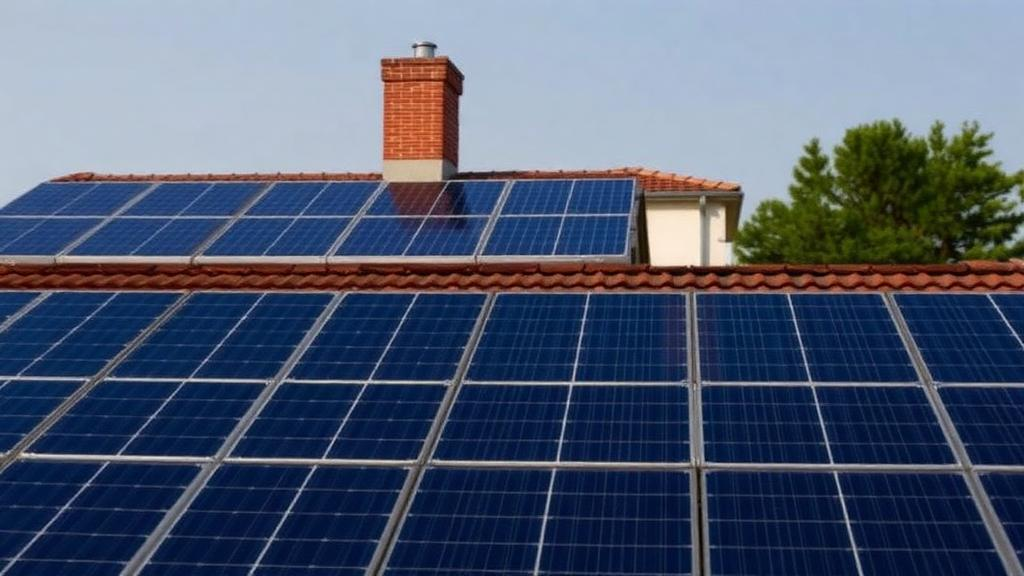
Rooftop solar panels are supposed to be a climate win: clean electricity generated on the homeowner’s own roof, displacing fossil power from the grid. But a new study in the Journal of Industrial Ecology confirms a stubborn behavioral wrinkle that could quietly erode those gains. When households start producing their own electricity at essentially zero marginal cost, they tend to use more of it. The phenomenon, known as the solar rebound effect, has been debated for years, with published estimates ranging wildly from under 8 percent to more than 33 percent of extra consumption per kilowatt-hour generated. Now Stefan Poier and Michael Bucksteeg of the FernUniversität in Hagen and the University of Cologne have produced one of the most rigorous household-level assessments to date, and their verdict is sobering: German households that install photovoltaic systems increase their total electricity consumption by roughly 20 percent for every unit of solar power they generate.
The scale of the finding matters far beyond Germany. The researchers calculate that if the roughly 20 percent rebound effect were replicated globally under widespread rooftop PV adoption, it could add more than 2,000 terawatt-hours of extra household electricity demand by 2050, assuming about 30 percent of installed solar capacity sits on roofs. For comparison, the entire European Union consumed 2,729 terawatt-hours of electricity in 2024. In other words, the behavioral response to free solar power is not a rounding error in the energy transition; it is system-relevant, with direct consequences for grid infrastructure, storage requirements, backup generation capacity, and the life-cycle emissions of the electricity sector.
What makes the study unusual is its data architecture. The authors combined the German Socio-Economic Panel, a longitudinal survey of roughly 19,000 households conducted annually, with a purpose-built online survey of more than 2,200 respondents, about half of them PV owners. Because the panel data record only electricity drawn from the public grid, they miss the self-consumed portion of solar generation, which is precisely the cheap electricity most likely to trigger extra use. To close that gap, the team built a feedforward neural network with a single hidden layer of twelve neurons, trained on survey responses, to reconstruct total household consumption from grid withdrawals, PV generation, dwelling size, household size, income, and indicators for electric vehicles and electric heating. Predictions were constrained to physically plausible bounds: total consumption had to be at least as large as grid withdrawals and no larger than grid withdrawals plus generation.
Identifying a causal effect rather than a correlation required careful design. The researchers applied Mahalanobis distance matching to pair each adopting household with comparable non-adopters based on baseline electricity use, dwelling size, household size, and income, producing a matched sample of 6,530 cases across 775 unique households. They then used a difference-in-differences framework with household and year fixed effects, which strips out time-invariant household differences and economy-wide trends, isolating the behavioral change attributable to PV adoption itself. Crucially, the authors followed a strict rebound definition, excluding simple fuel switching, such as replacing a gas boiler with a heat pump, so the measured effect reflects genuine increases in the consumption of energy services rather than electrification of other end uses.
The headline result held up under extensive stress testing. The generation-based rebound effect ranged from 20.1 to 21.6 percent across specifications, and alternative neural network architectures produced aggregated estimates between 15.0 and 24.7 percent, all statistically significant. The effect was robust to dropping covariates, changing standard error assumptions, and splitting the sample. One exception was instructive: when the researchers restricted the sample to typical residential system sizes, excluding installations generating more than 15,000 kilowatt-hours per year, the rebound estimate fell significantly. That makes sense, the authors note, because very large systems are usually operated as income-producing assets rather than as a substitute for household demand, so their high generation volumes mechanically depress the ratio.
The most striking insight, however, lies beneath the average. Using a Mundlak decomposition, which separates within-household variation from stable between-household differences, the team showed that the rebound effect is strongly conditioned by how much electricity a household consumed before installing panels. A hypothetical household with zero pre-installation consumption and an extremely oversized system would show a rebound of nearly 35 percent. For a more typical household consuming 3,000 kilowatt-hours before adoption, the effect drops to about 25.4 percent. The downward-sloping relationship crosses zero at roughly 11,044 kilowatt-hours of pre-consumption, above which some households may actually reduce their total electricity use after going solar, a pattern consistent with saturation: homes that already use a lot of energy have less behavioral room to expand.
Efficiency tells a parallel story. The researchers defined household efficiency as the gap between predicted consumption, based on income, living space, and occupancy, and actual observed consumption before adoption. Households that consumed less than predicted were classified as efficient, and those efficient households rebounded almost twice as strongly as their less efficient counterparts, with an effect of about 21.6 percent versus 12.9 percent. The efficiency gradient persisted even among owners of oversized systems, suggesting that rebound is driven less by the sheer abundance of cheap solar electricity and more by behavioral flexibility. Efficient households, the authors argue, were likely cost-sensitive before adoption, keeping consumption artificially constrained, and the arrival of free rooftop power relaxed those previously binding limits.
Notably, the size of the PV system relative to baseline consumption did not change the rebound elasticity itself. Oversized systems did produce substantially larger absolute increases in post-adoption consumption, nearly 934 kilowatt-hours more on average than undersized systems, but that difference simply reflects their higher generation volumes. The marginal effect of roughly 20 percent was remarkably stable across system dimensions. This matters for modelers: it means the system-level impact of a solar installation depends on who adopts it, not just how big it is. Deployment strategies concentrated among efficient, previously low-consuming households will generate more rebound-induced demand than the same capacity installed among high-consumption homes.
The findings echo patterns documented elsewhere in energy research, including the prebound effect in building renovation, where households that under-consume relative to their building’s characteristics show the strongest post-renovation rebound. Similar dynamics appear in mobility and agricultural water use. Recent work on Swiss households suggests the mechanism is primarily price-driven, with income effects and moral licensing playing minor roles, and the German evidence is consistent with that interpretation: households respond rationally to the collapse of marginal electricity costs, not to some vague feeling of environmental virtue. Because feed-in tariffs in Germany now fall below retail prices, self-consumption is strongly incentivized, and comparable net-billing regimes in California, China, Japan, and much of Europe suggest the results travel well beyond the German case.
The policy implications are concrete. The authors argue against restricting solar deployment and instead recommend preserving marginal price signals after adoption, through time-varying network charges, dynamic tariffs, or residual levies on self-consumed electricity, so the effective cost of an extra kilowatt-hour never falls to zero. They also propose post-adoption feedback, such as benchmarking consumption against pre-installation levels, and restructuring subsidies as long-term monitored grants rather than one-off payments, with feed-in tariffs calibrated to pre-adoption consumption and grid value. More fundamentally, the study is a warning to life-cycle assessment and energy system modeling: treating efficiency gains as proportional demand reductions risks overstating net savings precisely where efficiency is highest. Rebound, the authors conclude, is not a curiosity at the margins of the energy transition but a central link between household behavior, infrastructure planning, and the credibility of net-zero pathways.
Subject of Research: The solar rebound effect: increased household electricity consumption following residential photovoltaic adoption
Article Title: Here comes the sun: investigating the solar rebound effect and consumption behavior in photovoltaic households
Article References: Poier, S., & Bucksteeg, M. (2026). Here comes the sun: investigating the solar rebound effect and consumption behavior in photovoltaic households. Journal of Industrial Ecology, 30(4), 1903-1917. https://doi.org/10.1007/s44498-026-00129-6
Image Credits: AI Generated
DOI: 10.1007/s44498-026-00129-6
Keywords: solar rebound effect, photovoltaics, household energy consumption, rebound effect, energy policy, difference-in-differences, machine learning, life cycle assessment, energy transition, self-consumption, industrial ecology, Germany
Cite Scienmag News
Faith Mcneil. (October 3, 2026). Rooftop Solar’s Hidden Cost: Households Use 20% More Electricity After Going Solar. Scienmag. https://scienmag.com/rooftop-solars-hidden-cost-households-use-20-more-electricity-after-going-solar/
Faith Mcneil. "Rooftop Solar’s Hidden Cost: Households Use 20% More Electricity After Going Solar." Scienmag, 3 October 2026, https://scienmag.com/rooftop-solars-hidden-cost-households-use-20-more-electricity-after-going-solar/. Accessed 4 October 2026.
Faith Mcneil. "Rooftop Solar’s Hidden Cost: Households Use 20% More Electricity After Going Solar." Scienmag. October 3, 2026. https://scienmag.com/rooftop-solars-hidden-cost-households-use-20-more-electricity-after-going-solar/


