


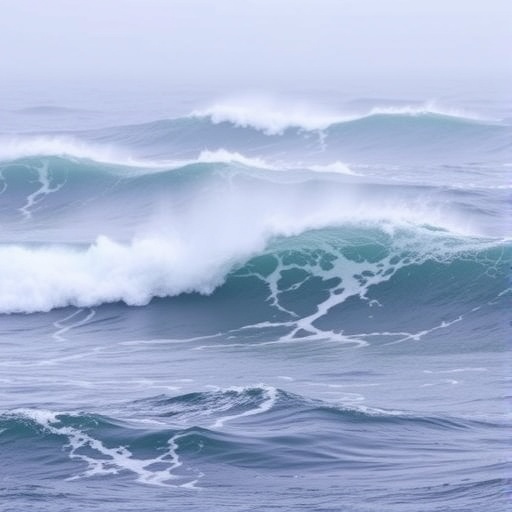
On January 1, 1995, the Draupner oil platform in the North Sea faced an extraordinary event: an enormous wave, towering 80 feet high, slammed against its structure with devastating force. This colossal wave damaged steel railings and scattered heavy equipment across the platform’s deck, but its most lasting legacy was the invaluable scientific data it provided. It marked the first moment in recorded history when a rogue wave—once relegated to maritime folklore and skepticism—was captured and measured in the open ocean. This measurement forever changed the way oceanographers and engineers understand the sudden, monstrous waves known to mariners as “rogues.”
For centuries, sailors told stories about waves that appeared suddenly and without warning, waves unlike any other seen on the sea. These natural anomalies seemed too extreme to be real, dismissed as myths or exaggerated tales. Francesco Fedele, an associate professor at the Georgia Institute of Technology’s School of Civil and Environmental Engineering, reflects on this historical skepticism. “Seafarers had long spoken of these giant waves, but until the Draupner event, science hadn’t confirmed their existence,” Fedele explains. The 1995 observation was more than a breakthrough; it was a paradigm shift confirming the harsh reality hiding behind sailor’s lore.
In the decades since the Draupner wave measurement, rogue waves have moved beyond myth and entered the realm of rigorous scientific inquiry. These waves, giant in scale and sudden in occurrence, have perplexed experts seeking to understand the mechanisms behind their sudden emergence. Fedele, questioning prevailing ideas, led an international investigation into the underlying physics dictating rogue wave formation. Their groundbreaking study—published in the prestigious journal Scientific Reports—analyzed an unprecedented dataset: 27,500 detailed wave records spanning nearly two decades from the North Sea, the most comprehensive collection of its kind. This extensive dataset, with half-hour snapshots of wave height, frequency, and direction, enabled new insights into the true nature of rogue waves.
The conventional wisdom surrounding rogue wave formation has long rested on the principle of modulational instability. This theoretical framework describes how small disturbances in wave timing and spacing can cause energy to consolidate into a single massive wave. In controlled environments like laboratory wave tanks or narrow water channels, this mechanism has been observed to amplify waves dramatically. However, Fedele’s team found that the open ocean behaves differently. Unlike the constrained energy flow in labs, ocean waves radiate energy multidirectionally, dispersing it in complex patterns that modulational instability cannot fully explain.
After meticulously analyzing the North Sea data, Fedele and his colleagues observed no definitive signatures of modulational instability during rogue wave events. Instead, their findings highlighted two far more fundamental processes at work. The first is linear focusing—an effect emerging when waves traveling at various speeds and from different directions align by coincidence at a precise time and location, combining their energies to create a significantly taller wave. The second is rooted in nonlinear wave interactions known as second-order bound nonlinearities. These nonlinearities distort wave shapes, stretching crests upwards to become steeper and taller while flattening troughs—amplifying the wave height by as much as 15 to 20 percent beyond what linear theory predicts.
Together, these two phenomena offer a compelling, physically grounded explanation for rogue wave formation that does not invoke exotic or rare oceanic conditions. Linear focusing orchestrates the convergence of wave energies, while the nonlinear dynamics enhance and magnify the resulting crest. This fusion of effects overturns earlier assumptions that rogue waves are statistical anomalies outside the predictable behavior of ocean waves. “Rogue waves arise naturally from the ocean’s inherent physics,” Fedele emphasizes. “They are extreme expressions of ordinary wave dynamics, not outliers violating natural laws.”
The implications of this research extend beyond academic circles into maritime safety and engineering. Rogue waves pose genuine hazards to ships, offshore oil platforms, and coastal infrastructure worldwide. Yet many forecasting models continue to treat these waves as unpredictable freak occurrences, leaving vessels and structures vulnerable. Fedele insists that honoring the science is essential: “Extreme wave events like rogues are explainable, and their risks can be anticipated with better models.” This insight calls for updating wave forecasting and structural design principles to incorporate these newly understood wave mechanics to enhance safety measures at sea.
In practice, Fedele’s work is already influencing risk assessment and operations. Organizations such as the National Oceanic and Atmospheric Administration (NOAA) and industry leaders like Chevron have adopted his models to refine predictions about where and when rogue waves are most likely to occur. By integrating these improved physical descriptions into forecasting tools, they aim to mitigate the dangers rogue waves pose to marine navigation and offshore energy extraction. This scientific advancement ushers a new era where ocean risk management is grounded in data and physics, rather than guesswork or superstition.
Further pushing the frontier of rogue wave research, Fedele is applying machine learning techniques to decades worth of wave observations. These algorithms sift through complex patterns in data—considering variables like wave height, direction, and timing—to identify subtle precursors signaling the potential emergence of rogue waves. Machine learning offers the promise of transforming vast, noisy ocean datasets into actionable forecasts, giving mariners early warnings and improving real-time safety decisions. “The key is teaching computers to ‘listen’ to the ocean’s signals,” Fedele remarks, pointing toward a future of predictive oceanography empowered by artificial intelligence.
What emerges from this research is a profound lesson about nature’s capacity for surprise. Rogue waves do not stem from mysterious forces breaking natural laws; rather, they arise when commonplace wave behaviors align under rare but inevitable conditions. This perspective reframes rogues not as anomalies but as natural extensions of ocean dynamics, bearing their own identifiable “fingerprints.” Each rogue wave manifests a structured group of waves before and after the peak—clues embedded within the wave’s shape that tell the story of its formation. Understanding these patterns enriches our knowledge of ocean processes and enhances our ability to coexist safely with the sea.
Ultimately, rogue waves are a stark reminder of the ocean’s power and unpredictability, yet they belong to the ocean’s normal behavioral repertoire. As Fedele eloquently synthesizes, “Rogue waves are simply a bad day at sea. They are extreme, yes—but they are part of the ocean’s language, a language we are only now beginning to understand.” This new scientific clarity transforms ancient maritime myth into measurable reality, guiding future research and safety efforts to better navigate the challenges posed by our planet’s vast, restless oceans.
News Publication Date: Not specified
Web References:
https://www.nature.com/articles/s41598-025-07156-6
References: Scientific Reports (Journal)
Keywords
Machine learning, Ocean physics
Cite Scienmag News
Bethany Barker. (August 7, 2025). Rogue Waves: Not Freaks of Nature, Just a ‘Bad Day’ at Sea. Scienmag. https://scienmag.com/rogue-waves-not-freaks-of-nature-just-a-bad-day-at-sea/
Bethany Barker. "Rogue Waves: Not Freaks of Nature, Just a ‘Bad Day’ at Sea." Scienmag, 7 August 2025, https://scienmag.com/rogue-waves-not-freaks-of-nature-just-a-bad-day-at-sea/. Accessed 3 September 2026.
Bethany Barker. "Rogue Waves: Not Freaks of Nature, Just a ‘Bad Day’ at Sea." Scienmag. August 7, 2025. https://scienmag.com/rogue-waves-not-freaks-of-nature-just-a-bad-day-at-sea/


