


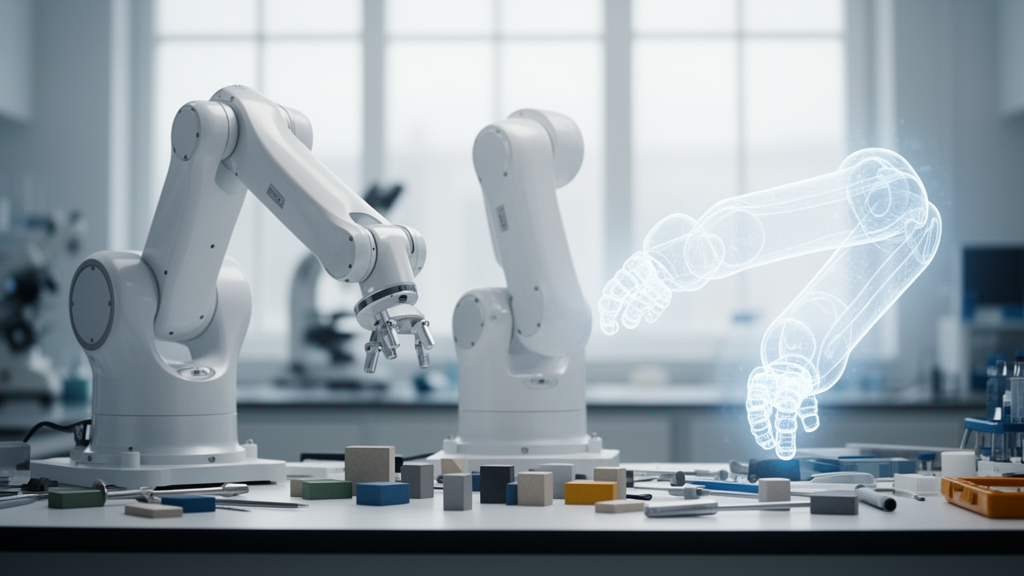
Robots are superb at reacting. Show a dual-arm machine a pill bottle and a pad, and a well-trained policy can map what its cameras see straight onto what its grippers should do. What robots are historically bad at is imagining. Most visuomotor policies operate in a perpetual present, translating the current sensory snapshot directly into motor commands without ever asking how the scene will look a second from now. For single-arm pick-and-place that blind spot is survivable. For two arms that must coordinate over long stretches of time—lifting, placing, scanning, handing off—it is often fatal, because the arms interfere with each other and the consequences of an early mistake only reveal themselves later in the task.
A team at the Northwest Institute of Mechanical and Electrical Engineering in Xianyang, Shaanxi, China, has now built a framework that gives bimanual robots exactly that missing capacity for foresight. Writing in Frontiers in Neurorobotics, Xukun Liu and colleagues introduce WIS, the World-guided Instruction Semantic Diffusion Policy, a hierarchical architecture that tightly couples a language-driven world model with a diffusion-based action generator. The core idea is deceptively simple: before the robot commits to an action sequence, an internal model forecasts how the environment will evolve under that sequence, and those predictions actively steer the generation of the actions themselves. The result, evaluated on the RoboTwin 2.0 benchmark with Aloha-AgileX dual-arm robots, is a policy that consistently outperforms strong baselines across every task tested, with only marginal increases in computational cost.
The architecture rests on three pillars. The first is a multimodal language-visual perception module. The robot sees the world through a single depth image, which is back-projected into a 3D point cloud using calibrated camera intrinsics and extrinsics. A lightweight multilayer-perceptron encoder, built around element-wise max-pooling, compresses the raw 3D coordinates into a compact visual feature. In parallel, a pre-trained language encoder converts the natural language instruction—say, a description of the manipulation goal—into a semantic embedding. The two streams are then fused through a cross-modal attention mechanism: the language embedding is used to compute attention weights over individual point-cloud tokens, allowing the policy to dynamically focus on the task-relevant regions of the scene. Different parts of the workspace may matter to different arms depending on the instruction, and this attention mechanism lets the policy ground its semantics in the geometry it actually observes.
The second pillar is the language-conditioned world model, the component that supplies the predictive reasoning. The world state is represented as a latent vector that fuses visual observations, the robot’s proprioceptive state, and language semantics. From this latent state, a transformer-based dynamics model forecasts future state trajectories over a prediction horizon, conditioned on the current state, the proposed action sequence, and the language instruction. Language is injected at each timestep through cross-attention, so the forecasts are not generic physics predictions but task-relevant ones: the model anticipates the state dynamics that matter for the instruction at hand. The predicted trajectory is then compressed by a temporal aggregation network into a compact guidance representation that serves as a prior for the action generator.
Training such a latent world model is notoriously fragile. If the encoder maps every observation to a constant vector, the prediction loss collapses to a trivial minimum while the model learns nothing about dynamics. The team counters this with two complementary regularizers. A target encoder, maintained as a slowly updated exponential moving average of the online encoder, provides a stable learning target that discourages representation drift. A variance regularization term, computed over the batch dimension, pushes the latent features to preserve diversity and prevents the variance from collapsing to zero. The world model’s forecasting accuracy degrades gracefully with horizon: on the Place A2B Right task, mean squared error rises from 0.012 at a one-step horizon to 0.087 at ten steps, while cosine similarity falls from 0.94 to 0.71—an approximately linear error growth that suggests the model captures dynamics without catastrophic accumulation within the tested range.
The third pillar is the hierarchical diffusion policy, which decouples high-level task planning from low-level motor generation. Diffusion policies generate actions by learning to reverse a noising process: starting from a sample of Gaussian noise, a denoising network iteratively refines a noisy action sequence over a fixed number of steps until a clean trajectory emerges. WIS layers a semantic bottleneck on top of this machinery. A high-level planner, itself a diffusion process operating in a compact latent space, produces a latent plan conditioned on the perception feature, the language embedding, and the world model’s guidance. This plan encodes high-level task progression rather than motor detail. A low-level diffusion controller then generates the actual action sequences, conditioned on the latent plan and the original context. To guarantee that the controller cannot bypass the planner, a stop-gradient operation is applied to all conditioning inputs except the latent plan, forcing it to rely on the plan as the sole conduit for task-level semantic and predictive information. The plan dimension is deliberately kept small, creating a tight information bottleneck that encourages the planner to extract only the most task-relevant temporal abstractions.
The genuinely novel ingredient is the prediction-aware diffusion sampling mechanism, which threads the world model’s foresight directly into the denoising process. At each denoising step, the world model predicts the future states that the current noisy action estimate would produce, and a correction term—computed as the gradient of an energy function built on cosine similarity between the predicted trajectory and a reference future trajectory—is added to the score estimate. This formulation mirrors classifier-guided diffusion, where the gradient of an energy or log-likelihood function biases generation toward desirable outcomes. The guidance is normalized for stability, re-computed at every denoising step using the most recent action estimate, and applied only during the final five of ten denoising steps, once the coarse structure of the trajectory is already established. During training, the reference trajectory comes directly from the expert demonstration. At test time, when expert trajectories for novel scenes are unavailable, the system retrieves nearest-neighbor trajectories from the training set using a distance metric over initial states and language embeddings, aligns them via dynamic time warping, and averages their future state sequences into a soft reference target.
The team was careful about the risks of overconfident guidance. Prediction errors accumulate over extended horizons, especially in contact-rich bimanual scenarios, so the guidance strength is deliberately conservative. A sensitivity analysis on Place A2B Right showed performance improving monotonically as the guidance weight increased from 0.01 to 0.1, peaking at a 58 percent success rate, then declining to 51 and 43 percent at weights of 0.2 and 0.5. The broad plateau between 0.05 and 0.1 suggests the method is reasonably robust to this hyperparameter, while the decline at higher values confirms that excessive reliance on imperfect predictions harms action quality. For tasks with semantically novel instructions, the guidance strength is halved to reduce dependence on potentially mismatched references.
The experimental results are striking in their breadth. Across five bimanual tasks—moving a pill bottle pad, placing objects in two configurations, placing a phone stand, and scanning an object—WIS achieved success rates of 50, 55, 58, 52, and 39 percent respectively, averaged over five independent training seeds with 100 evaluation rollouts per trained model. The strongest baseline, DP3, which shares the 3D point-cloud representation but lacks the world model and predictive guidance, reached 41, 46, 49, 44, and 31 percent on the same tasks. Paired two-tailed t-tests confirmed the improvements are statistically significant for all tasks. Older reactive baselines fared far worse: ACT and Diffusion Policy, which rely on 2D RGB observations and lack 3D geometric information, recorded near-zero success rates in the high-dimensional 14-degree-of-freedom dual-arm setting. Ablation studies on Place A2B Right quantified each component’s contribution: removing the world model cost 14 percentage points, removing cross-modal attention cost 12, removing the guidance gradient cost 9, and removing the high-level planner cost 8—evidence that every architectural element plays a non-trivial role.
Perhaps most remarkable is the computational economy of the whole design. All experiments ran on a laptop with an NVIDIA GeForce RTX 4060 GPU. A per-module runtime breakdown shows the guidance gradient computation costs only 22.5 milliseconds per denoising step, 11.7 percent of the total per-step time, and since guidance is evaluated only during the final five steps the effective per-action cost is roughly halved. Compared with DP3, WIS adds just 0.1387 seconds of average inference time and 0.005 gigabytes of memory increment. The authors are candid about the limits: the evaluation is simulation-only, covers in-distribution generalization to randomized initial configurations rather than zero-shot transfer to novel objects or paraphrased instructions, and the reference-based guidance may not encompass all viable strategies. Still, the demonstration that explicit predictive reasoning—tightly coupled with semantic understanding and hierarchical generation—can be bought for so little compute is a compelling datapoint in the quest for robots that do not merely react to the world, but anticipate it.
Subject of Research: WIS: world-guided instruction semantic diffusion policy for predictive bimanual manipulation
Article Title: WIS: world-guided instruction semantic diffusion policy for predictive bimanual manipulation
Article References: Liu, X., Hou, L., Cheng, P., Luo, X., Xie, F., Wei, J., Wang, F., & Liu, A. (2026). WIS: world-guided instruction semantic diffusion policy for predictive bimanual manipulation. Frontiers in Neurorobotics, 20, Article 1940438. https://doi.org/10.3389/fnbot.2026.1940438
Image Credits: AI Generated
DOI: 10.3389/fnbot.2026.1940438
Keywords: bimanual manipulation, diffusion policy, world model, imitation learning, language-conditioned robotics, robotics, neurorobotics, predictive control, RoboTwin 2.0, dual-arm coordination, world-guided, instruction
Cite Scienmag News
Denise Maddox. (October 16, 2026). Robots Learn to Imagine the Future Before Acting: New Diffusion Policy Gives Dual-Arm Machines Predictive Foresight. Scienmag. https://scienmag.com/robots-learn-to-imagine-the-future-before-acting-new-diffusion-policy-gives-dual-arm-machines-predictive-foresight/
Denise Maddox. "Robots Learn to Imagine the Future Before Acting: New Diffusion Policy Gives Dual-Arm Machines Predictive Foresight." Scienmag, 16 October 2026, https://scienmag.com/robots-learn-to-imagine-the-future-before-acting-new-diffusion-policy-gives-dual-arm-machines-predictive-foresight/. Accessed 16 October 2026.
Denise Maddox. "Robots Learn to Imagine the Future Before Acting: New Diffusion Policy Gives Dual-Arm Machines Predictive Foresight." Scienmag. October 16, 2026. https://scienmag.com/robots-learn-to-imagine-the-future-before-acting-new-diffusion-policy-gives-dual-arm-machines-predictive-foresight/


