


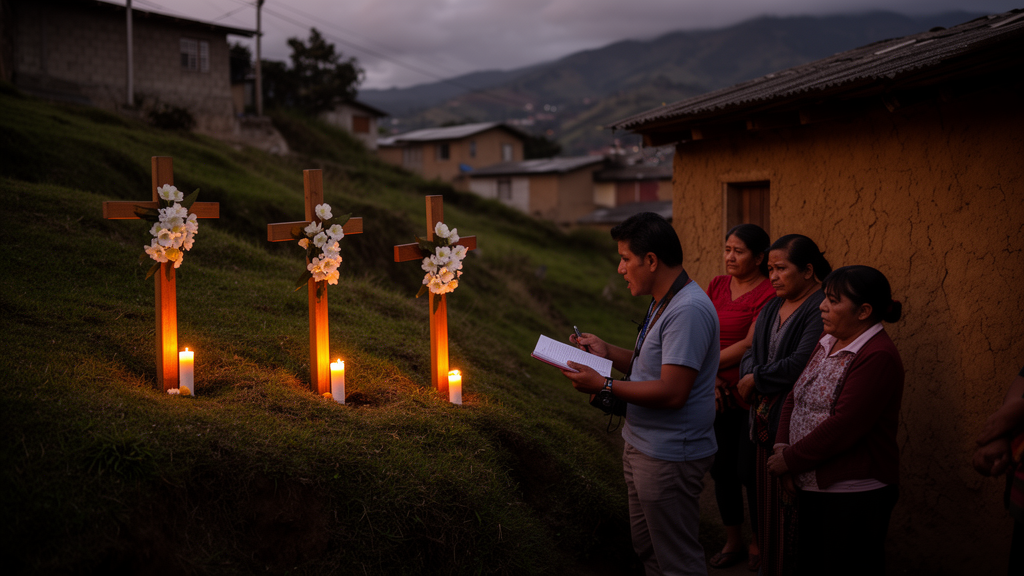
On 8 December 2024, four minors from Las Malvinas, a working-class neighborhood in southern Guayaquil, were detained by military personnel near a shopping mall. Steven Medina was eleven years old. Josué Arroyo was fourteen. Ismael Arroyo and Nehemías Arboleda were both fifteen. Their families reported them missing the following day, and the remains of four persons were later found near Taura. The investigation proceeded under the legal category of enforced disappearance, and sixteen soldiers were eventually charged. But a new study argues that what happened in Ecuadorian journalism during those months was itself a kind of contest: a struggle over whether the boys would appear in the public record as rights-bearing children or as peripheral bodies inside a security narrative.
The research, published in Frontiers in Communication by Fernanda Tusa and Jorge Maza-Córdova of Universidad Técnica de Machala, together with Ignacio Aguaded of Universidad de Huelva and Santiago Tejedor of Universitat Autònoma de Barcelona, examined how eight Ecuadorian digital outlets covered the Malvinas case between December 2024 and August 2025. The team selected twelve purposively chosen journalistic texts from El Comercio, El Universo, El Mercurio, La Hora, Primicias, GK, Extra and Expreso, spanning breaking-news updates, investigative explainers, crime reporting and editorials. Using qualitative content analysis combined with critical discourse analysis, they coded nine variables in each text: child representation, source hierarchy, lexical agency, territorial references, visual treatment, contextual density, genre, underlying frame and transmitted values.
The analysis revealed three recurrent narrative configurations. The first, labeled securitized/officialist, privileged order, duty, procedural cooperation and official definers, often relying on passive constructions and territorial danger as explanatory context. The second, rights/forensic, foregrounded the children’s legal minority, family testimony, forensic evidence and explicit attribution of responsibility. The third, sensationalist, emphasized shock, graphic detail and crime-story suspense, sometimes naming violence with precision but risking the aestheticization of suffering. Crucially, these were not fixed ideological identities of entire outlets; hybrid texts were common, and coverage drifted across configurations as evidence accumulated.
One of the study’s most technically revealing findings concerns grammar. In official or security-oriented coverage, responsibility was frequently displaced into passive or nominal constructions: the children were left, an incident occurred, an excess was under investigation. Such wording did not always deny harm, but it grammatically separated outcome from actor. By contrast, rights-oriented and forensic reporting increasingly employed active, legally specific vocabulary, terms such as detained, abandoned, beaten, tortured, forcibly disappeared and executed, which reconnected acts with agents and legal categories. The authors emphasize that the ethical distinction is not between emotional and objective language but between evidentially supported precision and euphemistic indeterminacy.
Source hierarchies proved equally decisive. Early straight-news items frequently relied on military, ministerial or prosecutorial statements to establish what could be responsibly asserted, producing what the researchers call an officialist tendency even in texts that did not explicitly defend the armed forces. Institutional speakers supplied the chronology, terminology and limits of certainty, while families and human-rights actors often appeared later or as reactive sources. The authors explain this pattern through Bennett’s indexing theory and the hierarchy-of-influences model rather than through assumed partisan loyalty: during an unfolding disappearance case, official sources offer speed, verifiability, legal protection and ready-made language. As forensic information, videos and judicial proceedings accumulated, the indexed range of legitimate debate widened, and later coverage became more willing to use terms such as enforced disappearance, torture and abuse of power.
Territorial language emerged as a third mechanism. References to Las Malvinas and southern Guayaquil performed two different functions across the corpus. In some texts, place contextualized the social conditions in which families lived, the community’s fear and the wider security crisis. In others, place operated as a condensed sign of danger: descriptors such as conflictive zone or high-crime sector placed the children inside a pre-existing map of suspicion. The authors argue that this geography of suspicion can become a cognitive shortcut under militarized governance, making extraordinary coercion appear more intelligible or expected, and subtly displacing accountability: readers are invited to ask what kind of area the children came from before asking what obligations state agents had toward them. Rights-oriented reporting countered this by reconstructing the chain of custody, treating geography as evidence of institutional movement rather than as a moral property of the victims.
The study also documents what it terms biographical silence. In early coverage, the children were visible as a collective, the four minors, the disappeared children, but rarely as individuals embedded in school, family, friendship and neighborhood life. Humanization increased when family testimony became central: reports that named the boys, specified their ages, described relatives’ searches or reconstructed their last communications created a different subject position, casting them as sons, brothers and community members rather than anonymous bodies in a security chain. The authors connect this to Judith Butler’s concept of differential grievability, arguing that class-coded cues, territorial stigma and proximity to crime can weaken presumptions of innocence, making some young lives less readily recognized as worthy of protection.
A particularly revealing episode involved soldiers’ statements reported by Expreso that the boys did not look like children and were taller than the soldiers. The authors analyze these quotations as reproducing a justificatory logic in which bodily appearance is mobilized to suspend the legal relevance of minority. Even when journalists present such claims critically, the quotation becomes part of the public discursive field. The ethical task, they argue, is not to suppress official testimony but to contextualize it with verified ages, due-process obligations and the principle that perceived appearance cannot nullify child-protection duties. The case confirms the central insight of the sociology of childhood: legal age does not automatically guarantee equal symbolic protection, because public discourse can recognize or fail to recognize the social and legal meaning of youth.
Visual treatment provided a parallel moral grammar. Photographs of vigils, relatives holding portraits and public demonstrations framed the case through grief, collective recognition and claims for justice, positioning families as active rights-claimants. Photographs of reconstruction sites, roads and forensic scenes served an evidentiary function, making chains of action visible. Sensationalist visual treatment, especially when paired with shock headlines, increased affect but risked turning suffering into spectacle. The authors stress that a powerful image can be ethically justified when it provides evidence, preserves dignity and contributes to public understanding; concern arises when graphic material exceeds informational necessity or is repeatedly circulated for attention. Genre also conditioned what could be said: longer investigative pieces were more likely to connect detention, transfer, abandonment, forensic findings and judicial proceedings into a causal sequence, while episodic compression increased dependence on the dominant source of the moment.
The findings carry direct implications for newsroom practice. The authors propose written child-protection protocols covering age verification, source-diversity checks, scrutiny of territorial stigma, proportionality tests for images and identifying details, trauma-informed family contact, legally accurate terminology and post-publication updating when evidence changes. They also articulate an ethics of memory: because digital archives give reporting a long afterlife, early official narratives should not remain frozen in search results after judicial findings have materially changed the public record. Ethical memory requires correction of disproven claims, preservation of the children’s names and biographies in dignified contexts, and archive structures that do not repeatedly foreground graphic imagery. The study is limited by its purposive sample of twelve texts and the absence of audience reception or newsroom interviews, and the authors call for comparative research across Latin American contexts of militarized security, journalist interviews on source routines and reception studies testing how alternative headlines, place descriptors and images affect judgments of childhood, legitimacy and state responsibility.
Subject of Research: Narrating childhood under state violence: media power, territorial stigma and the Malvinas case in Ecuadorian journalism
Article Title: Narrating childhood under state violence: media power, territorial stigma and the Malvinas case in Ecuadorian journalism
Article References: Narrating childhood under state violence: media power, territorial stigma and the Malvinas case in Ecuadorian journalism. (n.d.). https://doi.org/10.3389/fcomm.2026.1734083
Image Credits: AI Generated
DOI: 10.3389/fcomm.2026.1734083
Keywords: Ecuador journalism, Malvinas case, child rights, media framing, state violence, enforced disappearance, territorial stigma, critical discourse analysis, media ethics, moral panic, mediated memory, newsroom protocols
Cite Scienmag News
Courtney Benton. (October 16, 2026). How Ecuador’s Press Narrated Four Children Killed by the Military. Scienmag. https://scienmag.com/how-ecuadors-press-narrated-four-children-killed-by-the-military/
Courtney Benton. "How Ecuador’s Press Narrated Four Children Killed by the Military." Scienmag, 16 October 2026, https://scienmag.com/how-ecuadors-press-narrated-four-children-killed-by-the-military/. Accessed 16 October 2026.
Courtney Benton. "How Ecuador’s Press Narrated Four Children Killed by the Military." Scienmag. October 16, 2026. https://scienmag.com/how-ecuadors-press-narrated-four-children-killed-by-the-military/


