


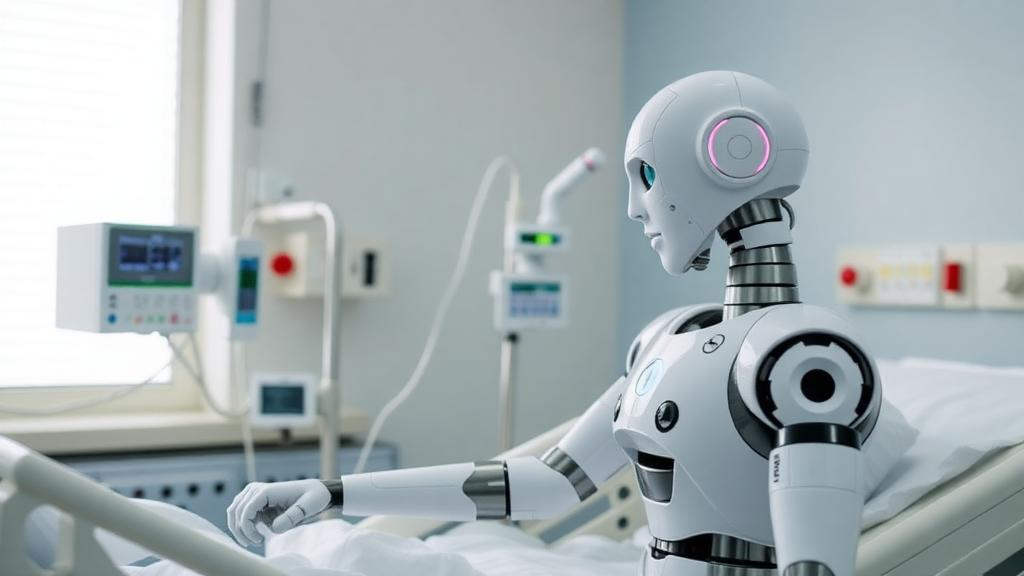
Intensive care units have become the proving ground for some of medicine’s most ambitious automation projects. Robots now shuttle supplies down hospital corridors, remind patients to perform breathing exercises, and even help hoist critically ill patients out of bed for their first wobbly steps after weeks of sedation. Yet for all the headlines and hardware, a surprisingly basic question has gone unanswered: what, exactly, counts as intelligent robot-assisted care in the nursing of critically ill patients? Without a shared definition, studies of these systems are nearly impossible to compare, and hospitals have no rigorous framework for deciding whether a given robot genuinely belongs in the ICU care team.
A team of Chinese nursing researchers has now tackled that definitional vacuum head-on. In a concept analysis published in BMC Nursing, Yingying Wang of the First Affiliated Hospital of Wannan Medical University and colleagues applied Walker and Avant’s classic eight-step method of concept analysis to the phrase intelligent robot-assisted care in critical care nursing. The approach, a staple of nursing science since the 1980s, forces researchers to dissect a fuzzy concept into its essential attributes, the conditions that must precede it, its consequences, and the concrete empirical measures that would tell a bedside observer the concept is actually present. The result is not a gadget review but a conceptual architecture for one of the fastest-moving corners of digital health.
The methodological backbone of the study was a structured literature search spanning nine English- and Chinese-language databases from their inception to 3 June 2026, supplemented by reference list searching. The identification and screening process was reported in a PRISMA 2020-style flow diagram, the same transparency standard used for systematic reviews of clinical trials. From this harvest, fourteen topic-related reports fed directly into the concept development, while methodological, ethical, and background literature supported the authors’ interpretation. That bilingual scope matters: much of the world’s ICU robotics research emerges from Chinese and East Asian hospitals, and restricting the search to English would have silently skewed the resulting definition toward Western engineering priorities.
The analysis distilled the sprawling field into four defining attributes, each of which must be present for a practice to qualify as intelligent robot-assisted care in critical care nursing. The first is an embodied robotic system, meaning a physical machine occupying space in the clinical environment rather than an algorithm running invisibly on a server. The second is intelligent sensing and task execution, the capacity to perceive the patient or environment and act on that perception, whether by recognizing a patient’s movement attempts or adjusting assistance during early mobilization. The third attribute is integration into critical care nursing practice: the robot must slot into the actual workflows of intensive care, not operate as a standalone novelty. The fourth, and arguably most consequential, is clinician-governed augmentation of care, the principle that the machine extends rather than replaces nursing judgment.
That fourth attribute draws the sharpest boundary around the concept. The authors explicitly distinguish intelligent robot-assisted care from software-only artificial intelligence, from passive devices, and from robotic applications that lack either nursing-practice integration or clinician governance. A predictive deterioration algorithm, however sophisticated, is not robot-assisted care because it has no body. A passive pressure-redistributing mattress, however useful, senses and executes nothing intelligently. And a robot deployed by an engineering team without nursing oversight fails the governance test. In an era when the words artificial intelligence are stamped on nearly every hospital purchase, this definitional discipline functions as a kind of quality control for the entire field.
The researchers also mapped the antecedents, the conditions that must exist before such care can responsibly occur. These include genuine clinical need, task suitability, system compatibility with the existing ICU infrastructure, trained clinicians ready to work alongside the machine, organizational support from hospital leadership, and pre-established safeguards covering safety, ethics, and data protection. The list reads like a checklist for any hospital administrator contemplating a robotics pilot, and its emphasis on organizational and human factors reflects a hard-won lesson from decades of health technology implementation: the machine is rarely the limiting factor, the surrounding system is.
What has robot-assisted care actually delivered in the studies examined? The reported findings include task feasibility, an increased mobilization dose for patients, and a signal of functional improvement in a selected neurocritical-care population. Early mobilization is a particularly telling application, because intensive care unit-acquired weakness remains one of the most feared complications of prolonged critical illness. Getting an ICU patient standing within days of waking, when each session demands two to four clinicians and considerable physical risk, is precisely the kind of labor-intensive, high-stakes task where an embodied robot with intelligent sensing could change the arithmetic of care. The Chelsea Critical Care Physical Assessment Tool, one of the measures used in this literature, provides a standardized way to track whether that promise translates into measurable functional gain.
The authors are careful not to oversell the evidence. Preparation and coordination demands remained substantial across studies, and effects on patients and staffing varied from one report to another. This candor matters in a field prone to demonstration-project enthusiasm, where a robot that dazzles in a promotional video can falter when asked to navigate a crowded ICU at 3 a.m. during a code. The concept analysis deliberately frames robot-assisted care as augmentation under retained clinician authority, a framing that keeps accountability where clinical law and ethics already place it, with the human care team.
Perhaps the most practically useful output of the analysis is its set of empirical referents, the observable phenomena that would confirm the concept in action. The authors describe four attribute-linked empirical referent domains that identify a specified application, while patient, clinician, workflow, technical, safety, ethical, and relational measures separately evaluate consequences and implementation quality. In plain terms, proving that a robot belongs in the ICU requires more than showing the device works. It requires evidence across at least seven distinct measurement domains, from patient outcomes and clinician workload to workflow disruption, technical reliability, safety events, ethical acceptability, and the quality of the human-robot relationship at the bedside.
The study arrives at a moment when intensive care is under simultaneous pressure from workforce shortages, aging populations, and the rising acuity of surviving patients. By fixing the meaning of intelligent robot-assisted care, the researchers have given the field something it has conspicuously lacked: a common language for identifying, reporting, and evaluating these systems task by task. The definition supports consistent communication across disciplines and countries, and it embeds safety, ethical, and relational safeguards directly into the concept rather than treating them as afterthoughts. Whether robots ultimately become as unremarkable a presence in the ICU as the ventilator or the infusion pump will depend on many trials and many years. But now, at least, the question of what is being tested has a rigorous answer, and that clarity may prove to be the most important piece of infrastructure the robotics revolution in critical care receives.
Subject of Research: Concept analysis of intelligent robot-assisted care in critical care nursing
Article Title: Intelligent robot-assisted care in critical care nursing: a concept analysis using Walker and Avant’s method
Article References: Intelligent robot-assisted care in critical care nursing: a concept analysis using Walker and Avant’s method. (n.d.). https://doi.org/10.1186/s12912-026-05471-5
Image Credits: AI Generated
DOI: 10.1186/s12912-026-05471-5
Keywords: critical care nursing, intensive care units, robotics, artificial intelligence, concept analysis, human-robot interaction, patient safety, nursing care, early mobilization, ICU-acquired weakness, clinician governance, Walker and Avant method
Cite Scienmag News
Denise Maddox. (October 13, 2026). Robots in the ICU: Scientists Define What Robot-Assisted Nursing Care Really Means. Scienmag. https://scienmag.com/robots-in-the-icu-scientists-define-what-robot-assisted-nursing-care-really-means/
Denise Maddox. "Robots in the ICU: Scientists Define What Robot-Assisted Nursing Care Really Means." Scienmag, 13 October 2026, https://scienmag.com/robots-in-the-icu-scientists-define-what-robot-assisted-nursing-care-really-means/. Accessed 13 October 2026.
Denise Maddox. "Robots in the ICU: Scientists Define What Robot-Assisted Nursing Care Really Means." Scienmag. October 13, 2026. https://scienmag.com/robots-in-the-icu-scientists-define-what-robot-assisted-nursing-care-really-means/


