


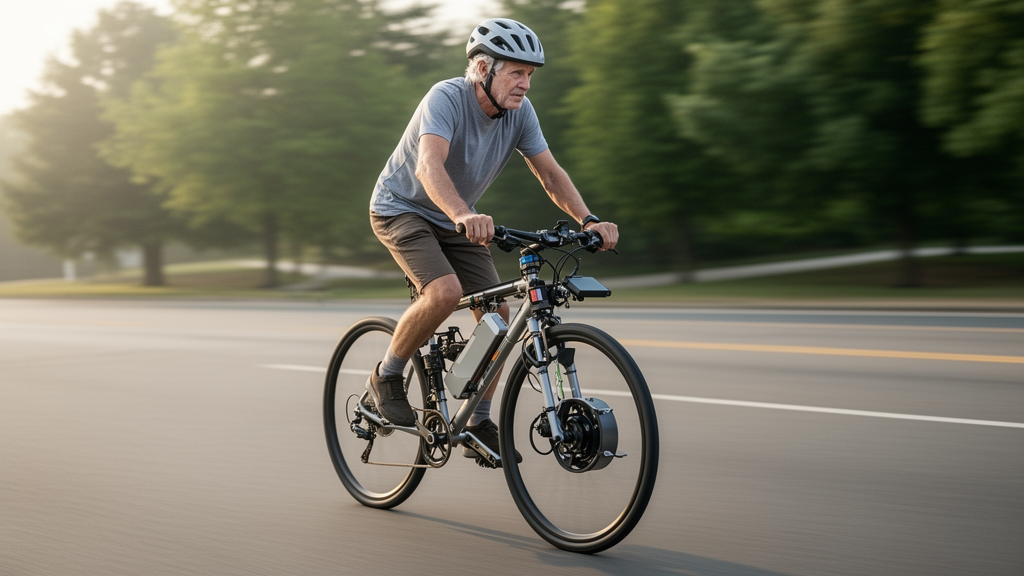
Cycling is one of the healthiest ways for older adults to stay mobile, but it is also one of the most balance-demanding. A new study from the BiPerAge trial, published in BMC Geriatrics, has taken a close look at which components of balance actually matter for riding a bicycle safely in real traffic. The researchers, working at the Friedrich-Alexander-Universität Erlangen-Nürnberg in Germany and Ben-Gurion University of the Negev in Israel, found that the balance skills linked to outdoor cycling competence are surprisingly specific: not general steadiness on two feet, but dynamic, trunk-related control that keeps the upper body stable while the world tilts beneath the wheels.
The stakes are considerable. Older cyclists accounted for 45 percent of cycling fatalities in the European Union in 2012, a share that rose to 50 percent by 2023. That increase likely reflects both a growing number of older people staying active on bikes and the rising popularity of heavy, high-speed pedelecs, which are power-assisted bicycles with electric motors supporting the rider during pedaling. Importantly, the most serious injuries among older riders occur in single-bicycle falls and crashes that involve no other road user, and pedelec riders are affected more often than conventional cyclists. The most common causes are road-surface irregularities such as narrow tracks or poorly visible obstacles, incorrect bicycle fitting, and loss of balance during balance-demanding maneuvers, with mounting and dismounting carrying particular risk.
To understand what separates skilled older cyclists from wobbly ones, the team enrolled 116 community-dwelling adults aged 65 and older, with an average age of 74.0 years and a slight majority of women. All participants had shown objectively measured unsteadiness on a standardized outdoor cycling course, committing at least three errors. That course, adapted from an earlier German trial called SiFAr, included six tasks relevant to everyday traffic: a slalom, slow cycling through a corridor lasting at least ten seconds, mounting and dismounting to both left and right sides, riding through a narrow alley, turning left, and cycling a figure eight. On average, participants made 13.1 errors, scored on a protocol that allowed up to 57, and a second ride was recorded on video to verify the scoring.
The heart of the study was an unusual piece of laboratory equipment called the PerStBiRo system, short for Perturbation Stationary Bicycle Robotics. Developed at Ben-Gurion University, it consists of a stationary bicycle mounted on a moving platform that delivers unannounced tilts to the right, left, forward, and backward, with individualized angles between one and ten degrees and velocities from ten to 500 millimeters per second. Participants pedaled hands-free at roughly 50 revolutions per minute while a Stereolabs ZED 2i camera tracked their shoulder and trunk angles, and a loose safety harness stood ready to arrest any fall. After a three-minute warm-up that calibrated each rider’s natural trunk position, the main protocol delivered 43 perturbations in random timing and direction over up to ten minutes, with angle and velocity increasing gradually.
From this test the researchers extracted several technically distinct measures. During unperturbed cycling, they calculated the average mediolateral root mean square of trunk sway over ten-second intervals before each perturbation, capturing how much the torso naturally wobbled during steady pedaling. During perturbed cycling, they measured the trunk time-to-peak angle, the time from perturbation onset to the peak trunk angle within one second, and the root mean square of trunk sway within that same one-second window. Only perturbations of at least five degrees were analyzed, because smaller tilts did not consistently evoke detectable balance reactions. Alongside this cycling-specific battery, participants completed conventional clinical tests: the Short Physical Performance Battery, the more demanding Modified Balance Error Scoring System performed with eyes closed, a four-meter gait speed test, and the Four Square Step Test, which requires rapid multidirectional stepping around crossed sticks.
The statistical picture that emerged was one of weak but meaningful associations. In bivariate Spearman correlations, more outdoor cycling errors were linked to more errors on the Modified Balance Error Scoring System, slower gait speed, greater trunk sway during unperturbed cycling, a shorter trunk time-to-peak angle after perturbations, and lower trunk sway during perturbed cycling. Notably, the conventional Short Physical Performance Battery showed no significant relationship with cycling competence at all, likely because participants were functionally high performers with an average score of 11.2 out of 12, creating a ceiling effect that blunted the test’s sensitivity. The same high-functioning sample averaged a gait speed above one meter per second and Four Square Step Test times typically under ten seconds, indicating healthy, non-frail older adults.
When the researchers moved to multivariable regression, adjusting for age, sex, country, and weekly distance cycled, only two measures remained independently associated with cycling errors: longer time on the Four Square Step Test and greater trunk sway during unperturbed cycling. The final model explained about 25.7 percent of the variance in cycling errors. A sensitivity analysis confirmed both associations for the German center, which contributed 73 participants, while the Israeli subgroup of 43 showed no statistically significant results despite comparable coefficient sizes, a discrepancy the authors attribute to insufficient statistical power. The reactive perturbation measures, intriguingly, dropped out of the independent model, suggesting that steady-state trunk control during ordinary pedaling may be a more realistic proxy for real-world riding than brief reflex-like responses to sudden tilts.
Why would less trunk sway during unperturbed cycling predict better outdoor performance? The authors draw on prior work showing that skilled younger cyclists rely on lean control with smaller inputs, and that older cyclists use a more tightly regulated balance strategy with less mediolateral postural sway under safe conditions. Because the seated position of cycling reduces the contribution of ankle and hip musculature that dominates easier balance tasks, the trunk appears to take on a compensatory role during curves, abrupt braking, and uneven ground. The pattern of results, in which only trunk-demanding dynamic tasks correlated with cycling errors while low-demand static tasks did not, suggests the relationship is genuinely task-specific rather than a reflection of generally superior balance among fitter participants.
The counterintuitive finding that greater trunk sway after perturbations accompanied better cycling competence deserves attention. The authors interpret this as evidence of a more flexible or responsive postural control strategy: riders confident in their mediolateral balance may allow greater movement excursion and recover smoothly, whereas stiffer responses might reflect defensive compensation. Advancing age is associated with greater trunk stiffness, and alternative cycling strategies such as steering and knee movements may also come into play. The one-second analysis window may simply be too short to capture the full re-stabilization process, and the authors note that reactions in the second and third seconds after a perturbation should be examined in future work.
The study carries clear practical implications. Assessments of older cyclists, the authors suggest, should incorporate challenging dynamic balance measures such as the Four Square Step Test together with task-specific evaluations of trunk control during cycling, rather than relying on standard static tests that miss the demands of riding. Such a movement profile could help identify individuals at risk of cycling-related difficulties and inform targeted training, potentially building on earlier evidence that perturbation-based balance training on a bicycle simulator improves reactive and proactive balance in older adults. The authors are careful to frame their conclusions as exploratory and hypothesis-generating: the cross-sectional design cannot establish causation, the sample consisted of experienced, high-functioning cyclists with at least three baseline errors, and no formal sample-size justification was performed. Longitudinal analyses will be needed to determine whether improving dynamic trunk control actually makes older riders safer on the road. Still, for a population increasingly drawn to e-bikes and longer riding careers, knowing that the secret of steady cycling lives in the trunk, not the ankles, is a genuinely useful starting point.
Subject of Research: Association between balance control components and outdoor cycling competence in older adults
Article Title: Outdoor cycling competence and balance control in older adults – cross-sectional analysis of the BiPerAge trial
Article References: Rogler, J., Krumpoch, S., Freiberger, E., Margalit, N., Zehavi, R., Melzer, I., Barak, S., Shapiro, A., Amir, D. J., Levi, S., Lubovsky, O., & Kob, R. (2026). Outdoor cycling competence and balance control in older adults – cross-sectional analysis of the BiPerAge trial. BMC Geriatrics, 26(1), Article 1306. https://doi.org/10.1186/s12877-026-08491-7
Image Credits: AI Generated
DOI: 10.1186/s12877-026-08491-7
Keywords: older adults, cycling, balance control, trunk sway, perturbation training, PerStBiRo, Four Square Step Test, BiPerAge trial, geriatrics, pedelec safety, postural control, gait speed
Cite Scienmag News
Ophelia Keating. (October 19, 2026). Robotic Bike Reveals How Older Cyclists Keep Their Balance on the Road. Scienmag. https://scienmag.com/robotic-bike-reveals-how-older-cyclists-keep-their-balance-on-the-road/
Ophelia Keating. "Robotic Bike Reveals How Older Cyclists Keep Their Balance on the Road." Scienmag, 19 October 2026, https://scienmag.com/robotic-bike-reveals-how-older-cyclists-keep-their-balance-on-the-road/. Accessed 19 October 2026.
Ophelia Keating. "Robotic Bike Reveals How Older Cyclists Keep Their Balance on the Road." Scienmag. October 19, 2026. https://scienmag.com/robotic-bike-reveals-how-older-cyclists-keep-their-balance-on-the-road/


