


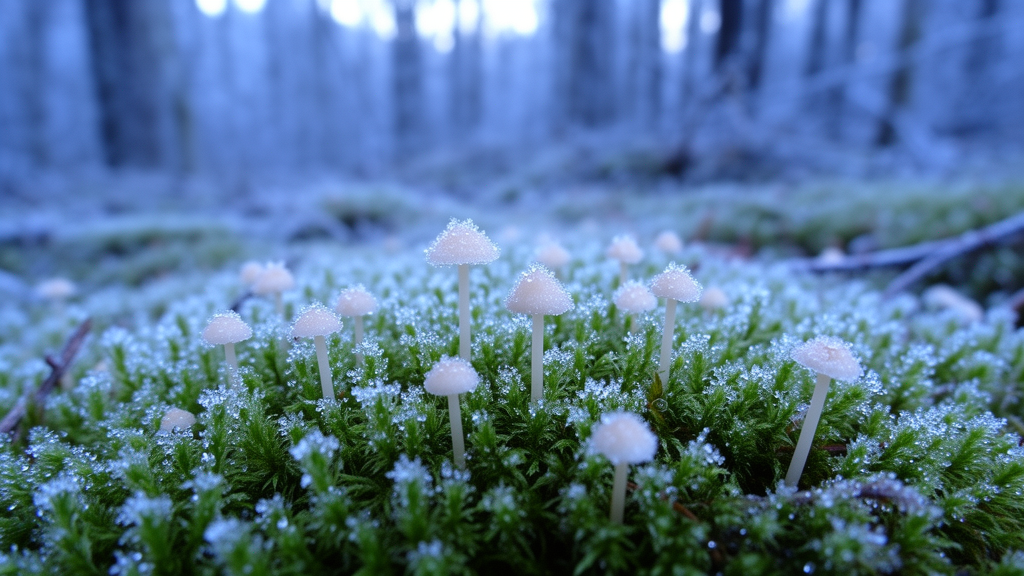
Deep in the cold corners of the world—polar tundra, mountain slopes, and damp boreal forests—lives a group of obscure black fungi that has quietly perfected the art of surviving the cold. These fungi belong to the family Epibryaceae, an early-diverging lineage within the order Chaetothyriales, a group of melanized fungi better known for rock-dwelling lifestyles and, in some cases, for causing disease in humans. A new study published in IMA Fungus has now sequenced the whole genomes of six reference strains from the genus Epibryon, the largest and most recognizable genus in the family, and the results paint a vivid picture of a lineage shaped by life at low temperatures. The research, led by an international team of mycologists, combines comparative genomics, phylogenomics, and functional annotation to explain why these fungi cluster around mosses, liverworts, and lichens in some of the chilliest habitats on Earth.
The Chaetothyriales are a fascinating order of ascomycete fungi, characterized by their dark, melanin-rich cell walls and their remarkable ability to colonize extreme environments. Ancestral state reconstructions suggest the order originated from melanized, slow-growing rock-inhabiting fungi or lichen-associated ancestors, and today its members occupy a striking diversity of niches: some live on bare rock exposed to punishing ultraviolet radiation, others associate with ants, lichens, or plants, and a few have evolved as opportunistic pathogens of humans. The order is currently divided into at least seven families, including the Herpotrichiellaceae, which contains thermophilic human pathogens such as Cladophialophora carrionii, the agent of chromoblastomycosis. The Epibryaceae, first formally described in 2014, sit near the base of this evolutionary tree, making them a key lineage for understanding how the ecological diversity of the entire order came to be.
Until now, genomic information on the Epibryaceae was almost entirely absent, which hindered any serious attempt to understand the molecular basis of their apparent preference for cold. The genus Epibryon comprises roughly fifty described species, most of them tiny fungi that form small, dark, bristly fruiting bodies measuring just 40 to 150 micrometers across. They typically grow on the older, dying, or dead leaves of mosses and leafy liverworts, sometimes showing remarkable specificity for particular host species or even particular microsites such as leaf nerves or individual cells. A few species have been reported from rock surfaces, soil, or as epiphytes, and several were described from high-latitude regions, hinting at a link between the lineage and low temperatures long before genomic tools could test that idea.
To close this gap, the researchers selected six reference strains spanning the diversity of the family: Epibryon bryophilum, E. humicola, E. interlamellare, E. minutissimum, E. sylvestris, and E. turfosorum. The fungi were cultured on Sabouraud’s Glucose Agar at 28 degrees Celsius for a week, and DNA was extracted using the classic CTAB method with chloroform and isoamyl alcohol. Sequencing was carried out on Illumina platforms, including the NovaSeq 6000, MiSeq, and BGI-Seq500, generating 150-base-pair paired-end reads. The team then assembled the genomes de novo using SPAdes with multiple k-mer sizes, filtered out non-eukaryotic contamination with the deep-learning tool Tiara, and assessed completeness with BUSCO against a Chaetothyriales-specific database. Gene prediction and annotation were performed with the Funannotate pipeline, drawing on databases such as InterPro, PFAM, dbCAN, MEROPS, UniProt, and EggNOG to assign functions to the predicted proteins.
The resulting genomes averaged 29.09 megabase pairs in size, ranging from 26.20 to 34.97 Mbp, and contained an average of 10,495 predicted genes. BUSCO completeness averaged 85.8 percent using a set of 6,265 conserved fungal genes, a respectable figure for these fragmented assemblies. The researchers then compared these new genomes with publicly available references across the subclass Chaetothyriomycetidae, including 62 genomes from the Chaetothyriales itself, plus representatives of the Phaeomoniellales, Pyrenulales, and Verrucariales. Orthology analysis with OrthoFinder2 classified genes into orthogroups, and a phylogenomic tree built from 296 single-copy orthogroups confirmed that all Epibryon species share a common ancestor and that the family forms a distinct, early-diverging branch within the order.
One of the most striking taxonomic outcomes concerns Cladophialophora brunneola, a fungus isolated from karst rock at 2,220 meters altitude in Guizhou, China. Previously described as an early-diverging lineage within the Chaetothyriales, this species clearly clusters within the Epibryaceae in both the phylogenomic and multilocus analyses, which were based on the ribosomal genes SSU, ITS, and LSU together with the protein-coding RPB2 gene. The authors therefore formally reclassified it as Epibryon brunneolum comb. nov. Interestingly, this rock-dwelling species showed the highest proportion of orthogroups containing two genes, suggesting greater protein diversity, and it also possesses the highest number of carbohydrate-active enzymes in the family—features that may reflect the severe fluctuations in temperature and humidity experienced by fungi living on sun-exposed rock surfaces.
The functional comparisons revealed a distinctive enzymatic toolkit that sets the Epibryaceae apart from their relatives. On average, family members carry 297 genes assigned to the CAZyme database, spanning 106 families, and 345.7 genes in the MEROPS peptidase database, spanning 89 families. Crucially, the Epibryaceae show a reduced set of enzymes associated with lignin degradation, including contractions in the auxiliary activity families AA7 and AA9 and the glycoside hydrolase family GH12. They also uniquely possess the carbohydrate-binding module CBM52, which binds to endo-1,3-beta-glucanase and enhances its activity during cell septation, though its precise ecological role remains to be elucidated. On the peptidase side, the family uniquely harbors the enzyme U74, which has a nonspecific catalytic site capable of digesting proteins without any restriction on substrate size, and shows expansions in the S53 and T02 families alongside contractions in C26 and C85.
The most compelling evidence for cold adaptation comes from the analysis of stress-response genes. All Epibryaceae species possess the cold shock protein CspA, an RNA-binding enzyme that stabilizes ribosomal structures and maintains protein translation under cold stress. No other family in the Chaetothyriales carries this protein, although it is known to be expanded among black fungi isolated from Antarctic environments in the class Dothideomycetes, underscoring its importance for fungal survival at low temperatures. At the same time, the Epibryaceae lack the ClpA/B conserved site 2, a domain associated with protecting cellular structures during heat stress, suggesting a reduced tolerance for high temperatures. The family also shows a duplication of 5-formyltetrahydrofolate cyclo-ligase in its last common ancestor and an expansion of the DNA recombination and repair protein Rad51, which has five copies compared with four in the ancestral Chaetothyriales and only two in several Herpotrichiellaceae. Rad51 repairs DNA damage caused by ultraviolet light, and its expansion may help these fungi withstand the intense radiation of glacial and high-altitude environments.
These genomic signatures align neatly with the ecological record. Mapping the isolation sites of Epibryaceae strains onto the Köppen climate classification shows that most known isolates come from polar regions and cold or temperate continental zones, with precipitation distributed throughout the year. The family’s reduced capacity for lignin and complex polysaccharide breakdown fits its saprobic lifestyle on mosses and liverworts, which offer readily accessible carbon sources in nutrient-poor, cold environments where lignin-rich plant material is scarce. The authors suggest that this combination of traits—a psychrophilic preference, a saprobic ecology on bryophytes, and occasional associations with lichens, soil, and the phyllosphere—distinguishes the Epibryaceae from all other chaetothyrialean lineages and may reflect an ancestral ecological state shared with closely related orders such as the Verrucariales, many of which are lichen-associated.
The study also highlights how much remains to be discovered. Despite extensive herbarium records, molecularly characterized isolates of Epibryon remain scarce, and the true breadth of the family’s ecological distribution is only beginning to emerge. The finding that a genus once defined by its moss-dwelling habit also includes rock-inhabiting and soil-dwelling species suggests that future sampling from underexplored cold regions will likely reveal further diversity and refine our understanding of its specialization. For now, the genomes of these six strains provide the first molecular window into a lineage that traded heat tolerance for cold resilience, and they demonstrate how comparative genomics can transform a little-known family of moss-inhabiting microfungi into a model for studying fungal adaptation to some of the planet’s most demanding environments.
Subject of Research: Genomics and cold-adaptation mechanisms of the psychrophilic fungal family Epibryaceae in the order Chaetothyriales
Article Title: Genomics and ecology of Epibryaceae , a psychrophilic family in Chaetothyriales
Article References: Lustosa, B. P. R., Belmonte-Lopes, R., de Hoog, S., Costa, F. D. F., Jacomel, B., dos Santos, G. D., Razzolini, E., Li, Y., Xue, R., Baura, V. A., Souza, E. M. D., Gomes, R. R., Ahmed, S. A., Selbmann, L., Song, Y., & Vicente, V. A. (2025). Genomics and ecology of Epibryaceae, a psychrophilic family in Chaetothyriales. IMA Fungus, 16, Article e170120. https://doi.org/10.3897/imafungus.16.170120
Image Credits: AI Generated
DOI: 10.3897/imafungus.16.170120
Keywords: Epibryaceae, Epibryon, Chaetothyriales, psychrophilic fungi, comparative genomics, cold shock protein CspA, CAZymes, MEROPS peptidases, phylogenomics, bryophytes, black fungi, genome annotation
Cite Scienmag News
Roger Howard. (October 19, 2026). Cold-Loving Fungi: Genomes Reveal How a Moss-Dwelling Family Conquered the Chill. Scienmag. https://scienmag.com/cold-loving-fungi-genomes-reveal-how-a-moss-dwelling-family-conquered-the-chill/
Roger Howard. "Cold-Loving Fungi: Genomes Reveal How a Moss-Dwelling Family Conquered the Chill." Scienmag, 19 October 2026, https://scienmag.com/cold-loving-fungi-genomes-reveal-how-a-moss-dwelling-family-conquered-the-chill/. Accessed 19 October 2026.
Roger Howard. "Cold-Loving Fungi: Genomes Reveal How a Moss-Dwelling Family Conquered the Chill." Scienmag. October 19, 2026. https://scienmag.com/cold-loving-fungi-genomes-reveal-how-a-moss-dwelling-family-conquered-the-chill/


