


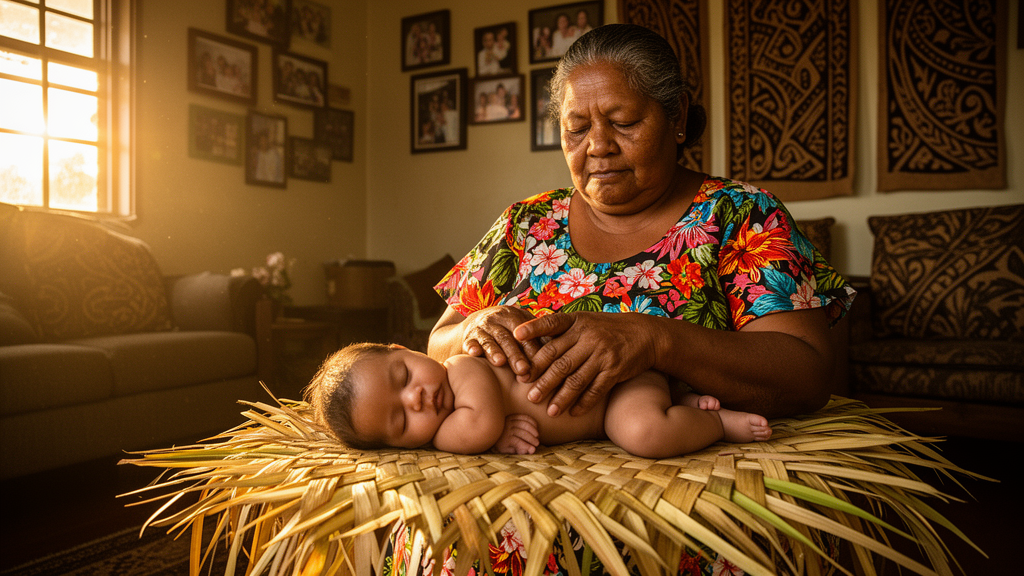
In the quiet hours after a baby finally falls asleep, decisions made about where that infant sleeps can mean the difference between life and death. Sudden Unexpected Death in Infants, known as SUDI, remains one of the most devastating outcomes in early childhood, and in Aotearoa New Zealand it strikes Pacific communities at disproportionately high rates. A new qualitative study published in BMC Public Health has taken an unusual and culturally grounded approach to understanding why: rather than asking what Pacific mothers know about safe sleep, researchers sat down with both mothers and grandmothers from Samoan, Tongan, Cook Island Māori, and Niue families to listen, in their own words and on their own terms, to how knowledge about infant sleep is created, shared, and acted upon within families.
The research team, led by Amio Matenga-Ikihele of Moana Connect and the University of Auckland, conducted eight focus groups with 31 mothers and grandmothers living in Auckland between February and October 2022. What sets this study apart methodologically is its commitment to Pacific research paradigms. The investigators used the Kakala framework, a Pacific methodology that structures research like the weaving of a garland, from gathering and making to presenting and reflecting, combined with Talanoa, a conversational approach rooted in open, respectful dialogue across the Pacific. This meant participants were not treated as data points but as knowledge holders whose lived experience carries analytical weight equal to any clinical guideline.
The technical findings are striking in their nuance. Using a general inductive approach to analysis, the researchers identified three overarching themes: knowledge and awareness of SUDI, infant sleep practices, and the sources of information and influence that shape family decisions. Crucially, the first theme dismantles any assumption that the problem is a simple knowledge deficit. Participants demonstrated solid awareness of SUDI and its established prevention measures, including the importance of a clear cot, avoiding exposure to tobacco smoke, and positioning babies safely for sleep. These women knew what the health system recommends, and many could articulate it clearly.
Yet knowledge alone did not translate into practice, and here lies the study’s most consequential insight. Despite understanding official advice, many mothers reported choosing to follow the guidance of family members, particularly grandmothers, over that of healthcare professionals, especially around bedsharing. In Pacific cultural worldviews, the grandmother is not a peripheral figure but a central conduit of infant care knowledge, an authority whose experience spans generations and whose involvement reflects values of collective child-rearing, kinship obligation, and intergenerational wisdom. When a grandmother says the baby should sleep beside her, that instruction carries a weight that no pamphlet or clinic consultation can easily displace.
This dynamic creates what public health researchers call a translation gap, but framing it as a simple failure of communication would be a mistake. Bedsharing sits at the intersection of culture, practicality, and love. For many families, sharing a sleeping surface facilitates breastfeeding, enables close monitoring of the infant, and reflects norms of physical closeness that are central to Pacific parenting. International evidence indicates that bedsharing can elevate risk under certain conditions, particularly when combined with maternal smoking, alcohol or drug consumption, sofa-sharing, or soft bedding, while the risk profile under other circumstances remains debated. Blanket discouragement, the study’s authors argue, simply pushes the practice out of clinical view, leaving families without the harm-reduction information that could genuinely save lives.
The implications for health services are profound. The researchers conclude that SUDI prevention strategies must be co-designed with Pacific communities, integrating risk minimisation approaches with Pacific cultural worldviews rather than imposing generic messages that families quietly set aside. They specifically call for grandmothers to be recognised and engaged as key conduits of infant care knowledge, effectively turning the most influential voices in the household into partners rather than obstacles. This represents a shift from a deficit model, in which Pacific families are seen as needing correction, to a strengths-based model in which existing family structures become the delivery mechanism for safer sleep practices.
The study also carries a pointed message for clinicians. Health professionals, the authors argue, should be supported to engage in open, non-judgmental conversations about safer bedsharing rather than issuing blanket prohibitions. In practical terms, this means a midwife or Well Child nurse might ask not whether a family bedshares, but how, and then provide specific, actionable advice: keeping the baby face-up, ensuring the sleep surface is firm, keeping bedding away from the infant’s head, avoiding sofa-sharing, and never bedsharing after drinking alcohol or smoking. Such conversations require time, cultural humility, and trust, resources that are often scarce in pressured primary care settings but which the evidence suggests are decisive.
Context matters for understanding the urgency. Pacific peoples make up a significant and youthful share of New Zealand’s population, and SUDI rates in Pacific infants have historically exceeded those of the general population, a disparity shaped by socioeconomic factors, housing conditions, smoking prevalence, and access to culturally responsive care. Previous national interventions, including the distribution of wahakura, the flax woven portable sleep spaces pioneered in Aotearoa, have shown that culturally embedded solutions can work when they respect rather than override Māori and Pacific practices. The new study extends that logic by identifying precisely who within Pacific families holds the authority to normalise such solutions.
Methodologically, the study offers a template for health research with indigenous and migrant communities. The Kakala framework and Talanoa methodology are not merely stylistic choices; they alter what data becomes visible. In a talanoa, participants can raise topics a structured interview would never surface, and the relational warmth of the format encourages honesty about practices, like bedsharing, that families might otherwise conceal from researchers they fear will judge them. Ethics approval was granted by New Zealand’s Southern Health and Disability Ethics Committee in November 2021, and all participants gave written informed consent. The work was funded by the Health Research Council of New Zealand’s Pacific Project Grant, with the funders having no role in the design, analysis, or decision to publish.
The broader lesson reaches well beyond Auckland. Around the world, public health campaigns fail when they treat households as collections of individuals receiving messages, rather than as social systems in which advice flows through relationships of trust and obligation. This study demonstrates that in Pacific families in Aotearoa, the shortest path to a safer sleeping baby may run through the grandmother’s hands. If health systems learn to equip and honour those hands with accurate, non-judgmental information, the gap between what families know and what families do may finally begin to close, and fewer Pacific whānau will have to endure the unthinkable loss that SUDI represents.
Subject of Research: SUDI prevention knowledge and infant sleep practices among Pacific mothers and grandmothers in New Zealand
Article Title: Exploring SUDI knowledge and practices among Samoan, Tongan, Cook Island Māori, and Niue mothers and grandmothers in Aotearoa New Zealand: a qualitative study
Article References: Matenga-Ikihele, A., Pole, K., Langridge, F., Fa’aui, A., Heather, M., Percival, T., Paynter, J., & Nosa, V. (2026). Exploring SUDI knowledge and practices among Samoan, Tongan, Cook Island Māori, and Niue mothers and grandmothers in Aotearoa New Zealand: a qualitative study. BMC Public Health. https://doi.org/10.1186/s12889-026-29886-6
Image Credits: AI Generated
DOI: 10.1186/s12889-026-29886-6
Keywords: SUDI, sudden unexpected death in infants, infant sleep practices, bedsharing, Pacific health, Talanoa methodology, Kakala framework, grandmothers, Aotearoa New Zealand, qualitative research, health equity, co-designed interventions
Cite Scienmag News
Harold Sullivan. (October 19, 2026). Grandmothers Hold the Key: Why Pacific Families Choose Kin Over Clinics in Infant Sleep Safety. Scienmag. https://scienmag.com/grandmothers-hold-the-key-why-pacific-families-choose-kin-over-clinics-in-infant-sleep-safety/
Harold Sullivan. "Grandmothers Hold the Key: Why Pacific Families Choose Kin Over Clinics in Infant Sleep Safety." Scienmag, 19 October 2026, https://scienmag.com/grandmothers-hold-the-key-why-pacific-families-choose-kin-over-clinics-in-infant-sleep-safety/. Accessed 19 October 2026.
Harold Sullivan. "Grandmothers Hold the Key: Why Pacific Families Choose Kin Over Clinics in Infant Sleep Safety." Scienmag. October 19, 2026. https://scienmag.com/grandmothers-hold-the-key-why-pacific-families-choose-kin-over-clinics-in-infant-sleep-safety/


