


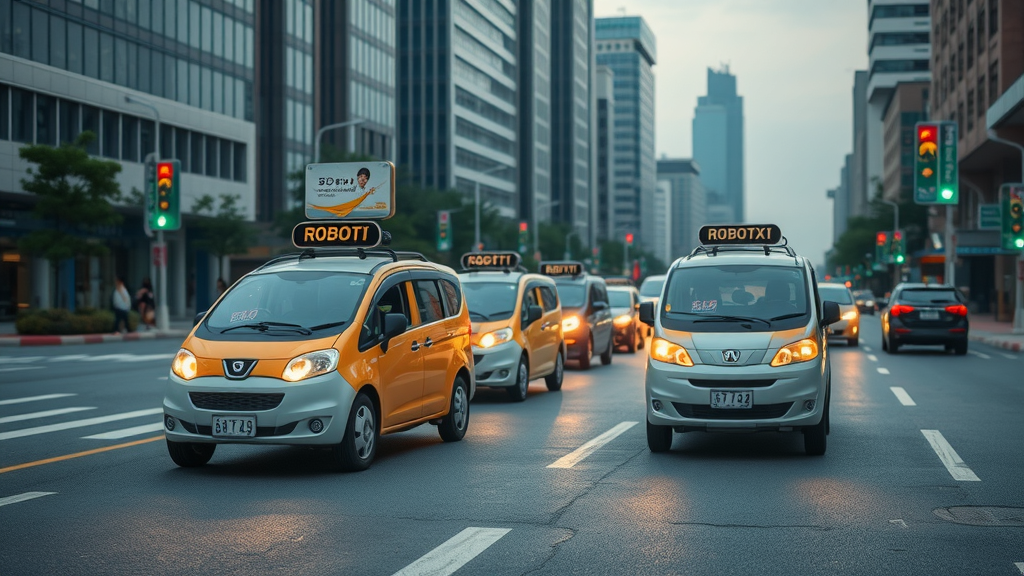
Driverless robotaxis have moved from futuristic concept to everyday reality on the streets of several cities, yet their consequences for urban transport systems and energy consumption have remained stubbornly uncertain. Now, one of the first large-scale empirical analyses of fully autonomous ride-hailing operations suggests that these vehicles could deliver surprisingly large efficiency gains, provided cities deploy them with deliberate optimization. A study published in Nature Sustainability, based on more than four million trip records from Wuhan, China, reports that an optimized robotaxi fleet could shrink the required number of vehicles by 62.5 percent and cut daily energy consumption by 44.8 percent compared with current operations.
The research team, led by Zelin Wang and Zhiyuan Liu of Southeast University together with collaborators at the National University of Singapore, the University of Bristol, the University of Wisconsin-Madison, and Monash University, seized a rare scientific opportunity. Wuhan is among the first cities worldwide where fully driverless ride-hailing services operate at commercial scale alongside conventional, human-driven taxis. By pairing the operational records of robotaxis with trajectory data from traditional taxis in the same market, the researchers could compare, street by street and hour by hour, how autonomous and human-driven fleets actually behave in the same urban environment rather than in simulations alone.
The first major finding concerns competition. When the team mapped where robotaxi pickups and drop-offs occurred, they found that robotaxi activity overlaps spatially with human-driven taxi demand to a striking degree. In other words, driverless ride-hailing is currently serving many of the same trips, in many of the same places, that conventional taxis already serve. This indicates potential direct competition within the on-demand mobility market, with both fleets chasing the same passengers in the densest and most commercially active parts of the city. For urban planners, the result raises questions about whether unmanaged robotaxi growth will simply duplicate existing services rather than expanding mobility options where they are most needed.
The relationship with public transit, however, tells a different and more hopeful story. The researchers measured how often trip endpoints fell within the catchment areas of metro and bus stations, using the share of trips beginning and ending inside these zones as an indicator of transit connectivity. Robotaxi trips showed markedly lower station-to-station ratios than human-driven taxi trips: 46.9 percent for metro-station catchments and 61.6 percent for bus-station catchments. This suggests robotaxis are relatively more active in areas less well served by fixed-route transit, and that they may function as a complement to buses and metro lines, feeding passengers to and from stations, rather than as a substitute that siphons riders away from public transport.
The study also broke new ground by connecting robotaxi operations to the physical structure of the street network. Drawing on road-network complexity measures, the team found that autonomous ride-hailing activity concentrates on simpler, less intricate street segments, an intuitive but previously unquantified pattern reflecting how autonomous driving systems navigate environments with fewer complicated intersections and interactions. Crucially, the researchers demonstrated that incorporating network complexity into their demand model improved predictive performance, meaning that the geometry of the road network itself carries real information about where robotaxi demand will materialize. This offers cities a practical analytical tool: by understanding which network environments attract autonomous services, planners can anticipate where fleets will concentrate and how deployment patterns might evolve.
The headline results come from the optimization analysis. The team constructed an upper-bound scenario in which dispatch and ride-sharing were jointly optimized, effectively asking how efficiently a perfectly coordinated robotaxi system could serve the observed demand. The answer was dramatic. Under this scenario, the required fleet size could be reduced by 62.5 percent, and daily operational energy consumption could fall by 44.8 percent. The scale of these potential savings reflects the enormous inefficiency latent in current on-demand vehicle fleets, where a large fraction of driving consists of empty repositioning between passengers. Prior theoretical work, including the landmark minimum-fleet analysis published in Nature in 2018, had suggested such savings were possible; the Wuhan study provides some of the first evidence grounded in real driverless operations rather than human-driven proxies.
The energy implications extend well beyond the vehicles themselves. Because robotaxis are predominantly electric in most commercial deployments, reductions in fleet size and kilometers traveled translate directly into lower electricity demand, smaller charging infrastructure footprints, and reduced demands on the power grid during peak hours. A smaller fleet also means fewer batteries manufactured, fewer vehicles parked at any moment, and potentially less pressure on urban land devoted to vehicle storage. The findings connect to a broader body of research on how shared autonomous mobility reshapes vehicle lifetimes and the carbon footprint of electrified transport, and they suggest that the operational choices made by robotaxi operators today will echo through urban energy systems for decades.
Still, the authors and independent observers caution that the reported savings represent an upper bound achievable under idealized coordination, not a forecast of business as usual. Real-world dispatch involves stochastic demand, passenger waiting-time tolerances, regulatory constraints on where vehicles may operate, and the commercial realities of competing operators running independent fleets. Realizing even a fraction of the modeled 62.5 percent fleet reduction would require coordination mechanisms, data sharing, or regulatory frameworks that currently do not exist in most cities. The study’s value lies in quantifying the size of the prize, giving policymakers a concrete sense of what is at stake in how they regulate and structure autonomous mobility markets.
The competitive dynamics identified in the study add urgency to that governance question. If robotaxis and human taxis are competing for the same trips while robotaxis simultaneously complement public transit, cities face a delicate balancing act. Encouraging robotaxi services to fill transit gaps could enhance accessibility in underserved neighborhoods and support transit ridership, while unchecked market overlap could destabilize existing taxi industries and add vehicle kilometers to congested corridors. The authors argue that their empirical findings provide support for aligning robotaxi deployment with urban sustainability goals, implying that deployment policy, not just technology, will determine whether autonomous mobility helps or hinders city-level climate and efficiency targets.
Wuhan’s experience offers an early template for other cities as robotaxi operations expand globally, with services now running or planned across China, the United States, and Europe. The methodology developed by the team, combining large-scale operational data, network-complexity modeling, and fleet optimization, can be applied wherever autonomous ride-hailing operates alongside conventional modes. As driverless fleets grow, the study suggests the decisive question is no longer whether robotaxis can serve urban trips, but whether cities will harness the coordination and planning needed to capture their full sustainability potential, transforming a disruptive technology into a durable pillar of low-energy urban transport.
Subject of Research: Urban energy and transport impacts of autonomous robotaxi deployment
Article Title: Urban energy and transport impacts of autonomous robotaxi deployment
Article References: Urban energy and transport impacts of autonomous robotaxi deployment. (n.d.). https://doi.org/10.1038/s41893-026-01944-2
Image Credits: AI Generated
DOI: 10.1038/s41893-026-01944-2
Keywords: robotaxis, autonomous vehicles, urban transport, energy consumption, ride-hailing, public transit, fleet optimization, ride-sharing, Wuhan, sustainability, road network complexity, electric vehicles
Cite Scienmag News
Sloane Callahan. (September 22, 2026). Robotaxis Could Slash Urban Fleet Size and Energy Use by Nearly Two-Thirds, Wuhan Study Finds. Scienmag. https://scienmag.com/robotaxis-could-slash-urban-fleet-size-and-energy-use-by-nearly-two-thirds-wuhan-study-finds/
Sloane Callahan. "Robotaxis Could Slash Urban Fleet Size and Energy Use by Nearly Two-Thirds, Wuhan Study Finds." Scienmag, 22 September 2026, https://scienmag.com/robotaxis-could-slash-urban-fleet-size-and-energy-use-by-nearly-two-thirds-wuhan-study-finds/. Accessed 4 October 2026.
Sloane Callahan. "Robotaxis Could Slash Urban Fleet Size and Energy Use by Nearly Two-Thirds, Wuhan Study Finds." Scienmag. September 22, 2026. https://scienmag.com/robotaxis-could-slash-urban-fleet-size-and-energy-use-by-nearly-two-thirds-wuhan-study-finds/


