


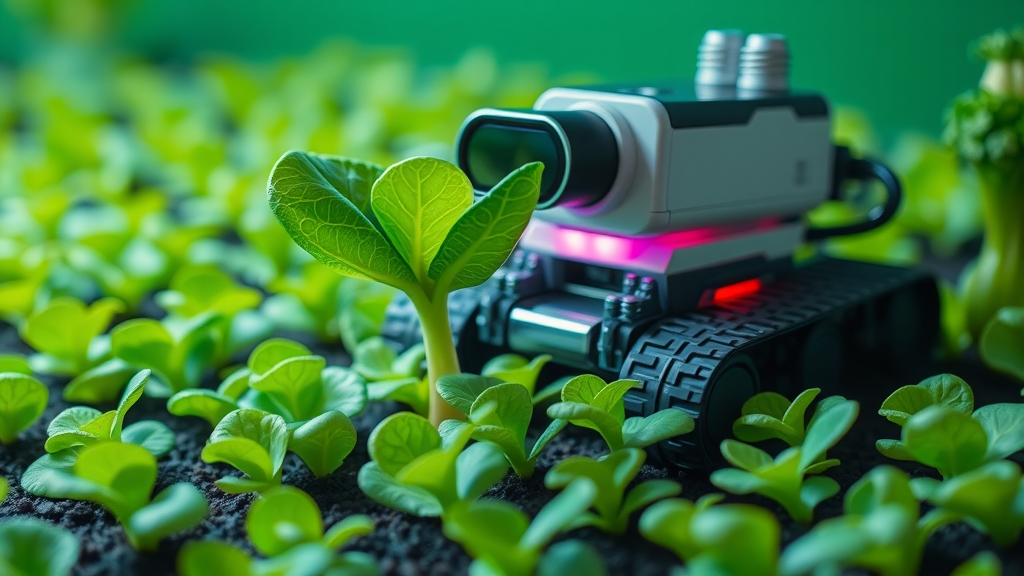
A robotic platform that rolls quietly between rows of potted lettuce, fusing depth cameras with multispectral sensors, may soon transform how scientists measure the earliest and most fragile stage of crop life. Researchers at the Beijing Academy of Agriculture and Forestry Sciences have unveiled an end-to-end phenotyping framework that captures greenhouse lettuce seedlings in full three-dimensional, spectrally annotated detail, turning a task that once demanded tedious manual measurement into an automated, non-destructive digital workflow. The study, published in Artificial Intelligence in Agriculture, addresses one of the most stubborn problems in controlled-environment agriculture: how to reliably see, segment, and measure plants that are only a few centimeters wide and often nearly indistinguishable in color from the soil they grow in.
The difficulty of seedling phenotyping is easy to underestimate. Lettuce seedlings are diminutive, morphologically plastic, and in some cultivars spectrally almost identical to their growing medium. In ordinary RGB images, this produces low visual contrast and blurred boundaries between plant and substrate, undermining the appearance-based algorithms that work well on mature crops. Yet the seedling stage is precisely when subtle morphological changes carry the most biologically significant information about genotype, vigor, and stress response. Single-modality sensing compounds the problem: color cameras miss physiological state, while depth sensors alone struggle with the weak textures of young foliage. What was needed was a system that could capture geometric structure and physiological condition simultaneously, at scale, without touching a single leaf.
The team’s answer is an unmanned ground vehicle with a straddle-type chassis that drives directly over rows of potted lettuce, imaging the canopy from above without disturbing growth. Mounted at the center of the vehicle is a rigidly coupled, synchronously triggered imaging unit combining a time-of-flight Femto Bolt depth camera with a CropEye-A1 multispectral camera that records reflectance in four narrow bands centered at 550, 660, 720, and 840 nanometers. These bands are critical proxies for chlorophyll content, biomass, and plant stress. The UGV captures one synchronized frame every four seconds as it follows predefined paths, a deliberately sparse sampling strategy that balances spatial overlap against storage and computational cost, with mechanical dampers suppressing the blur of vehicle motion.
Because the two sensors differ in resolution, field of view, and optical geometry, the raw data streams arrive misaligned. The researchers built a registration module that extracts SIFT keypoints from both modalities, generates initial matches through FLANN descriptor pairing, and then filters false correspondences using a statistical slope- and angle-consistency test based on the median absolute deviation criterion. Surviving matches feed a RANSAC estimator that computes an affine transformation, registering each multispectral band precisely to the RGB reference frame. This pixel-level alignment is the quiet foundation of the entire pipeline: without geometrically consistent RGBD and multispectral data, every downstream step would inherit systematic error.
At the heart of the framework sits MS-SegNet, a novel dual-backbone instance segmentation network that extends the lightweight YOLOv11n-Seg architecture. One backbone processes RGBD input while a parallel branch handles multispectral data, allowing each to specialize in its own modality before features are merged. Fusion is hierarchical rather than uniform: a Shallow Cross-Self Attention Fusion module combines edge-level features at the C3 and C4 stages, using cross-attention, CBAM-style self-attention refinement, and a learnable prompt vector that adaptively weighs geometry-dominant against reflectance-dominant information. At the deepest stage, a Transformer-based Deep Fusion Module applies local-window attention to align high-level semantic representations. The backbone itself was upgraded with an ADown downsampling module that preserves fine leaf detail, and a C2PSDA attention block that contrasts two attention heads to suppress the false responses that substrate textures otherwise provoke.
The numbers are striking. On a dataset of 410 synchronized multimodal frames covering 237 lettuce varieties across seven horticultural types, with 1,726 manually annotated seedling instances, MS-SegNet achieved a precision of 0.993, an mAP@50 of 0.994, an mAP@75 of 0.973, and an mAP@50:95 of 0.854, outperforming YOLOv8n-Seg, YOLOv9n-Seg, Mask R-CNN, and Mask2Former under identical training conditions. The two-stage generalist models lagged by 6.7 to 8.7 percentage points on the strictest metric, underscoring how demanding fine-grained seedling segmentation is. Ablation experiments confirmed that each proposed module contributes measurable gains, and Grad-CAM visualizations showed the network focusing tightly on seedling contours where baseline models scattered attention across pots, soil, and irrigation pipes. Mid-level feature fusion proved decisively better than early input stacking or late decision merging, which cannot refine boundaries through cross-modal interaction.
Reconstructing the scene in 3D posed a different challenge. With frames captured only every four seconds, inter-frame overlap is minimal and traditional visual odometry or SLAM approaches fail. The team instead initialized global camera poses with a structure-from-motion pipeline, masked out static vehicle components that would generate false feature matches, and then recovered absolute metric scale by comparing SfM-derived displacements with depth-based ICP alignments across frame pairs, aggregating robustly via the median. A final incremental generalized ICP refinement, run in a multi-resolution voxel framework with surface-normal constraints, suppressed residual drift. Qualitative comparisons showed that classical SfM-MVS produced hole-ridden, fragmented canopies, while modern monocular reconstruction models such as VGGT and Pi3 suffered severe drift and geometric distortion on the weakly textured, top-down greenhouse imagery. The proposed pipeline alone yielded metrically consistent, structurally stable reconstructions across entire trajectories.
Notably, the reconstruction framework generalized without any parameter adjustment to two morphologically contrasting species, lily and tomato, preserving tomato’s layered branching despite heavy self-occlusion and recovering lily’s smooth, repetitive stems where photometric features are inherently scarce. For the lettuce seedlings themselves, the fused semantic multispectral point clouds enabled extraction of canopy area, plant height, crown width, volume, and compactness, alongside vegetation indices including NDVI, NDRE, and PRI. System-derived plant height and crown width agreed strongly with manual measurements, achieving R-squared values of 0.8379 and 0.918 with root-mean-square errors of roughly 11 millimeters, centimeter-level accuracy sufficient for quantitative growth monitoring.
The spectral dimension adds a capability that geometry alone cannot deliver: physiological assessment. Using the 90th percentile of NDVI and NDRE distributions within each segmented seedling, a statistic that suppresses background interference and highlights the most active leaf tissue, the researchers established a four-level health grading system from vigorous to poor. Correlation analysis revealed strong positive associations between vegetation indices and volumetric growth traits, while RGB-derived intensities correlated weakly, confirming that trichromatic color carries little discriminatory power in substrate-dominated greenhouse scenes. The upshot is early detection of subtle stress signatures in sparse seedling canopies, something neither RGB imaging nor 3D geometry could achieve independently.
The authors are candid about limitations. Segmentation accuracy dips under the strictest overlap thresholds along fine leaf edges, reconstruction quality is sensitive to deviations from planned trajectories under the fixed sampling interval, and the absence of laser-scanner ground truth means geometric fidelity was validated indirectly through trait agreement. As plants mature and canopies overlap, occlusion will inevitably degrade reconstruction, and transferring the segmentation model to new species still requires fresh annotation. Even so, the framework offers a compelling template for automated, non-destructive seedling phenotyping in controlled environments. The team’s stated next steps, real-time deployment on autonomous robots, integration with temporal growth models, and expansion to additional spectral modalities and crop varieties, point toward a future in which every seedling in a breeding program carries its own continuously updated digital twin, accelerating data-driven breeding and precision cultivation at industrial scale.
Subject of Research: UGV-based multimodal RGBD–multispectral fusion for 3D phenotyping of greenhouse lettuce seedlings
Article Title: UGV-based multimodal RGBD–multispectral fusion framework enables high-quality 3D phenotyping of greenhouse lettuce seedlings
Article References: Yang, S., Qiu, G., Xia, J., Zhao, Y., Wen, W., Wang, C., Gou, W., Guo, X., & Zhao, C. (2026). UGV-based multimodal RGBD–multispectral fusion framework enables high-quality 3D phenotyping of greenhouse lettuce seedlings. Artificial Intelligence in Agriculture. https://doi.org/10.1016/j.aiia.2026.08.015
Image Credits: AI Generated
DOI: 10.1016/j.aiia.2026.08.015
Keywords: lettuce seedlings, plant phenotyping, multispectral imaging, RGBD sensing, unmanned ground vehicle, 3D reconstruction, instance segmentation, MS-SegNet, controlled environment agriculture, NDVI, greenhouse robotics, deep learning
Cite Scienmag News
Alan Morgan. (September 12, 2026). Robot Rover Fuses Depth and Multispectral Imaging to Digitally Twin Lettuce Seedlings in 3D. Scienmag. https://scienmag.com/robot-rover-fuses-depth-and-multispectral-imaging-to-digitally-twin-lettuce-seedlings-in-3d/
Alan Morgan. "Robot Rover Fuses Depth and Multispectral Imaging to Digitally Twin Lettuce Seedlings in 3D." Scienmag, 12 September 2026, https://scienmag.com/robot-rover-fuses-depth-and-multispectral-imaging-to-digitally-twin-lettuce-seedlings-in-3d/. Accessed 5 October 2026.
Alan Morgan. "Robot Rover Fuses Depth and Multispectral Imaging to Digitally Twin Lettuce Seedlings in 3D." Scienmag. September 12, 2026. https://scienmag.com/robot-rover-fuses-depth-and-multispectral-imaging-to-digitally-twin-lettuce-seedlings-in-3d/


