


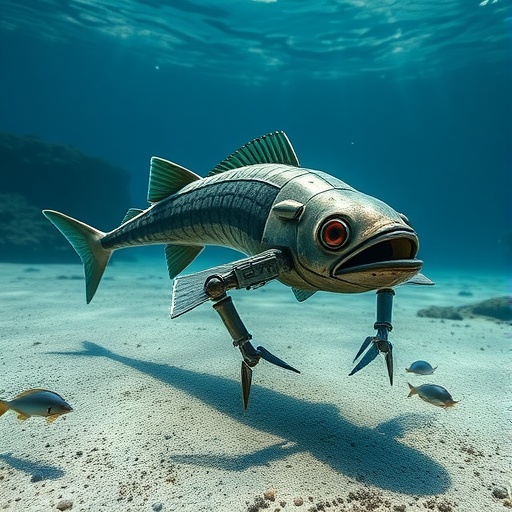
For decades, scientists have pondered how the earliest vertebrates transitioned from aquatic to terrestrial environments, a monumental evolutionary leap that underpins the terrestrial biodiversity we see today. A new interdisciplinary study led by researchers at the University of Cambridge brings fresh insight into this puzzle by exploring the locomotion of modern “walking” fish through innovative robotics and computational modeling. The team constructed a biomimetic fish-like robot combined with detailed movement simulations to demonstrate how diverse fish species, separated by millions of years of evolution, independently developed remarkably similar walking behaviors when moving on land.
Their findings reveal a locomotion strategy described as the “undulating tripod gait,” a primitive but effective method where a fish uses its front fins or head as anchor points while undulating its tail to propel itself forward. This gait mimics a swimming motion adapted for terrestrial movement, resembling a fish flopping awkwardly on land but serving as an evolutionary bridge to limb-based walking. Such convergence in multiple species — including African lungfish, bichirs, and armored catfish — highlights an ancient locomotive solution that likely played a critical role in early vertebrate evolution.
The research team began by closely observing species such as Polypterus senegalus, a grey bichir native to African waters, known for its amphibious habits. Through video analysis and biomechanical modeling, they identified consistent patterns of movement that, despite appearing clumsy, enabled these fish to traverse short distances across land safely and efficiently. Unlike specialized limbs of terrestrial vertebrates, these fish employ fundamental swimming mechanics adapted for a different medium: gravity-bound, terrestrial surfaces.
To test the robustness of their hypothesis, the researchers developed a robotic fish designed to replicate these undulating motions mechanically. Equipped with actuated fins and a flexible body, the robot was subjected to exhaustive trials evaluating various gait patterns. Remarkably, among all tested locomotion modes, the undulating tripod gait inspired by real fish consistently yielded the highest speed and efficiency over terrestrial ground, validating the researchers’ computational predictions. Any deviation from this pattern resulted in slower and less stable movement, underscoring how evolution might have fine-tuned such locomotive strategies through natural selection.
This discovery not only sheds light on contemporary fish species’ adaptive strategies but also offers a compelling model to reinterpret paleontological fossil data. Ancient transitional species such as Tiktaalik, often referred to as “fishapods,” exhibit morphological traits that blur the line between fish and tetrapods. Applying similar biomechanical and robotics-based analyses to such fossils could clarify how early vertebrates refined terrestrial locomotion from rudimentary swimming motions, bridging a massive evolutionary gap still shrouded in mystery.
Moreover, the study delves into the evolutionary pressures favoring this walking capability among fish. Predation avoidance and habitat exploitation emerge as primary drivers; fish equipped with the ability to maneuver on land gain a tactical advantage by escaping aquatic predators or migrating between isolated pools during droughts or tidal changes. The undulating tripod gait, though primitive, represents an elegant evolutionary innovation offering survival benefits without necessitating fully developed limbs.
From an engineering perspective, the integration of biological insight and robotics in this study exemplifies the potential for bio-inspired design to recreate and analyze complex natural behaviors. By synthesizing empirical motion capture data with physical robotic experimentation, the researchers established a feedback loop that not only confirmed hypotheses but also generated novel insights unattainable from observation alone. This blend of biology, engineering, and paleontology sets a precedent for future interdisciplinary explorations of locomotion and evolution.
The implications of this work extend beyond academic curiosity. Understanding the principles governing transitional locomotion could inform the development of amphibious robots capable of navigating variable environments, with applications ranging from environmental monitoring to search and rescue missions in challenging terrains. Additionally, insights into convergent evolution mechanisms illuminate broader patterns of how life adapts to changing conditions, enriching our perspective on evolutionary biology and functional morphology.
Interestingly, the study emphasizes how seemingly rudimentary and inefficient movements in nature often conceal deep evolutionary wisdom—a testament to the power of natural selection to find solutions that balance complexity, energy expenditure, and survival functionality. The repeated emergence of the undulating tripod gait across phylogenetically distant fish illustrates how simple biomechanical principles can recur independently, highlighting evolutionary constraints and opportunities.
Future research ambitions include applying this multimodal approach to fossil specimens, reconstructing ancestral locomotive abilities to build a comprehensive narrative of vertebrate terrestrial adaptation. By bridging data from living species, robotic models, and fossil evidence, scientists hope to decode the stepwise acquisition of terrestrial locomotion that paved the way for the rich diversity of land-dwelling vertebrates.
In sum, the integration of robotics with evolutionary biology unveiled by the Cambridge team marks a milestone in understanding one of life’s grand transitions — from water to land. The undulating tripod gait, once a marginal curiosity pigeonholed in niche fish behaviors, is now unveiled as a fundamental motif in vertebrate locomotion evolution, carrying profound implications for biology, paleontology, and engineering alike.
News Publication Date: 2-Jun-2026
Web References:
Cite Scienmag News
Denise Maddox. (June 2, 2026). Robot Fish May Reveal How Our Ancient Ancestors Took Their First Steps. Scienmag. https://scienmag.com/robot-fish-may-reveal-how-our-ancient-ancestors-took-their-first-steps/
Denise Maddox. "Robot Fish May Reveal How Our Ancient Ancestors Took Their First Steps." Scienmag, 2 June 2026, https://scienmag.com/robot-fish-may-reveal-how-our-ancient-ancestors-took-their-first-steps/. Accessed 4 September 2026.
Denise Maddox. "Robot Fish May Reveal How Our Ancient Ancestors Took Their First Steps." Scienmag. June 2, 2026. https://scienmag.com/robot-fish-may-reveal-how-our-ancient-ancestors-took-their-first-steps/


